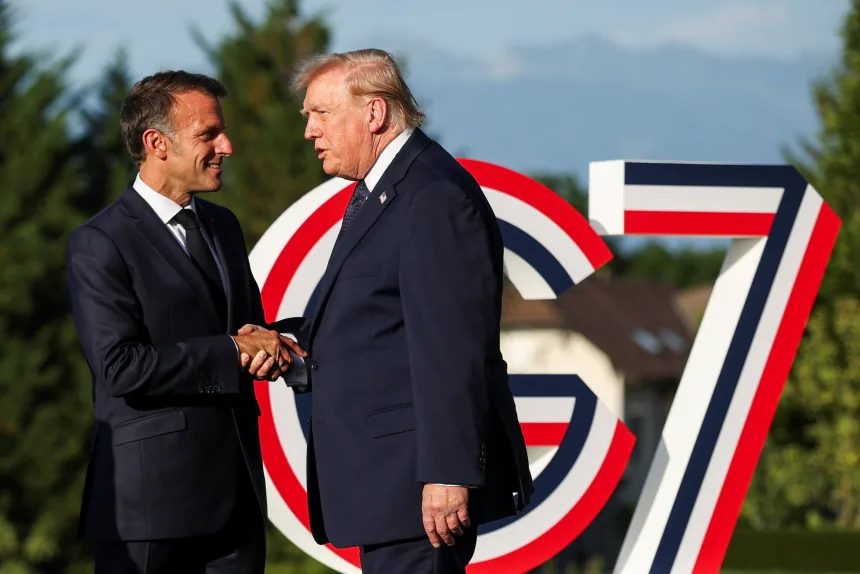
The Trump Iran agreement details remain one of the biggest unanswered questions at this week’s gathering of world leaders in Switzerland. While President Donald Trump has celebrated the newly signed memorandum with Tehran as a diplomatic breakthrough, key allies arrived at the G7 summit still trying to understand exactly what was agreed upon and how the arrangement will be implemented.
The uncertainty has become a central topic of discussion among Western leaders meeting along the shores of Lake Geneva. Although officials from both countries have confirmed the existence of a signed memorandum, the text itself has not yet been released publicly, leaving governments, investors, and regional partners working with limited information. Ongoing diplomatic information concerning international agreements and treaty procedures can be found through <a href=”https://www.state.gov/“>U.S. Department of State</a>.
Questions surrounding the document have only intensified as different officials have offered varying descriptions of its contents, timeline, and future obligations.
Trump Iran Agreement Details Become a Key Topic at the G7 Summit
Behind closed doors, discussions among G7 leaders reportedly focused heavily on the agreement and its potential consequences for regional stability.
Several leaders entered the summit expecting additional clarity after the memorandum was formally signed. Instead, many left initial meetings with the same questions they had upon arrival. The lack of publicly available documentation has made it difficult for allied governments to evaluate how the agreement may affect security, trade routes, sanctions policy, and future diplomatic negotiations.
French President Emmanuel Macron has taken a visible role in encouraging broader discussions involving regional stakeholders. Leaders from Egypt, Qatar, and the United Arab Emirates have been invited to participate in conversations alongside G7 members, reflecting the significant influence Gulf nations have had throughout the negotiation process.
The broader international framework surrounding diplomatic negotiations and conflict resolution remains a priority for organizations such as <a href=”https://www.un.org/“>United Nations</a>, particularly when agreements have implications for regional security and economic stability.
Several officials attending the summit indicated that understanding the operational details of the memorandum is essential before governments can make commitments related to future security initiatives or reconstruction efforts.
Secrecy Surrounding the Memorandum Raises Political Questions
One of the most unusual aspects of the agreement is the limited amount of information available despite its geopolitical significance.
Days after the signing ceremony, neither negotiating side had released the complete text of the roughly one-and-a-half-page memorandum. That absence has fueled speculation not only among foreign governments but also among political commentators and policy analysts inside the United States.
Confusion deepened when officials offered different explanations regarding the timing of the document’s public release. Some administration representatives suggested publication could occur before a formal ceremony expected later in the week, while others implied the disclosure could happen afterward.
The issue extends beyond simple curiosity. Policymakers, businesses, and international organizations often rely on public access to diplomatic agreements when evaluating future economic and political risks. International legal frameworks governing treaties and diplomatic arrangements are regularly documented through <a href=”https://www.icj-cij.org/“>International Court of Justice</a> resources, where transparency remains a recurring principle in global governance discussions.
Even some political allies who have generally supported Trump’s foreign policy initiatives have publicly questioned why the memorandum remains unavailable for review.
The debate has shifted from whether an agreement exists to whether enough information has been provided to allow meaningful public scrutiny.
Regional Partners May Play a Major Role in the Next Phase
While attention remains fixed on the undisclosed memorandum, officials have already begun discussing what comes next.
The agreement is expected to be followed by additional negotiations focused on more complex issues, including Iran’s nuclear activities and broader regional security concerns. Trump suggested those future discussions may prove less difficult than the negotiations that produced the current memorandum.
At the same time, Gulf nations are expected to play a significant role in future economic initiatives linked to post-conflict recovery efforts. Discussions have included the possibility of a reconstruction fund valued at approximately USD 300 billion, a figure that would require substantial financial participation from regional governments.
Economic development and reconstruction initiatives in conflict-affected regions are frequently supported through international institutions such as <a href=”https://www.worldbank.org/“>World Bank</a>, whose programs often involve long-term infrastructure and recovery planning.
As meetings continue in Switzerland, many participating governments remain focused on obtaining greater clarity regarding the memorandum’s provisions, implementation timeline, enforcement mechanisms, and the commitments expected from international partners involved in the next stage of negotiations.