
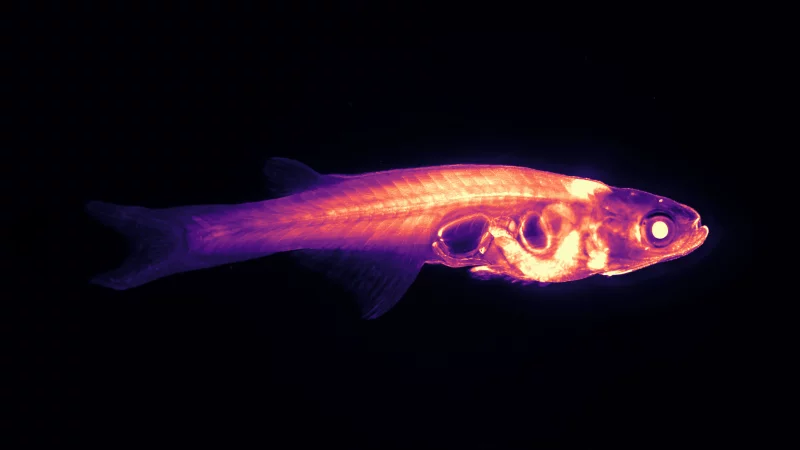
The field of transparent fish brain research is drawing increasing attention after one of the world’s leading neuroscience centers announced an ambitious effort to unlock one of biology’s most stubborn mysteries: how brain activity produces behavior. At the center of that effort is Danionella, a tiny transparent fish that scientists believe could provide an unprecedented window into the workings of a living brain.
Researchers at the Howard Hughes Medical Institute’s Janelia Research Campus are investing heavily in the species, expanding facilities and developing new artificial intelligence tools designed to process enormous amounts of neural data. Their goal is straightforward in theory but enormously challenging in practice: observe nearly every neuron in a functioning brain and understand how those signals translate into decisions, movement, memory, and social interaction.
The project represents a significant shift for a research institution already known for pioneering work in neural mapping and advanced imaging technologies. Information about ongoing scientific programs at the campus can be found through <a href=”https://www.janelia.org/“>Janelia Research Campus</a>.
Transparent Fish Brain Research Offers a Rare View Inside a Living Brain
For decades, neuroscientists have faced a fundamental obstacle. The brain is one of the most difficult organs to observe while it is actively working.
In most animals, layers of bone, skin, and tissue limit direct observation of neural activity. Danionella presents a rare exception. The fish possesses a naturally transparent body and lacks portions of the skull structure that typically obstruct researchers’ view of the brain.
That unusual anatomy allows scientists to monitor neural processes with a level of detail that is difficult to achieve in mammals and many other laboratory species.
Researchers believe this capability could help answer questions that have remained unresolved despite decades of technological progress. Modern neuroscience has successfully identified individual neurons, neural circuits, and signaling pathways. What remains elusive is understanding how those countless signals combine to produce complex behaviors.
Scientific initiatives focused on neural systems and brain function continue to receive significant support from organizations such as <a href=”https://www.nih.gov/“>National Institutes of Health</a>, reflecting the growing importance of brain research worldwide.
Unlike zebrafish, which lose much of their transparency as they mature, adult Danionella retain the characteristics that make them attractive to neuroscientists, creating opportunities for long-term behavioral studies.
Artificial Intelligence Will Play a Critical Role in the Project
The promise of transparent fish brain research comes with a major challenge: data volume.
Scientists expect the project to generate extraordinary amounts of information as imaging systems capture activity across hundreds of thousands of neurons. Traditional analysis methods would struggle to process that data efficiently, making artificial intelligence an essential component of the initiative.
Researchers plan to combine advanced imaging, machine learning, and computational modeling to identify patterns that human observers might otherwise miss. The strategy mirrors a broader trend across scientific disciplines, where AI systems are increasingly being used to accelerate discovery and uncover relationships hidden within massive datasets.
The fish’s brain contains approximately 650,000 neurons. While that number is dramatically smaller than the estimated 86 billion neurons in the human brain, it is still complex enough to provide valuable insights into neural organization and behavior.
Developments in machine learning and computational science are also being explored by institutions including <a href=”https://www.nsf.gov/“>National Science Foundation</a>, where researchers continue investigating new approaches to data-intensive scientific challenges.
Scientists involved in the project believe artificial intelligence may eventually help bridge the gap between raw neural activity and observable behavior, one of the most difficult puzzles in neuroscience.
From Fish Schools to Human Brain Disorders
Beyond the technological challenge, researchers see practical scientific value in studying Danionella.
One area attracting particular interest involves social behavior. Scientists are already examining how these fish coordinate movement, respond to visual information, and interact with other members of their group. Schooling behavior may appear simple from the outside, but it requires rapid processing of sensory information and continuous decision-making by the brain.
Future experiments aim to move beyond laboratory setups where animals remain stationary. Researchers want to observe neural activity while fish move freely through complex environments and interact naturally with one another.
Achieving that goal will require new imaging systems, sophisticated tracking technology, and improved analytical tools. Several neuroscience initiatives supported by <a href=”https://www.hhmi.org/“>Howard Hughes Medical Institute</a> are already focused on developing those capabilities.
Scientists involved in the effort describe the project as a long-term undertaking rather than a quick breakthrough. Even mapping a single complex behavior in detail could take years. Yet many researchers believe the potential rewards justify the investment, particularly if insights gained from a transparent fish ultimately help explain broader principles shared across animal brains, including those of humans.