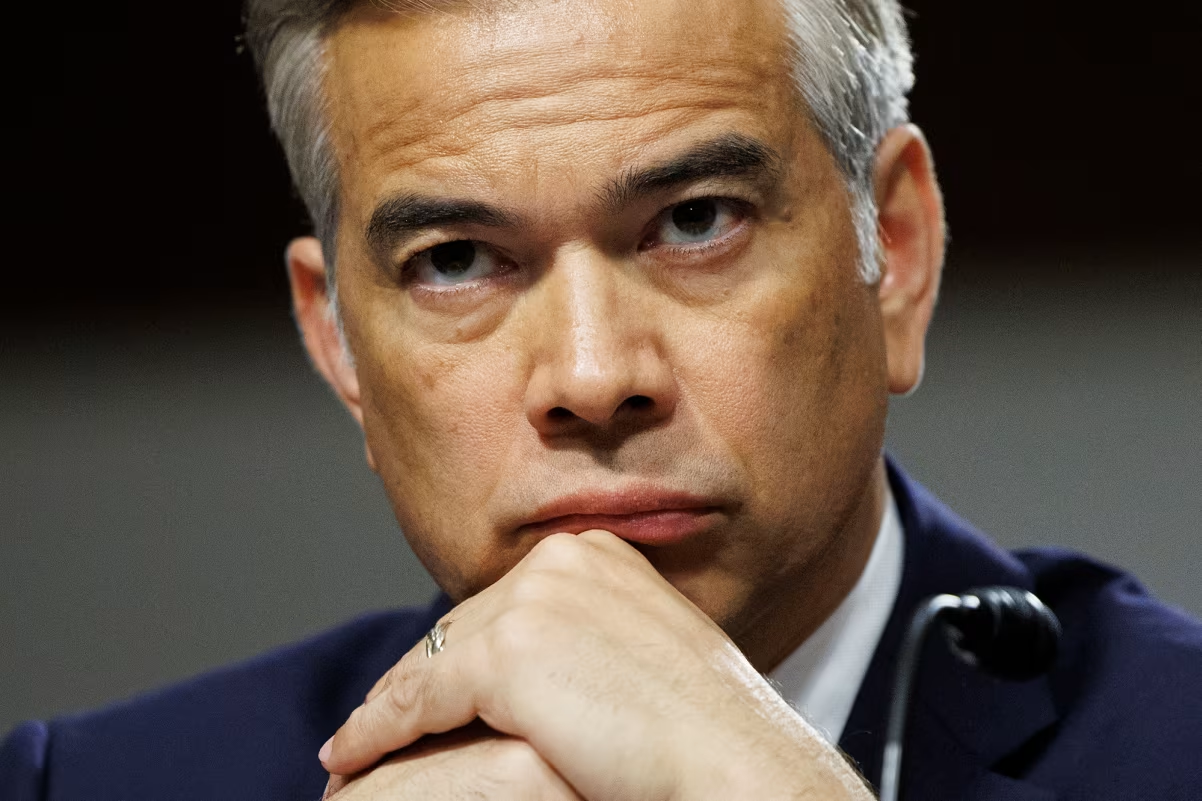
California Attorney General Rob Bonta has emerged as one of the most prominent state-level figures in major legal battles involving technology, social media and Hollywood. His office has taken on some of the country’s largest companies while also challenging policies from the federal government.
Bonta’s expanding national profile comes as California pursues high-stakes cases that could affect how Americans use social media, consume entertainment and access digital services. His recent work includes a multistate agreement involving Meta and a lawsuit challenging Paramount Skydance’s proposed acquisition of Warner Bros. Discovery.
The California Department of Justice describes Bonta as the state’s 34th attorney general. He took office in April 2021 after previously serving more than eight years in the California State Assembly and working as a deputy city attorney in San Francisco. His official biography details a career focused on consumer protection, civil rights, public safety and corporate accountability. California Attorney General Rob Bonta’s official biography also notes that he became the first person of Filipino descent to serve as the state’s attorney general.
That background helps explain why Bonta has become a central figure in California’s increasingly aggressive approach to corporate regulation. His office has pursued cases involving technology companies, antitrust issues, consumer protection and federal policies.
The legal battles also carry political consequences. Bonta is seeking reelection, and his visibility has fueled speculation about whether he could eventually pursue higher office. Several former California attorneys general have gone on to become governor, while Kamala Harris used the position as a step toward the vice presidency.
For Bonta, however, the immediate challenge is managing several major cases at the same time. His office has more than 5,000 employees and handles a broad range of legal and law-enforcement responsibilities.
Rob Bonta’s rise from California politics to national legal battles
Bonta was born in Quezon City, Philippines, and immigrated to California as an infant. His parents were involved with the United Farm Workers movement, and Bonta has said that their work influenced his interest in public service and justice.
He studied at Yale University and later earned a law degree from Yale Law School. After law school, Bonta worked in private practice before spending nine years as a deputy city attorney in San Francisco.
He entered electoral politics in 2012, becoming the first Filipino American elected to the California Legislature. During his time in the Assembly, he focused on issues including criminal justice, voting rights, housing and consumer protection.
Bonta became attorney general in 2021 after Gov. Gavin Newsom nominated him for the position. He won election to a full term in 2022.
His approach became particularly visible after Donald Trump returned to the White House. Bonta positioned California as a major center of legal resistance to federal policies that his office considered unlawful. His office says it has filed 87 lawsuits against the Trump administration and that those cases have protected more than $200 billion in state funding.
That strategy has made Bonta a familiar figure in national political coverage. It has also attracted criticism from opponents who argue that some enforcement decisions are driven by political considerations.
Eric Goldman, a professor at Santa Clara University School of Law, described enforcement decisions by attorneys general as inherently political because they involve judgments about which issues deserve government action and how those decisions will be perceived by voters.
Bonta’s supporters have presented a different explanation. Former California Senate leader Robert Hertzberg recalled Bonta’s work on bail reform as an example of an issue he pursued despite limited political incentives.
The contrast illustrates the broader question surrounding Bonta’s career: whether his aggressive legal strategy represents a long-term governing philosophy, political positioning or both.
His office has continued to pursue a wide portfolio beyond technology. Recent actions have involved public safety, environmental protection, voting rights, consumer issues and civil rights.
That breadth gives Bonta substantial influence inside California. His most consequential cases, however, increasingly extend beyond the state.
Meta settlement puts Bonta at the center of the social media fight
Bonta’s battle with Meta has become one of the clearest examples of his strategy.
California joined Colorado, Kentucky and New Jersey in litigation accusing Meta of designing features on Instagram and Facebook that encouraged excessive use among children and teenagers while misleading users and families about the risks.
In August, the case produced a major agreement. Meta announced an agreement with a bipartisan group of state attorneys general that includes new restrictions and parental controls for teenage users.
The agreement includes a two-hour default daily limit for Facebook and Instagram, nighttime restrictions, muted notifications during school hours and additional prompts designed to reduce prolonged use. Meta said the agreement involves approximately $18 billion in payments, although the California attorney general’s office initially described the settlement as $17 billion in its announcement.
The financial structure is also unusual. Meta said participating states would receive roughly 70% of the allocated payment over 10 years, while the remaining portion depends on TikTok and YouTube adopting specified measures and making matching payments.
Meta’s description of the agreement says the company wants TikTok and YouTube to adopt similar protections because teenagers move between multiple platforms.
That element gives the agreement implications beyond Meta. Instead of establishing rules for one company alone, the framework is designed to pressure competing platforms to adopt comparable safeguards.
Bonta has already warned that other technology companies could face coordinated action from state attorneys general if they fail to make changes involving child safety.
His office’s technology agenda extends beyond social media. It has pursued antitrust cases involving companies including Apple and Live Nation and has investigated xAI over allegations concerning its Grok chatbot and sexually explicit images.
Bonta has also supported legislation addressing AI companion chatbots and child safety.
The combination of litigation, regulation and proposed settlements has made his office an important player in the broader debate over how governments should regulate technology companies.
At the same time, the Meta agreement has drawn criticism. Goldman argued that the settlement’s structure could benefit Meta by encouraging state authorities to push its competitors toward similar restrictions.
That criticism reflects the unusual nature of the arrangement. The agreement is not simply about resolving allegations against Meta. It also seeks to establish a broader industry standard.
Why the Paramount-Warner fight could define Bonta’s next chapter
Bonta’s other major legal battle is unfolding in Hollywood.
In July, he led a coalition of 12 state attorneys general in a lawsuit seeking to block Paramount Skydance’s proposed $110 billion acquisition of Warner Bros. Discovery. The case argues that the merger would reduce competition in film and television and potentially harm consumers and other businesses across the entertainment industry.
California has a particular interest in the dispute because Paramount is based in the state and the entertainment industry is central to California’s economy.
The proposed transaction would combine two major Hollywood companies and significantly increase their control over film distribution and basic cable programming. Bonta’s office argues that the merger could lead to higher prices, reduced content quality and fewer choices for audiences.
The California Department of Justice’s merger filing says the combined company could control nearly one-third of theatrical motion pictures and nearly one-third of basic cable programming in the United States.
A federal court subsequently issued a temporary restraining order halting the merger while it considers the states’ request for further relief. Bonta’s office later secured an agreement keeping the companies from completing the merger until June 2027 or until a court ruling, whichever comes first.
The case has already created tension between Bonta and Paramount. His office has argued that the transaction deserves close antitrust scrutiny, while Paramount’s allies have accused him of using the case for political purposes.
Bonta has rejected that characterization and has said the federal government has failed to enforce antitrust and consumer-protection laws adequately, leaving states such as California with a larger role.
The dispute could have consequences beyond Paramount and Warner Bros. Discovery. If the states succeed, the case could influence how future media mergers are evaluated and how much authority state attorneys general can exercise when federal regulators have already reviewed a transaction.
Bonta has said he prefers resolving cases through negotiations rather than litigation. Yet the Paramount dispute has become increasingly adversarial, including the breakdown of recent negotiations.
For now, the merger remains tied up in the legal process. Bonta’s willingness to pursue the case illustrates the larger role he has carved out for California’s attorney general: using the state’s economic weight and legal authority to challenge some of the largest corporate transactions in the country.
The California DOJ’s July 2026 merger update says the agreement prevents the companies from merging until June 1, 2027, or until a court decision on the states’ claims, whichever comes first.