
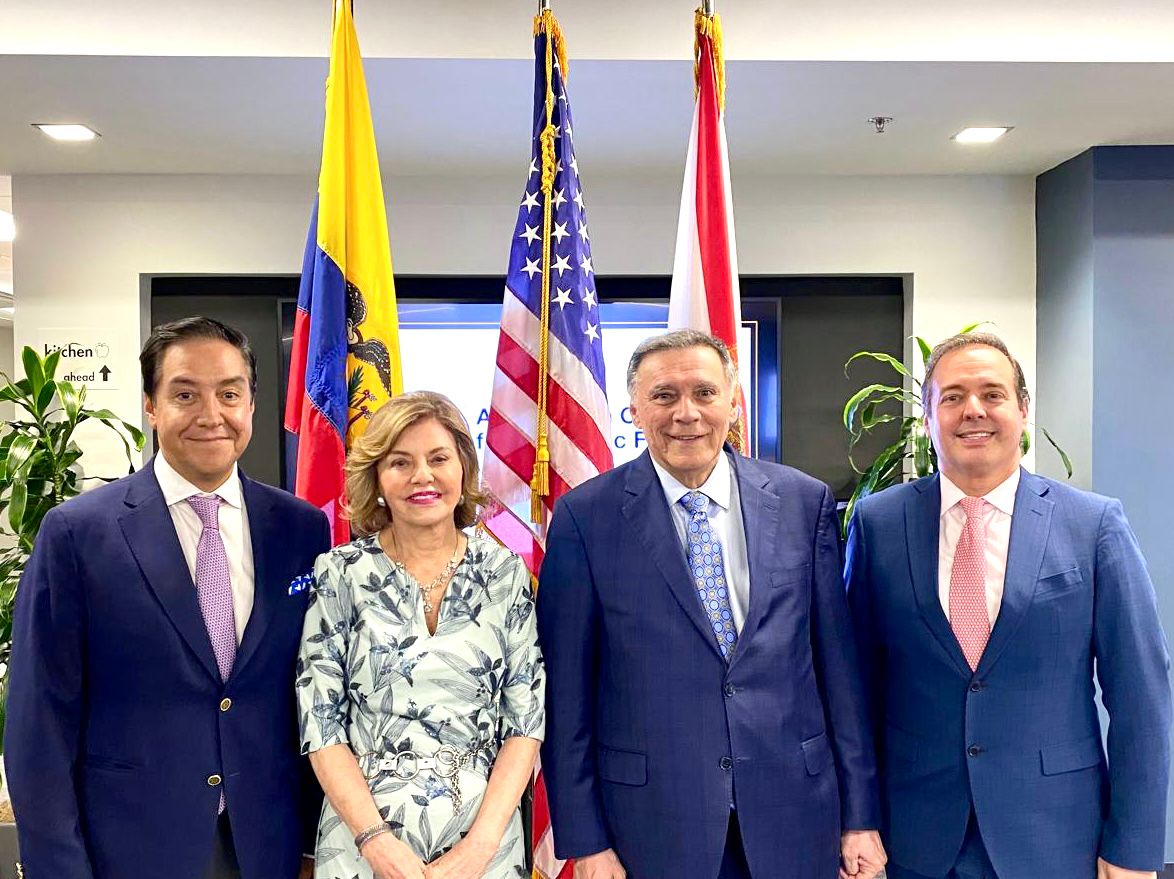
Javier Cárdenas-Moreno, President and CEO of Rhino Equipment and Isabel Noboa, prominent Ecuadorian business leader and President of Fundación Nobis, joined former Ecuadorian President Jamil Mahuad, Carlos Díaz-Rosillo, Founding Director of the Adam Smith Center for Economic Freedom, and other prominent political and business leaders at a high-level gathering focused on the role of the private sector in the development of Latin America.
The event brought together leaders from the business, political, and economic communities to explore a central question for the region: Can the private sector become one of the main engines of social transformation in Latin America?
The conversation examined how businesses can contribute beyond economic activity by creating employment, attracting investment, promoting innovation, supporting education, encouraging entrepreneurship, strengthening corporate responsibility, and contributing to regional development.
For Cárdenas-Moreno and Noboa, the discussion offered an opportunity to highlight the increasingly important role that entrepreneurs and companies can play in creating long-term value for their countries and communities.
Javier Cárdenas-Moreno and Isabel Noboa Put Business Leadership at the Center of the Conversation
The participation of Javier Cárdenas-Moreno and Isabel Noboa placed private-sector leadership at the heart of the discussion.
As President and CEO of Rhino Equipment, Cárdenas-Moreno brings an international business perspective to conversations about investment, industrial development, infrastructure, employment, and economic competitiveness.
His participation reflects the role that private companies can play in supporting economic activity while developing international connections and creating opportunities across different markets.
Isabel Noboa, meanwhile, represents a particularly relevant example of how business leadership can intersect with economic and social development in Ecuador. Through Nobis, the business group has developed activities across multiple sectors of the Ecuadorian economy, including agroindustry, agroexportation, real estate, commerce, tourism, health, food, and port activities. Nobis reports more than 7,000 direct jobs across its operations.
The experiences of Cárdenas-Moreno and Noboa illustrate two complementary dimensions of private-sector leadership: the ability to generate economic activity and the opportunity to create broader social impact.
Can the Private Sector Become an Engine of Social Transformation?
One of the central questions of the gathering was whether businesses can become one of the main engines of social transformation in Latin America.
The answer depends on how economic growth is connected to long-term social value.
Companies create employment, develop products and services, invest capital, generate tax revenues, build supply chains, and develop human talent. At the same time, businesses increasingly face expectations to contribute to the communities in which they operate.
For Latin America, where millions of people depend directly or indirectly on private-sector activity, strengthening entrepreneurship and investment can have effects that extend far beyond individual companies.
The challenge is to create an environment where businesses can grow while contributing to inclusive and sustainable development.
Job Creation as a Foundation for Development
Employment generation was one of the key areas connected to the role of entrepreneurs in national development.
A growing private sector can create opportunities for workers while supporting families, communities, and local economies. Employment also provides an important pathway for developing skills and expanding access to economic opportunity.
Nobis offers an example of this relationship between business activity and employment. The group reports more than 7,000 direct jobs through its operations in Ecuador.
For business leaders, the creation of quality employment is therefore not simply an economic indicator. It can also become a mechanism for developing human capital and strengthening communities.
Investment as a Driver of Economic Growth
Investment was another central component of the conversation.
Latin American countries require capital to expand productive capacity, modernize infrastructure, develop new industries, and create employment. Private investment can help accelerate these processes when supported by stable institutions, clear rules, access to financing, and a competitive business environment.
Nobis states that it has expanded its portfolio across strategic sectors of Ecuador’s economy and highlights investment as part of its contribution to the country’s development. The company also reports having invested USD 120 million in Ecuador during the last decade.
For entrepreneurs and business leaders, the ability to identify opportunities and deploy capital over the long term can become an important source of economic transformation.
Innovation and Entrepreneurship Can Expand Opportunity
The discussion also highlighted the importance of innovation and entrepreneurship in creating new opportunities throughout Latin America.
Entrepreneurs can introduce new technologies, business models, products, and services while helping established industries become more competitive.
For the region, supporting entrepreneurship means more than encouraging individuals to start companies. It also requires creating an ecosystem where entrepreneurs can access capital, education, technology, mentorship, and markets.
Fundación Nobis has developed programs focused on productive entrepreneurship, employability, technical and higher education, financial education, and entrepreneurial education.
This approach demonstrates how private-sector and philanthropic initiatives can complement economic activity by helping individuals develop the skills necessary to participate in the economy.
Education as an Investment in Human Capital
Education was another important dimension of the conversation about the role of entrepreneurs in national development.
Businesses depend on skilled workers, while economies increasingly depend on knowledge, technology, creativity, and specialized capabilities.
Fundación Nobis identifies education as a central element of its social responsibility strategy and focuses on programs designed to promote social mobility, economic inclusion, employment, and entrepreneurship.
This connection between business and education is particularly relevant as Latin American economies seek to adapt to technological change and compete in increasingly sophisticated global markets.
Investment in education can therefore be viewed not only as a social commitment but also as a long-term investment in the productivity and competitiveness of a country.
Corporate Responsibility and Sustainable Development
The conversation also addressed corporate responsibility and the growing expectation that businesses contribute to society beyond financial performance.
Nobis has emphasized a model based on what it describes as triple impact, incorporating economic, social, and environmental considerations into its activities. Its sustainability reporting highlights responsible practices and the company’s efforts to contribute to the well-being of communities.
For Latin American businesses, corporate responsibility can become an important component of long-term competitiveness and reputation.
The challenge is to integrate social and environmental considerations into the way companies operate rather than treating them as separate activities.
Jamil Mahuad Adds a Political and Institutional Perspective
The participation of Jamil Mahuad, former President of Ecuador, added a political and institutional perspective to the conversation.
Mahuad served as President of Ecuador from 1998 to 2000 and has subsequently worked in areas including negotiation, leadership, and governance.
His experience in government provided an additional perspective on the relationship between public institutions and the private sector.
For businesses to become stronger engines of development, entrepreneurs require an environment in which institutions, regulations, infrastructure, and economic policies allow productive activity to flourish.
The interaction between government and business therefore remains critical to determining how effectively private investment can translate into broader economic opportunity.
Carlos Díaz-Rosillo and the Importance of Economic Freedom
Carlos Díaz-Rosillo, Founding Director of the Adam Smith Center for Economic Freedom at Florida International University, brought an economic freedom and public-policy perspective to the gathering.
The Adam Smith Center focuses on ideas related to economic freedom, entrepreneurship, public policy, and the institutions that support prosperous societies. FIU identifies Díaz-Rosillo as the founding director of the center.
Díaz-Rosillo’s work has also emphasized the importance of reducing unnecessary barriers to productive economic activity. In an Adam Smith Center publication, he highlighted how excessive bureaucracy can discourage investment, innovation, and entrepreneurship while limiting opportunities for individuals and businesses.
This perspective complements the discussion about private-sector leadership: businesses can contribute to development, but they also need an environment that allows entrepreneurship, investment, and innovation to flourish.
From Business Growth to Regional Development
A strong private sector can have effects that extend beyond individual companies.
When businesses invest in a region, they can create jobs, develop suppliers, improve infrastructure, introduce technology, generate new services, and contribute to local economic ecosystems.
This is particularly relevant for Latin America, where regional development remains closely connected to the ability to attract investment and create productive opportunities outside major economic centers.
The experiences represented by Cárdenas-Moreno and Noboa demonstrate how private-sector leadership can operate across industries and markets while maintaining a focus on economic opportunity and development.
A New Vision of Business Leadership in Latin America
The discussion ultimately pointed toward a broader definition of business leadership in Latin America.
Entrepreneurs are not only creators of companies. They can also become investors, employers, innovators, educators, mentors, community partners, and contributors to national development.
For Javier Cárdenas-Moreno, participation in this type of high-level conversation reinforces the importance of connecting business leadership with broader discussions about economic competitiveness and development.
For Isabel Noboa, the experience of Nobis provides a concrete example of how a diversified business group can combine investment and economic activity with initiatives focused on education, entrepreneurship, employment, and social responsibility.
Together, their perspectives underscore a central idea: the private sector can play a transformative role in Latin America when entrepreneurship, investment, innovation, education, and responsibility are connected to a long-term vision for society.
The participation of Jamil Mahuad, Carlos Díaz-Rosillo, and other political and business leaders further demonstrated the value of bringing together different perspectives to address the region’s most important economic and social challenges.
As Latin America looks toward the next generation of economic growth, the role of entrepreneurs will extend beyond building successful companies. The leaders who can create jobs, attract investment, innovate, develop talent, and contribute to their communities may become some of the most important drivers of transformation across the region.