The Hindu pilgrims Nepal floods disaster has left families around the world searching for relatives who were traveling toward Mount Kailash when catastrophic flooding and landslides struck the Himalayan border region last Wednesday. Among the missing are large numbers of pilgrims who had undertaken the difficult journey to one of the most sacred mountains in Asia.
Social media has become an improvised network for families trying to locate loved ones. Posts often show photographs of missing relatives alongside telephone numbers and requests for information. For many families, the last known contact came near the border crossing between Nepal and Chinese-controlled Tibet, one of the areas severely affected by the disaster.
The exact number of pilgrims still unaccounted for has not been established. However, they appear to represent a significant portion of the hundreds of foreign nationals reported missing by Nepal and China.
The disaster has also exposed the vulnerability of religious tourism in the Himalayas, where pilgrimage routes increasingly intersect with roads, border infrastructure and rapidly changing mountain environments.
Mount Kailash is particularly significant because it is revered by Hindus, Buddhists, Jains and followers of indigenous Tibetan traditions. For Hindu pilgrims, the journey is closely associated with Lord Shiva and represents one of the most important religious journeys many devotees undertake.
The tragedy has therefore become more than a search-and-rescue operation. It has raised difficult questions about how sacred journeys should be managed as the Himalayan environment becomes increasingly exposed to climate-related hazards.
Why Hindu pilgrims were traveling through the disaster zone
Mount Kailash is located in Tibet and is considered one of the most sacred mountains in several Asian religious traditions. Rather than climbing the mountain, pilgrims traditionally complete a circumambulation around its base, a journey known as a kora.
The circuit covers roughly 32 to 33 miles and can take about three days. The route is physically demanding because of the extreme altitude and difficult terrain. National Geographic’s account of the Mount Kailash pilgrimage describes the circuit as the central physical and spiritual journey for pilgrims visiting the mountain.
For Hindu devotees, the significance is especially profound. Mount Kailash is traditionally regarded as the abode of Lord Shiva, one of Hinduism’s most important deities. The pilgrimage is therefore not simply a difficult trek through the mountains. It represents an act of devotion with deep religious and cultural meaning.
Historian of religion Hindol Sengupta said that visiting Kailash can be among the most important experiences for devotees approaching the later stages of their lives. The mountain occupies a particularly powerful place in Hindu religious imagination, where the Himalayas are associated with divine presence.
That spiritual importance helps explain why people continue to undertake a journey that can be physically punishing.
Among those now missing is Vivek Srivastav, an Atlanta resident and biotech scientist who had traveled with a group of 11 people toward Mount Kailash. His brother-in-law, Guarav Khare, initially appealed for help on X and said the family had been searching for him since the disaster.
Another family searching for relatives is that of Sanghamitra and Debarshi Banerjee, a couple in their 60s who were traveling as part of a group of 32 pilgrims. Their son-in-law, Shubham Kumar, said the family had warned them about the difficulty of the route.
The couple’s last known communication came as they approached a border crossing between Nepal and Tibet. After that, communication stopped.
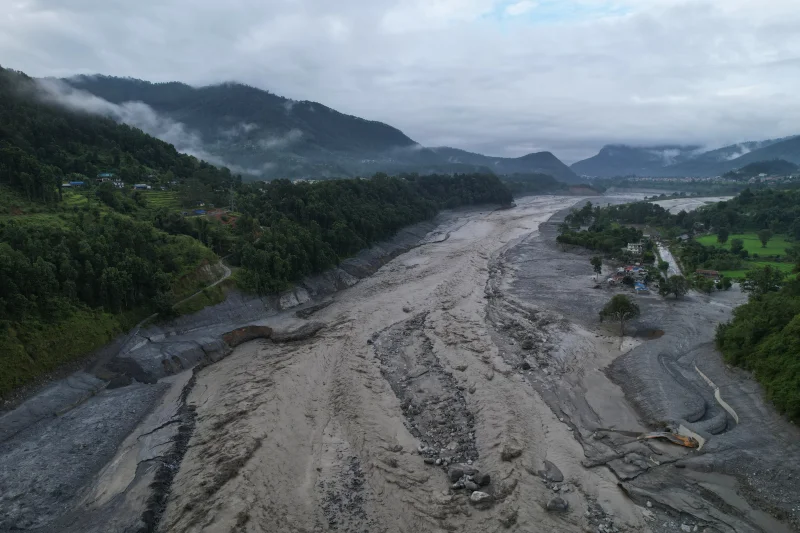
That location was close to the area where a section of glacier and rock collapsed into a river valley. The resulting torrent carried enormous quantities of water, ice and debris downstream, destroying infrastructure in its path.
Footage from the border area showed a powerful wave of debris overwhelming the Gyirong Port Immigration Office, a multistory border facility. The destruction left families trying to determine whether their relatives had crossed safely, remained trapped or had been swept away.
For pilgrims, the border crossing was not simply another stop on the journey. It was a critical transition point between Nepal and Tibet, where large groups could gather before continuing toward one of Asia’s most important religious destinations.
The Isha Foundation, a spiritual organization led by Jagadish Vasudev, known as Sadhguru, also lost contact with members of a large pilgrimage group. The organization said three guides and 77 pilgrims from 19 countries were unaccounted for.
The foundation’s group had reached the border shortly before the disaster. Vasudev later reflected on the strict scheduling system used to move pilgrims through immigration quickly, saying he wished the group had not been so disciplined about arriving early.
For families, those details offer little comfort. They instead underscore how quickly a carefully planned pilgrimage can become a life-threatening emergency in a high-altitude environment.
The Himalayan pilgrimage faces a changing climate
The Hindu pilgrims Nepal floods disaster has also intensified concerns about the future of pilgrimage routes across the Himalayas.
The region is already experiencing significant changes in its glaciers. The International Centre for Integrated Mountain Development, or ICIMOD, says glacier ice loss across the Hindu Kush Himalaya has accelerated sharply, with the rate of wastage doubling after 2000. ICIMOD’s 2026 assessment of Himalayan glacier change describes accelerating ice loss and growing risks for mountain communities.
Those changes do not mean that every flood or landslide in the Himalayas can automatically be attributed to climate change. The relationship between individual disasters and a warming climate is complex.
But the broader environmental trend is significant. Warmer temperatures can destabilize glaciers and increase the potential for dangerous changes in high-altitude environments. At the same time, more people are traveling into these regions.
Mount Kailash has traditionally required pilgrims to undertake an arduous journey. Increasing prosperity, improved transportation and expanding tourism infrastructure have made parts of the region more accessible to a larger number of visitors.
Sengupta argues that this transformation creates a difficult tension. The same roads and transportation systems that make sacred destinations accessible to more people can also place additional pressure on fragile mountain ecosystems.
The growth of pilgrimage is not inherently responsible for the disaster. There is no evidence in the material available that tourism caused the glacier collapse that preceded the floods.
The concern is instead about how authorities and communities manage growing numbers of visitors in an environment that is becoming increasingly difficult to predict.
That question extends beyond Mount Kailash. Himalayan pilgrimage destinations across India, Nepal and Tibet attract visitors because of their religious significance, while the same landscapes are increasingly exposed to glacier retreat, landslides, floods and other hazards.
The environmental pressure is particularly complicated because these mountains are not simply tourist destinations. They are also places where communities live, where rivers originate and where religious traditions have developed over centuries.
The Nepal Tourism Board itself recognizes the long-standing cultural connection between Nepal and the Kailash-Mansarovar region, including historical pilgrimage routes through the country’s far-western areas. Nepal’s official tourism information on pilgrimage sites reflects the country’s longstanding relationship with religious travel through the Himalayan region.
That relationship also has an economic dimension. Religious tourism provides income for transportation operators, guides, accommodation providers, local businesses and communities along pilgrimage routes.
Sengupta argues that protecting these journeys requires recognizing both sides of the equation. Pilgrims need access to places that are central to their faith, while governments and tourism operators must account for the ecological limits and physical dangers of the mountains.
The challenge becomes particularly difficult when infrastructure designed to improve access intersects with rapidly changing environmental conditions.
Families wait as pilgrimage groups confront an uncertain future
The disappearance of so many pilgrims has left families facing an agonizing lack of information.
For relatives, the distinction between a missing person, a person trapped somewhere without communications and someone who has died can be impossible to establish in the immediate aftermath of a disaster.
The scale of the pilgrimage groups has complicated that process. People traveled from India, the United States, Canada and several European countries, meaning families in multiple countries have been trying to establish what happened to relatives who were in the same region.
The Isha Foundation’s experience illustrates the international character of the pilgrimage. Its group included people from 19 countries, reflecting how Mount Kailash has become a destination for devotees far beyond the immediate Himalayan region.
Isha continues to organize Kailash Manasarovar journeys, demonstrating the enduring demand for the pilgrimage even as the region faces growing environmental risks. Isha Sacred Walks’ Kailash Manasarovar program shows how organized pilgrimages continue to bring international visitors toward the region.
For those who survive, the disaster could change perceptions of what it means to undertake such a journey.
Vasudev urged followers not to search for mystical explanations for the deaths and instead to focus on rescue, relief and reconstruction. He also called attention to the environmental pressures affecting the Himalayas and argued that countries across the mountain range need to do more to protect it.
His comments reflect a broader tension within religious tourism: the desire to preserve access to sacred places while preventing the journeys themselves from becoming increasingly dangerous.
For generations, the difficulty of reaching Mount Kailash was considered part of the pilgrimage. Walking long distances at extreme altitude was itself an expression of devotion.
Modern transportation has changed that equation. Roads, vehicles and organized tours allow far more people to reach areas that once required extraordinary physical effort. That accessibility has expanded the number of people who can participate, but it has also increased the complexity of managing safety and environmental pressures.
The current disaster demonstrates the consequences when those systems encounter a rapidly changing mountain environment.
For the families still waiting for information, however, the broader debate remains secondary. Their immediate concern is finding parents, siblings, spouses and children who left home for a sacred journey and have not returned.
The families of Shubhakshi and Sumit, whose daughters posted an appeal after the floods, are among those still searching. Their story reflects the human dimension of a disaster that has turned a pilgrimage associated with faith and devotion into a desperate international search for missing people.