LAFAYETTE, Georgia — Artificial intelligence is moving from the world of software and chatbots into the heart of American manufacturing, where it is helping factories detect defects, predict equipment failures and make faster production decisions.
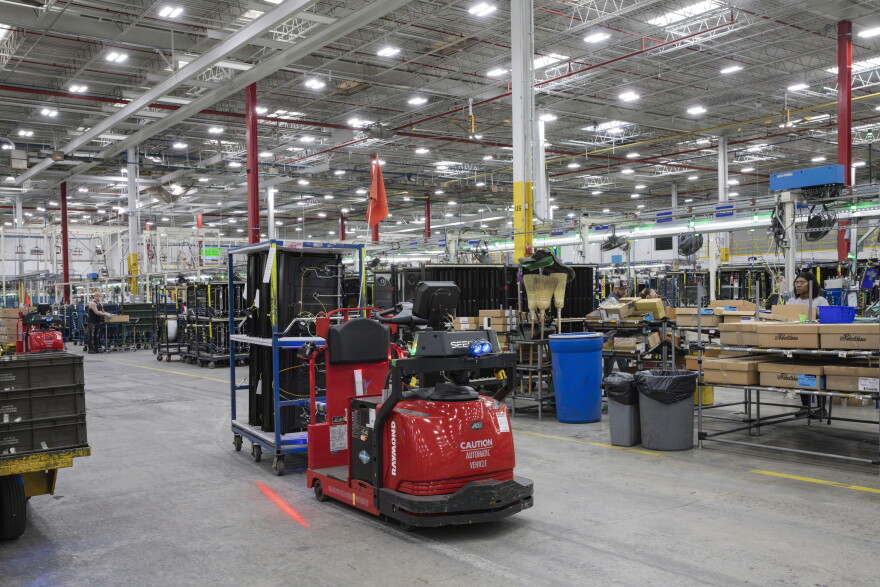
At Roper Corp., a GE Appliances-owned manufacturing facility in rural northwest Georgia, autonomous vehicles transport parts to assembly lines, robots install glass cooktops onto metal frames, and AI-powered cameras and sensors continuously monitor production.
The technology is part of a broader transformation underway across American manufacturing as companies seek to increase efficiency, reduce waste and remain competitive with lower-cost production overseas.
“We have these things everywhere out here,” said Tony Gabbert, Roper Corp.’s director of manufacturing operations.
When an AI-powered camera detects an anomaly — such as an incorrectly installed gasket on an oven — the system can automatically stop that section of the production line and trigger loud music to alert employees.
“If you hear AC/DC, you know to come running down here,” Gabbert said. “The quicker we know what the problem is, the quicker we can fix it.”
AI Brings a New Level of Precision to the Factory Floor
American manufacturers are under increasing pressure to produce high-quality products while controlling costs and maintaining speed.
For GE Appliances, the objective has long been to reduce manufacturing errors, equipment downtime and material waste while ensuring that every appliance meets quality standards before reaching consumers.
Artificial intelligence is now becoming an important part of that strategy.
Instead of relying solely on employees to identify problems after they occur, AI systems can analyze enormous amounts of information in real time and identify patterns that might otherwise be difficult for humans to detect.
“We’re not shooting for 97. We want to run 100 every day,” Gabbert said, referring to a key manufacturing performance metric.
The financial impact can also be substantial. Bill Good, GE Appliances’ vice president of manufacturing, estimates that the company can save between $1.5 million and $2 million annually for every percentage point of improvement in manufacturing performance.
That makes even seemingly small efficiency gains highly valuable.
From Data Collection to Artificial Intelligence
GE Appliances has been collecting manufacturing data through cameras and sensors for more than a decade.
Today, the company generates millions of lines of data every day. Its Brilliant Factory data platform provides a real-time view of operations across the company’s nine major appliance plants, allowing managers to monitor performance down to individual workstations.
From the company’s headquarters in Louisville, Kentucky, executives can see which machines are operating, which ones are down and why, how many appliances are being sent for repairs, which components are being discarded and how much production waste is costing the company.
The difference from the past is significant.
“In the old days, I would call my plant manager, and I’d say, ‘How you running today?’” Good said. “Now I’ll call them and say, ‘Why are you running so poorly?’”
AI takes that data analysis a step further.
Rather than simply displaying information, artificial intelligence can help identify potential causes of problems and recommend ways to address them. Plant managers can begin their workdays with AI-generated reports highlighting potential issues and suggesting solutions.
Predictive Maintenance Can Save Millions
One of the most important applications of AI in manufacturing is predictive maintenance.
Instead of waiting for a machine to break down, AI can analyze sensor data to identify warning signs that equipment may soon fail.
For example, if a motor begins running at an unusually high temperature, an AI system can flag the problem before the motor stops working completely.
The factory can then schedule maintenance at a convenient time instead of dealing with an unexpected breakdown.
That difference can be measured in thousands of dollars.
According to Good, shutting down a single assembly line can cost GE Appliances between $300 and $500 every minute.
“The name of the game in manufacturing is speed — speed at which you see the problem, speed at which you solve the problem,” he said. “Literally, minutes matter.”
“It Can Outthink Me”
For manufacturing veterans, artificial intelligence is also changing how expertise is transferred throughout a factory.
Good has nearly four decades of experience in manufacturing and has encountered countless production problems during his career.
Yet he says AI can analyze information in ways that would be difficult even for highly experienced professionals.
“It can outthink me,” Good said.
Rather than viewing that capability as a threat, Good believes AI can help close the experience gap between veteran employees and newer workers.
The technology can provide employees with information and analysis that previously depended heavily on decades of individual experience.
That could become increasingly important as manufacturers face workforce challenges and seek to train new generations of employees.
Robots and Autonomous Vehicles Are Changing Factory Logistics
AI is not limited to quality control and data analysis.
GE Appliances also uses a combination of mobile and stationary robots throughout its facilities.
Autonomous mobile robots can transport parts, raw materials and finished products around factories. They use digital maps, cameras and sensors to navigate their surroundings and dynamically adjust their routes.
Automated guided vehicles, meanwhile, follow predetermined paths and are designed for consistent and repetitive operations.
The result is a manufacturing environment in which machines handle many of the repetitive logistical tasks while human employees focus on more complex responsibilities.
AI Could Help Keep Manufacturing Jobs in the United States
One of the most significant implications of GE Appliances’ approach is economic rather than technological.
Manufacturing companies in the United States face intense competition from factories in countries where labor costs can be significantly lower.
AI and automation could help reduce that disadvantage by allowing American factories to produce goods more efficiently.
Good argues that increasing productivity can make domestic manufacturing more competitive.
“You have to be faster, better, more flexible. That’s the only thing that neutralizes the threat,” he said.
GE Appliances, which was acquired by Chinese conglomerate Haier in 2016, recently added 600 jobs in Georgia as part of a $180 million expansion.
The company is also using AI to optimize staffing.
If fewer employees are needed in one area of a plant, workers can be reassigned to other tasks. AI is also being used to forecast market demand, allowing the company to make production decisions closer to the time products are actually needed.
AI Is Becoming a Competitive Advantage for Manufacturers
The transformation taking place at Roper Corp. illustrates a broader shift in the manufacturing industry.
Artificial intelligence is no longer simply an experimental technology operating on the sidelines of production. It is increasingly becoming part of the infrastructure that determines how factories operate.
From identifying defects and predicting equipment failures to moving materials and forecasting demand, AI is helping manufacturers make decisions faster and with greater precision.
For GE Appliances, the objective is not simply to automate factories. It is to build a manufacturing system capable of continuously analyzing itself and improving its performance.
And for companies competing in a global market, that capability could become one of the most important advantages of all.
The factory of the future may not be one without people. Instead, it may be one where humans and intelligent machines work together — with AI helping employees see problems earlier, make better decisions and keep American manufacturing competitive.