KATHMANDU, Nepal — Nepal’s flood rescue effort is facing growing scrutiny. This comes after the government initially hesitated to accept foreign assistance while hundreds of workers remained trapped inside hydropower tunnels damaged by catastrophic flooding and landslides.
Authorities said Monday that 903 people had died and 4,247 remained missing after an ice-and-rock avalanche triggered floods and mudslides across Himalayan communities near the Nepal-Tibet border. At least 85 of those missing are Americans, according to the U.S. State Department.
The disaster has also created a major industrial rescue operation. Debris has blocked nine hydropower tunnels in Nepal’s Rasuwa and Nuwakot districts. As a result, 933 workers from Nepal, South Korea and China are trapped underground.
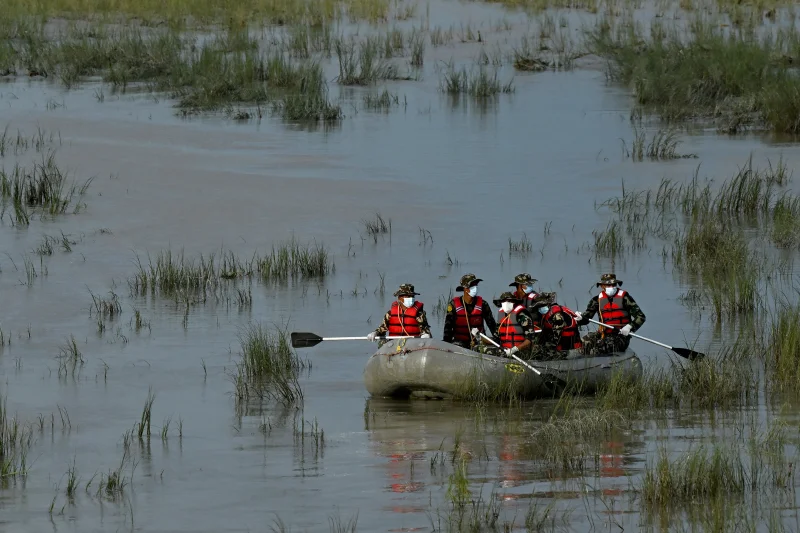
Rescue teams have been using drills, excavators and other heavy equipment to reach the workers. The scale of the operation, however, has exposed serious limitations in Nepal’s available rescue technology and expertise.
The Independent Power Producers’ Association of Nepal has criticized the government’s initial reluctance to bring in international specialists. They argue that the country did not have enough equipment or experience to handle a disaster of this magnitude.
Nepal Flood Rescue Effort Struggles With Tunnel Operations
Bhim Gautam, chief executive officer of the Independent Power Producers Association of Nepal, said the country’s experience has largely been limited to smaller flooding incidents.
“Our expertise is only in dealing with small flooding. We have never faced a situation like this before,” Gautam said.
The problem is not limited to clearing blocked tunnel entrances. In several locations, rescue teams first had to determine where the tunnels were beneath the debris. Gautam said workers spent as long as three days simply trying to locate some of the underground structures.
That delay has become a central concern as the number of missing people continues to rise.
The hydropower sector is particularly exposed because construction projects often operate in steep and difficult terrain. Tunnels can extend deep into mountains, while access roads and entrances can be vulnerable to landslides, floods and collapsing ground.
The Nepal Ministry of Home Affairs’ disaster response section is responsible for coordinating search and rescue operations and international assistance during disasters. The ministry says its disaster response structure includes the mobilization of search-and-rescue teams and coordination of international support.
Gautam said industry representatives had to pressure the government to approve foreign rescue teams. By late last week, Nepal had approved teams from China, India and Australia.
He argued that the decision came too late given the urgency of the situation.
The government has rejected the characterization that it refused foreign assistance. Finance Minister Swarnim Wagle said assistance was being accepted according to the needs on the ground.
Prime Minister Balen Shah later said the Nepali army and police were working alongside experts from India, China and South Korea at several hydropower tunnels.
The government has not responded to the criticism that the initial approach slowed the rescue effort.
Politics Complicate Nepal’s Response to the Disaster
The debate over foreign assistance is taking place against a sensitive political backdrop.
Political analyst Chandradev Bhatta said the government’s initial resistance may have reflected concerns about geopolitical influence. Nepal sits between India and China, two regional powers that have competed for influence in the country. Meanwhile, Western governments have also sought closer ties.
Bhatta pointed to Nepal’s experience following the devastating 2015 earthquake. During that time, international assistance became closely connected with competition among foreign powers seeking influence in Kathmandu.
“During the reconstruction phase, there was a huge competition, not only between our two neighbors China and India, but also the Western powers, who wanted to project their geopolitical power in Kathmandu,” Bhatta said.
That history has made foreign involvement a politically sensitive issue for the current government.
The sensitivity is particularly significant because Shah came to power after mass student-led protests challenged Nepal’s established political leadership and traditional parties. Those parties had often been viewed as having different degrees of alignment with India, China or Western countries.
Yet the disaster created a different political calculation.
As rescue operations struggled, criticism spread online over the government’s apparent reluctance to accept outside assistance. Social media users called for international help regardless of which country offered it.
Bhatta said the government may also have underestimated the scale of the disaster during the early stages.
“Had we taken support right at the beginning, perhaps we would have been able to save more lives,” he said.
The criticism comes as Nepal’s disaster response system attempts to deal with damage across remote mountain areas where roads and bridges have been destroyed. The country’s official disaster management structure includes mechanisms for coordinating international assistance. However, the scale and speed of this disaster have tested those systems.
The Nepal Tourism Board has also been involved in tracking missing foreign nationals. This is because many people caught in the disaster were tourists and pilgrims traveling through the affected Himalayan region.
The flood struck an area used by travelers heading toward Kailash Mansarovar in Tibet, a destination revered by both Hindus and Buddhists. The large number of missing foreign nationals has therefore added an international dimension to the rescue operation.
Questions Grow Over China’s Flood Death Toll
Questions are also emerging on the Chinese side of the Nepal-Tibet border.
China’s Foreign Ministry rejected reports that authorities had ignored early warnings or downplayed the scale of casualties. Beijing said information about the disaster had been released in a transparent and timely manner.
However, China’s reported casualty figures have not kept pace with the rapidly changing situation in Nepal.
The latest Xinhua reporting on the affected border region previously described the scale of the disaster. It also warned of additional flood risks along the Bhote Koshi River.
China’s most recent casualty update cited in the reference material was issued Saturday. It reported 16 confirmed deaths and 546 missing people on the Tibetan side of the border. Those figures had not been updated for more than 48 hours as of Monday.
The difference between the rapidly rising figures in Nepal and the slower updates from China has increased uncertainty over the full human cost of the disaster.
For rescue workers, however, the immediate challenge remains operational rather than political. Floodwaters and landslides have destroyed access routes, buried infrastructure and complicated efforts to locate people trapped underground.
The hydropower tunnels are among the most difficult rescue sites. This is because workers must first identify safe access points before heavy machinery can begin clearing debris.
The disaster has also placed pressure on Nepal’s private hydropower industry, which depends heavily on infrastructure built in challenging Himalayan terrain. Gautam said the sector had never faced an emergency of comparable scale.
As international rescue teams join Nepalese security forces and technical specialists, the response is shifting toward a multinational operation. The question now is how quickly those teams can reach the trapped workers. Additionally, it is important to determine whether the remaining rescue window can be used effectively.