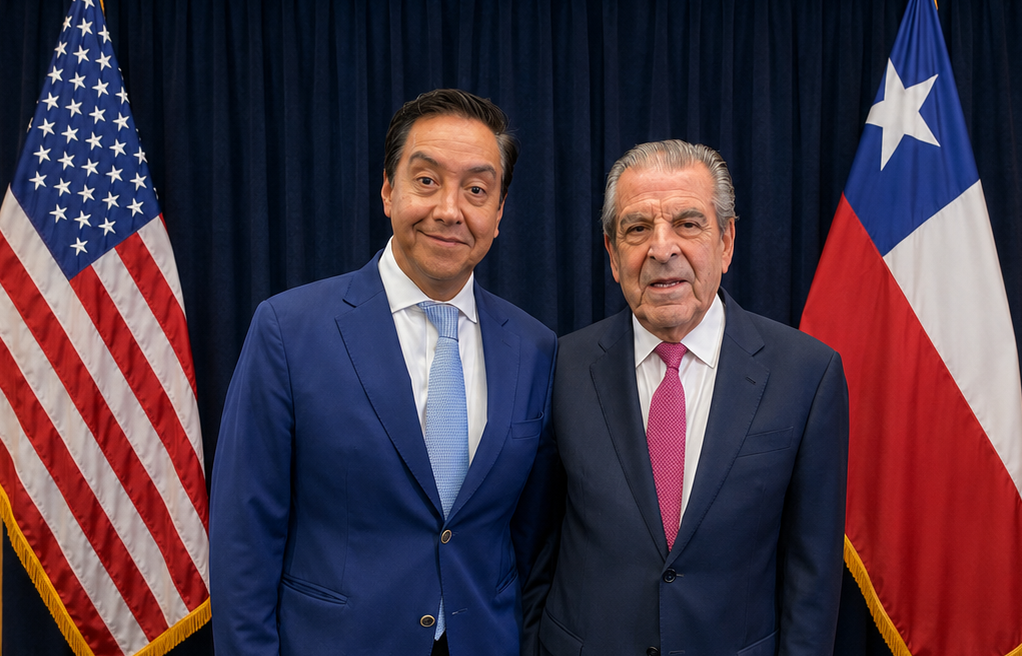
Javier Cárdenas-Moreno, President and CEO of Rhino Equipment, joined Eduardo Frei Ruiz-Tagle, former President of Chile, and other prominent political and business leaders at a high-level event focused on the future of Latin America, regional competitiveness, investment, infrastructure, and leadership.
The gathering brought together representatives from the business and political communities to discuss some of the most important challenges and opportunities facing Latin America. Among the central themes was “The Future of Latin America: Leadership, Investment and Infrastructure for a More Competitive Region,” a conversation addressing the conditions needed to strengthen economic growth and position Latin America for greater international competitiveness.
The discussion explored five key areas: the current state of Latin America, attracting investment and generating employment, infrastructure and development, economic relations with the United States, and the qualities needed by the next generation of Latin American leaders.
Javier Cárdenas-Moreno and Eduardo Frei Ruiz-Tagle Join Regional Leaders
Javier Cárdenas-Moreno, President and CEO of Rhino Equipment, participated in the event alongside Eduardo Frei Ruiz-Tagle, who served as President of Chile from 1994 to 2000.
The meeting provided a platform for business executives, political leaders, and other influential figures to exchange perspectives on the economic future of Latin America and the role that private-sector investment can play in strengthening the region.
For business leaders such as Cárdenas-Moreno, conversations surrounding infrastructure, investment, international trade, and economic development are particularly relevant to industries connected to construction, industrial activity, transportation, and infrastructure development.
The event also highlighted the importance of bringing together leaders with experience in both the public and private sectors to examine the opportunities available to Latin America in an increasingly competitive global economy.
The Current State of Latin America
One of the central topics was the current state of Latin America and the challenges the region faces in creating sustainable economic growth.
Latin America has significant economic potential, natural resources, human capital, strategic geographic locations, and access to major international markets. At the same time, the region continues to face challenges related to productivity, infrastructure, investment, institutional capacity, and employment.
Recent analysis from the OECD has emphasized the need for Latin America and the Caribbean to increase the quantity and quality of investment in strategic sectors to support productive transformation and more inclusive and sustainable development.
The discussion therefore focused on the importance of developing long-term strategies capable of transforming the region’s advantages into greater productivity, competitiveness, and economic opportunity.
How to Attract Investment and Generate Employment
Attracting investment and creating jobs emerged as another fundamental component of Latin America’s future.
Foreign and domestic investment can contribute to employment, productivity, innovation, and the development of new industries. However, investors also look for stable institutions, transparent regulations, efficient infrastructure, and predictable business environments.
Creating the right conditions for investment requires collaboration between governments and the private sector. According to the OECD, the quality of governance, institutional frameworks, transparency, and public policies can influence the amount and quality of investment attracted by countries in the region.
For Latin America, the challenge is not simply to attract capital, but to channel investment toward productive activities that generate employment, develop talent, increase technological capabilities, and strengthen local economies.
Infrastructure and Economic Development
Infrastructure was another central element of the conversation.
Modern roads, ports, airports, energy systems, telecommunications networks, water infrastructure, and digital connectivity are essential to economic development. Infrastructure reduces logistical barriers, connects markets, supports businesses, and can improve the competitiveness of entire regions.
The relationship between infrastructure investment and economic growth has long been recognized across Latin America. Research from the Economic Commission for Latin America and the Caribbean (ECLAC) has highlighted infrastructure as a fundamental component of productive activity and competitiveness, connecting people, goods, services, and information.
The challenge today goes beyond simply building more infrastructure. Latin America increasingly needs infrastructure that is efficient, resilient, sustainable, technologically advanced, and capable of supporting future economic growth.
This issue is particularly relevant to companies operating in the construction and heavy equipment sectors, where infrastructure investment directly influences demand for machinery, technology, services, and skilled labor.
Latin America’s Economic Relationship with the United States
Another important topic was the economic relationship between Latin America and the United States.
The United States remains a critical economic partner for countries throughout the region, with strong connections in trade, investment, manufacturing, technology, energy, agriculture, logistics, and services.
Strengthening these economic relationships can create opportunities for Latin American companies to expand internationally while also encouraging investment, supply-chain integration, technology transfer, and job creation.
For companies such as Rhino Equipment, which operates within the international construction equipment industry, maintaining strong relationships with the broader North American business community is particularly relevant to the development of international markets.
The conversation underscored the importance of viewing the relationship between Latin America and the United States not only through the lens of trade, but also through investment, infrastructure, innovation, entrepreneurship, and long-term economic cooperation.
What the Next Generation of Latin American Leaders Needs
The final theme focused on the next generation of Latin American leaders and the qualities required to guide the region through a rapidly changing global environment.
Future leaders will face challenges involving technological transformation, artificial intelligence, infrastructure modernization, climate resilience, international competition, economic inequality, and the development of human capital.
Leadership in this environment will require a combination of vision, innovation, accountability, adaptability, and the ability to build partnerships across political and economic sectors.
The discussion emphasized the importance of leaders who can think beyond short-term cycles and develop long-term strategies capable of strengthening competitiveness while creating opportunities for future generations.
A Shared Vision for a More Competitive Latin America
The meeting between Javier Cárdenas-Moreno and Eduardo Frei Ruiz-Tagle, together with other political and business leaders, reflected the importance of creating spaces where different perspectives can converge around Latin America’s future.
The conversation about leadership, investment, infrastructure, employment, and international economic relations highlighted the interconnected nature of the challenges facing the region.
For Latin America to become more competitive in the global economy, continued collaboration between governments, businesses, investors, entrepreneurs, and institutions will be essential.
The event provided an opportunity to examine these challenges from multiple perspectives while reinforcing a central idea: Latin America’s future competitiveness will depend on its ability to attract investment, modernize infrastructure, develop talent, strengthen international partnerships, and cultivate a new generation of visionary leaders.
For Javier Cárdenas-Moreno and Rhino Equipment, participation in this type of high-level business and leadership gathering reflects an ongoing engagement with conversations shaping the future of business, infrastructure, and economic development across the Americas.