Water scarcity and climate change are pushing communities across India to restore traditional water systems that were built centuries ago. Stepwells, ponds, johads and other rainwater-harvesting structures are being brought back into use as groundwater reserves face increasing pressure.
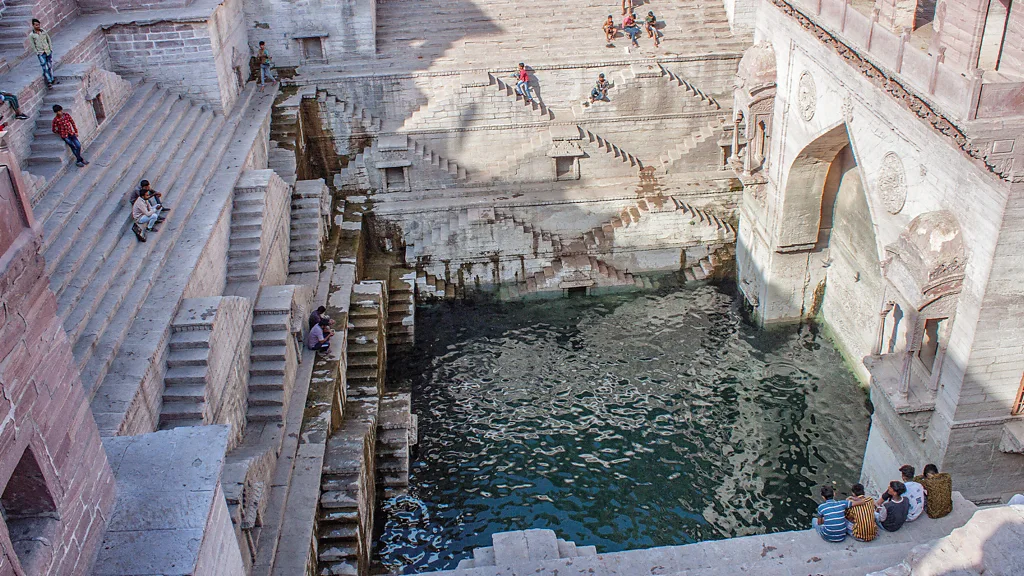
In 2025, water from the Moosi Rani Sagar stepwell in Alwar, Rajasthan, spilled over onto the footpath for the first time in more than 30 years.
The historic stepwell is part of a water-harvesting system built in the early 1800s. Covering about 1.3 acres, the structure had suffered from inconsistent water levels and heavy contamination until restoration work began in 2021.
Today, the stepwell holds water at depths of up to 30 feet. Local resident Vijay Sarswat, 60, says the level rarely falls below 20 feet, even during the driest months.
The transformation illustrates a broader shift in how India is approaching its water crisis. Structures once dismissed as relics are increasingly being viewed as practical tools for managing water in a warmer and less predictable climate.
Why India Is Reviving Ancient Water Systems
India is home to about 18% of the world’s population but has only around 4% of its freshwater resources. Much of the country’s water supply depends on groundwater, which supports rural drinking water and irrigation for hundreds of millions of people.
The problem is that groundwater does not replenish as quickly as it is being extracted in many regions.
According to the Central Ground Water Board, India’s groundwater resources are closely linked to rainfall, recharge conditions and patterns of extraction. When more water is pumped from an aquifer than natural processes can replace, groundwater levels can steadily decline.
Climate change makes that imbalance harder to manage. Higher temperatures can dry soils more rapidly, while increasingly intense rainfall can produce more runoff. Water that flows away quickly has less opportunity to infiltrate the ground and replenish aquifers.
Traditional water systems were often designed around a simple principle: slow water down.
Structures such as baoris, johads, kunds, tankas and nadis capture or retain water and allow it to move gradually through the landscape. Their designs vary, but many are intended to increase the amount of rainfall that remains available locally.
Stepwells Turn Heritage Into Water Infrastructure
Stepwells, known in different regions as baoris or baolis, are among India’s most distinctive traditional water structures.
Built with descending flights of steps, they allowed communities to reach groundwater while providing large storage spaces. Thousands were constructed across India between the seventh and 19th centuries.
Many were eventually abandoned as modern dams, canals and borewells became the dominant forms of water infrastructure.
The restoration of Moosi Rani Sagar demonstrates what can happen when these structures are treated as functioning parts of a watershed rather than simply historic monuments.
The Environmentalist Foundation of India has been involved in restoration efforts in Alwar, including work connected with the historic stepwell and its surrounding water system.
The objective is not simply to make an old structure look new.
A functioning water-harvesting system can help retain rainfall, support groundwater recharge and provide communities with another source of water during dry periods.
Johads Help Restore Alwar’s Water Supply
Stepwells may be the most recognizable traditional structures, but simpler systems are also playing an important role.
In Alwar, communities have revived johads, crescent-shaped earthen dams that temporarily retain monsoon runoff.
Their function is straightforward. Instead of allowing rainwater to run rapidly downstream, a johad holds the water long enough for some of it to infiltrate the ground.
That process can help replenish local aquifers.
The approach became particularly important after traditional water-management systems in parts of Alwar deteriorated. Deforestation and mining damaged watersheds, while increasing dependence on borewells extracted groundwater without necessarily replacing it.
By the mid-1980s, some rivers had dried up and parts of the region had been classified as a “dark zone,” indicating that groundwater extraction had exceeded the aquifer’s ability to recover.
In 1985, Rajendra Singh arrived in Alwar intending to establish a health clinic. Local residents told him that water was a more urgent problem.
Singh subsequently began helping villagers build johads.
The first projects produced rapid results. After the 1986 monsoon, the restored johad in Gopalpura filled with water, while wells that had been dry for years began to recover.
Other villages followed.
Between 1994 and 2007, more than 10,000 water-harvesting structures were built across Alwar, according to the material provided for this report. The work helped restore perennial flow to five rivers and benefited roughly 250 villages.
The Arvari River, which had previously been dry outside the monsoon season, flowed through the summer of 1996 for the first time in decades.
Maharashtra Shows How the Approach Can Scale
Traditional water management is also being revived in Maharashtra, particularly in drought-prone areas such as Marathwada.
The region sits on hard Deccan basalt, which can limit groundwater storage. When heavy rain falls, water can quickly become runoff unless it is captured and slowed.
Community-based watershed projects have attempted to address that problem by restoring soil and water conservation structures.
The Paani Foundation says its watershed-management initiatives involved more than 6,000 villages and created more than 550 billion litres of water-storage capacity.
The approach differs from simply drilling additional borewells.
A borewell provides access to groundwater, but it does not inherently replenish the aquifer. A canal can transport water from another location, but it does not necessarily improve groundwater levels beneath the fields around it.
Watershed structures work at a different level. They attempt to retain rainfall across the landscape and increase the time available for water to infiltrate the soil.
Why Traditional Systems Were Abandoned
Many of India’s traditional water systems survived for centuries but gradually fell into disuse.
Researchers and water experts have argued that the decline was not simply caused by the physical deterioration of the structures. Traditional water systems also depended on local institutions responsible for maintenance, desilting and managing access.
During the colonial period, those decentralized systems were weakened in many parts of India.
After independence, the country invested heavily in modern water infrastructure, including large dams, canals and electrically powered borewells.
In 1954, Prime Minister Jawaharlal Nehru described major infrastructure projects as the “temples of new India.”
That strategy dramatically increased India’s capacity to store and distribute water. But groundwater recharge received less attention.
The result was a system that became increasingly effective at extracting and transporting water while often remaining less effective at replacing the groundwater being consumed.
India Is Now Investing in Groundwater Recharge
That policy direction is beginning to change.
India’s national water programs increasingly emphasize rainwater harvesting, groundwater recharge and decentralized water conservation.
The Jal Jeevan Mission is part of India’s broader effort to expand reliable drinking-water access to rural households, while other government initiatives have supported village ponds and water-conservation structures.
Government data indicate that groundwater recharge from tanks, ponds and conservation structures increased from roughly 14 billion cubic metres in 2017 to about 25 billion cubic metres in 2024.
India has also developed a national master plan for artificial groundwater recharge, designed to direct rainwater and runoff into the ground rather than allowing it to drain away.
The strategy includes millions of proposed recharge and rainwater-harvesting structures.
Some of those structures may look remarkably similar to systems that communities were building hundreds of years ago.
The Missing Ingredient Is Not Always Technology
The revival of India’s ancient water systems is not necessarily an argument against modern infrastructure.
Large dams, pipelines, canals, treatment facilities and borewells remain important parts of the country’s water network.
The lesson from traditional systems is different: modern infrastructure does not have to replace local water-management practices.
In some cases, the two approaches can complement each other.
A borewell can provide access to groundwater. A johad can help replenish it.
A pipeline can deliver drinking water. A restored pond can retain rainfall.
A modern water-treatment system can improve water quality. A traditional catchment structure can help determine whether water remains available in the first place.
That distinction matters as climate change makes rainfall increasingly difficult to predict.
Community Management May Determine Whether Restoration Lasts
Restoring an ancient water structure is only the beginning.
These systems require regular maintenance, particularly desilting and repairs after heavy rainfall. They also depend on communities agreeing on how water should be managed.
In Alwar, the revival of water-harvesting structures was accompanied by renewed participation in village-level institutions.
For residents such as Varsha, 67, the benefits extend beyond having a more reliable well. She says that before her village constructed a johad, her well could become unreliable during the dry season. Now, she says, it holds water throughout the year.
She has also become more active in village assemblies.
That social dimension may be as important as the physical infrastructure.
Arun Krishnamurthy, founder of the Environmentalist Foundation of India, has argued that restoring stepwells requires more than funding and technical work. Without long-term civic discipline and maintenance, even a restored structure can eventually fail.
Ancient Knowledge Meets a Modern Water Crisis
India’s traditional water systems were not designed to solve climate change.
They were developed under local environmental conditions to manage seasonal rainfall, groundwater and water scarcity.
Yet many of the principles behind them remain relevant.
Capture rain locally. Slow runoff. Increase infiltration. Store water underground when possible. Maintain infrastructure collectively.
None of these techniques can solve India’s water crisis on its own. Population growth, groundwater extraction, agricultural demand, pollution and climate change require much broader responses.
But India’s experience suggests that the future of water management may not depend entirely on inventing new infrastructure.
Some of the answers may already be buried beneath the soil, waiting to be maintained and used again.