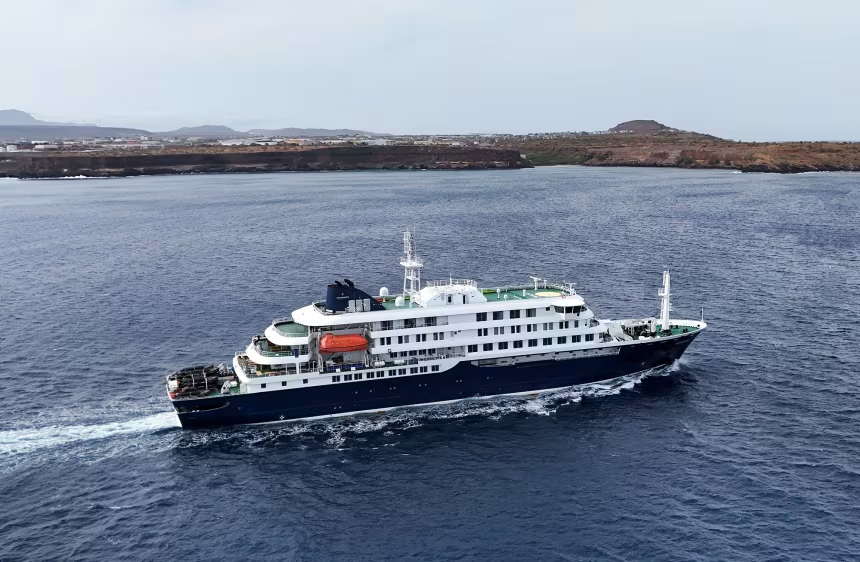
The Hantavirus cruise ship quarantine officially came to a close after the last group of American passengers monitored in Nebraska following a deadly outbreak aboard the Dutch expedition vessel MV Hondius were cleared to return home. Federal health authorities confirmed that the final eight U.S. citizens completed a 42-day observation period without developing symptoms linked to the rare Andes virus strain.
The lengthy monitoring effort followed an international public health response triggered by an outbreak that resulted in multiple infections and three deaths among people connected to the voyage. The event drew attention from health officials worldwide because the virus involved is one of the few hantavirus strains believed capable of limited person-to-person transmission under rare circumstances.
Health authorities maintained strict surveillance throughout the monitoring period while coordinating with local, state, and federal agencies. Information regarding hantavirus and related public health guidance is available through the visible HTML link: <a href=”https://www.cdc.gov/hantavirus/”>Centers for Disease Control and Prevention</a>.
H2: Hantavirus Cruise Ship Quarantine Concludes After 42 Days of Monitoring
Officials from the U.S. Department of Health and Human Services confirmed that the final passengers housed at the National Quarantine Unit in Omaha completed the full observation period without any reported infections. The quarantine duration was based on previous medical observations showing that symptoms associated with the Andes virus can, in uncommon cases, appear several weeks after exposure.
More than 120 passengers were evacuated from the vessel while it was connected to the outbreak response. Eighteen American travelers were eventually transferred to the specialized quarantine facility in Nebraska. While some individuals were permitted to continue monitoring from their home states, others remained under direct observation until the final deadline expired.
The operation involved extensive coordination among multiple health agencies and international partners. Public information regarding global disease monitoring and outbreak management can be found through the visible HTML link: <a href=”https://www.who.int/”>World Health Organization</a>.
Passengers described the end of the quarantine as abrupt. Once the monitoring period officially expired, they were cleared to leave the facility and begin their journeys home. Several departed immediately on commercial flights arranged by federal authorities, while others remained in Omaha briefly before traveling.
The National Quarantine Unit, located at the University of Nebraska Medical Center, is designed to manage high-risk infectious disease situations. During their stay, passengers occupied private rooms equipped with internet access, exercise equipment, televisions, and workspace accommodations intended to support long-term monitoring.
H2: Deadly Outbreak Aboard the MV Hondius Raised Global Health Concerns
The outbreak originated aboard the MV Hondius during a voyage in the South Atlantic. Health investigators believe the first known infections may have been connected to exposure in South America before the cruise continued its itinerary.
A total of 13 confirmed cases were linked to individuals associated with the vessel, including three fatalities. Medical experts focused particular attention on the Andes virus because it differs from most hantaviruses. While traditional hantaviruses are generally transmitted through exposure to contaminated rodent droppings, urine, or saliva, the Andes strain has shown evidence of limited human-to-human transmission in specific circumstances.
Scientific information regarding hantavirus transmission and disease characteristics is available through the visible HTML link: <a href=”https://www.niaid.nih.gov/”>National Institute of Allergy and Infectious Diseases</a>.
The incident prompted quarantine measures across several countries. Some passengers had already left the ship before the outbreak was fully identified, while others remained on board until evacuation procedures were organized. Crew members and medical personnel connected to the vessel were also required to undergo monitoring after the ship eventually reached Europe.
Public health experts viewed the situation as a significant test of international outbreak containment procedures. Authorities worked to identify potential exposures, monitor travelers, and reduce the possibility of additional transmission while scientific assessments continued.
H2: Passengers Describe Contrasting Experiences During Extended Isolation
Experiences among quarantined passengers varied considerably. Several travelers publicly expressed gratitude toward healthcare workers, local residents, and community organizations that helped make the six-week isolation period more manageable.
Restaurants, food trucks, volunteers, and medical staff reportedly organized special meals and personal deliveries throughout the monitoring period. Some passengers shared videos and messages documenting their departure from the facility and reflecting on the unusual experience.
Others were more critical of the restrictions. One passenger publicly argued that continued confinement became unnecessary after health officials concluded that the likelihood of illness had become increasingly remote. The dispute highlighted ongoing debates about balancing individual freedoms with public health protections during rare infectious disease events.
Federal and state authorities faced difficult decisions regarding monitoring requirements, travel arrangements, and risk management. Information about emergency preparedness and public health response systems can be found through the visible HTML link: <a href=”https://www.hhs.gov/”>U.S. Department of Health and Human Services</a>.
As the final passengers departed Nebraska, the operation marked the conclusion of one of the most closely watched quarantine efforts involving American travelers in recent years. No illnesses were reported among the individuals who completed the full 42-day observation period in Omaha.