
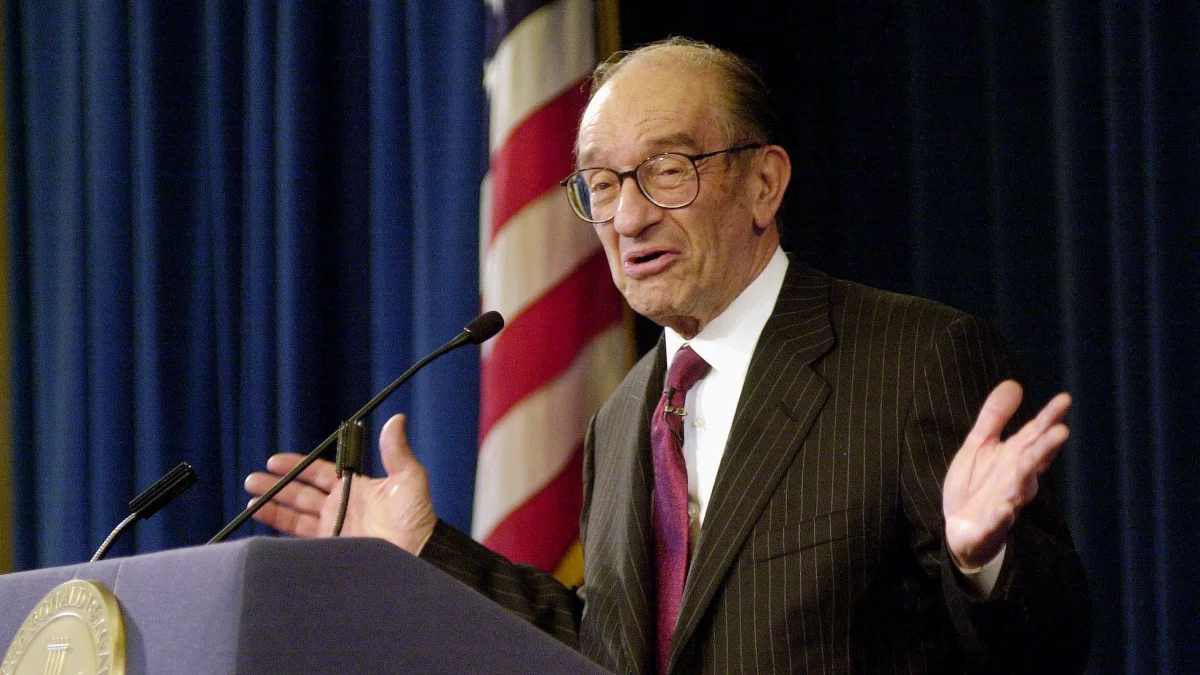
The Alan Greenspan legacy remains one of the most debated chapters in modern economic history. Greenspan, who served as chairman of the Federal Reserve from 1987 to 2006 and became one of the most influential economic policymakers of the late twentieth century, died at the age of 100 at his home in Washington, D.C. His death closes the story of a figure whose decisions helped guide the United States through market crashes, financial turbulence, technological transformation, and unprecedented economic expansion.
For nearly two decades, Greenspan occupied a position that gave him extraordinary influence over interest rates, inflation policy, financial markets, and investor confidence. At the height of his prominence, his public remarks could move stock markets within minutes, and his economic outlook was followed closely by governments, businesses, and central banks around the world.
Historical information regarding Federal Reserve leadership and monetary policy is maintained through Federal Reserve System, where Greenspan’s tenure remains one of the longest and most consequential in the institution’s history.
His supporters viewed him as a master strategist who helped sustain economic growth. Critics later argued that some of the policies associated with his era contributed to financial vulnerabilities that became visible years after he left office.
Alan Greenspan Legacy Was Built During an Era of Growth and Stability
Greenspan assumed leadership of the Federal Reserve during a period of uncertainty. Shortly after taking office, he confronted the 1987 stock market crash, one of the most dramatic single-day market declines in US history.
Over the years that followed, he guided monetary policy through a series of major events, including international financial disruptions, the rapid expansion of technology companies, and the economic aftermath of the September 11 attacks.
His approach often emphasized market flexibility, low inflation, and confidence in the ability of businesses and investors to allocate resources efficiently. During the 1990s, those policies coincided with strong economic growth, rising productivity, low unemployment, and expanding financial markets.
Greenspan became closely associated with the belief that technological innovation was reshaping the economy. He argued that productivity gains created opportunities for growth without necessarily generating excessive inflation, a view that influenced Federal Reserve policy decisions for years.
Economic research and historical monetary policy data continue to be analyzed through institutions such as National Bureau of Economic Research, where economists frequently study the long-term effects of decisions made during the Greenspan era.
For much of the 1990s, many investors and policymakers considered his leadership a model of successful central banking.
Financial Crisis Criticism Reshaped Public Perception
The Alan Greenspan legacy changed dramatically following the global financial crisis that erupted after his departure from the Federal Reserve.
Although Greenspan left office in early 2006, critics argued that policies pursued during his tenure contributed to conditions that fueled excessive risk-taking throughout the financial system. Low interest rates, expanding credit markets, and limited oversight of increasingly complex financial instruments became central points of debate.
Particular attention focused on the rapid growth of mortgage-backed securities, derivatives, and other financial products that played significant roles during the 2008 crisis.
Greenspan had long supported a market-oriented philosophy that emphasized self-regulation and limited government intervention. Supporters argued that innovation and competition produced economic benefits. Critics contended that those assumptions underestimated systemic risks.
Financial stability research and regulatory analysis continue to be conducted by organizations including International Monetary Fund, where the causes and consequences of major financial crises remain subjects of ongoing study.
As public confidence in financial institutions deteriorated during the recession, Greenspan increasingly became a symbol of broader debates over deregulation, market oversight, and the proper role of central banks.
Influence on Central Banking Continues Long After His Tenure
Despite the controversies surrounding his later years, Greenspan’s influence on economic policymaking remains substantial.
His tenure helped redefine expectations surrounding inflation control and demonstrated the growing importance of central bank communication in shaping market behavior. Future Federal Reserve leaders inherited a framework that placed significant emphasis on managing expectations as well as adjusting interest rates.
Greenspan was also known for his highly technical communication style. Investors frequently dissected his speeches and congressional testimony, searching for clues about future policy decisions. That relationship between central bank messaging and financial markets remains a defining feature of modern monetary policy.
The broader history of central banking and global economic governance continues to be documented by institutions such as Bank for International Settlements, which studies monetary policy and financial system developments worldwide.
Even years after leaving office, Greenspan remained an influential voice in discussions about economic growth, government spending, inflation, and financial regulation. His record continues to generate strong opinions among economists, investors, and policymakers, reflecting the scale of his impact on an era that transformed both the American economy and the global financial system.