
Shanghai — Unitree Robotics made a spectacular stock market debut in Shanghai on Wednesday, with its shares closing 460% above their initial public offering price and giving investors a powerful indication of the enthusiasm surrounding humanoid robots and China’s rapidly expanding robotics industry.
The company priced its shares at 150.80 yuan, equivalent to approximately $22.36 USD, before they surged during the first trading session and closed at 845 yuan, or about $125.31 USD. Unitree raised approximately $904 million USD through the IPO, while its market value reached roughly $50 billion USD by the end of the session.
The listing took place on Shanghai’s technology-focused STAR Market, a segment of the Shanghai Stock Exchange created for innovative companies. The exchange describes the STAR Market as having its own trading framework and rules designed for technology-oriented businesses. Shanghai STAR Market data and trading information.
The scale of Unitree’s first-day rally highlights how aggressively investors are positioning themselves around physical artificial intelligence, where software models are increasingly being connected to machines capable of operating in the real world.
For China, the listing also carries strategic significance. Beijing has identified humanoid robotics and embodied artificial intelligence as important areas for technological development, while manufacturers are being encouraged to move these systems from demonstrations and laboratories into real production environments.
The timing is notable because Unitree’s debut coincided with the World Humanoid Robot Games in Beijing, an event designed to demonstrate the capabilities of humanoid machines in activities ranging from athletics to practical tasks.
The company’s performance on the stock market therefore comes at a moment when humanoid robotics is moving from a futuristic concept toward a potential commercial industry.
Unitree Robotics Turns Humanoid Machines Into a Commercial Business
Founded in 2016 and headquartered in Hangzhou, Unitree has developed a broad robotics portfolio covering quadruped robots, humanoid machines, robotic components and platforms for research and industrial applications.
The company has become one of China’s most recognizable robotics manufacturers, particularly because of its strategy of offering advanced machines at prices below many competing systems.
Unitree’s business is not limited to humanoid robots. Its portfolio includes quadruped platforms, robotic arms and components, while its humanoid lineup has expanded rapidly in recent years.
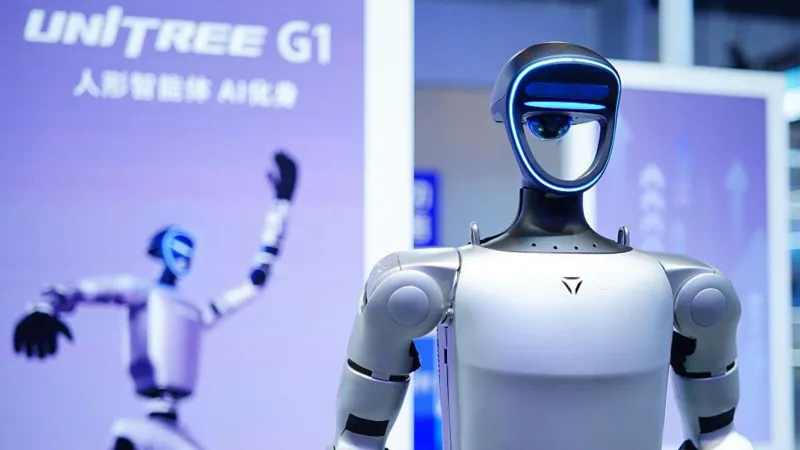
One of its most widely known products is the G1 humanoid robot. Unitree lists the machine from $13,500 USD, positioning it as a relatively accessible humanoid platform for developers, researchers and other customers. Unitree G1 humanoid robot specifications.
The G1 stands approximately 1.32 meters tall and weighs around 35 kilograms, depending on configuration. Unitree says the platform can be equipped with between 23 and 43 joint motors and incorporates technologies designed for imitation learning, reinforcement learning and physical manipulation.
Those specifications matter because humanoid robotics is increasingly shifting away from the simple question of whether a machine can walk.
The more important question is whether a robot can understand its environment, manipulate objects, learn tasks and repeat those tasks reliably enough to create economic value.
Unitree has been developing hardware and software around that objective.
Its humanoid platforms are designed to support research into embodied artificial intelligence, while the company’s broader ecosystem allows developers to experiment with robot control, data collection and machine learning.
The company has also used highly visible public demonstrations to promote its technology.
In February, Unitree’s humanoid robots attracted international attention after performing a coordinated martial arts routine during China’s Spring Festival Gala. The company said the performance involved 24 G1 humanoid robots and an H2 humanoid robot.
Unitree has also expanded its presence in competitive robotics. During the first World Humanoid Robot Games in Beijing, Unitree robots participated in events involving running, obstacle courses and relay races. The company’s H1 reportedly reached speeds above 5 meters per second, while teams using Unitree’s G1 platform also won medals.
These demonstrations are important for marketing, but they also reveal the industry’s central challenge.
A robot that can perform impressive movements under controlled conditions is not necessarily ready to replace human workers.
Commercial deployment requires reliability, battery endurance, safety, maintenance and the ability to perform useful tasks repeatedly in unpredictable environments.
That is why China’s effort to move humanoid robots into real-world applications is becoming increasingly important.
The country’s Ministry of Industry and Information Technology and the State-owned Assets Supervision and Administration Commission launched a 2026 initiative aimed at testing humanoid robots and embodied artificial intelligence in real production and living environments. The program specifically seeks to accelerate regular deployment and larger-scale commercialization. China’s 2026 humanoid robotics field-training initiative.
That approach could give Chinese robotics manufacturers an important advantage: access to large industrial environments where robots can be tested against specific, measurable tasks.
Factories, warehouses and logistics facilities are more predictable than private homes, making them a logical starting point for humanoid machines.
The commercial opportunity could therefore emerge first in industrial applications rather than consumer households.
Unitree’s IPO Raises the Stakes in the US-China Robotics Race
Unitree’s extraordinary market debut comes as robotics becomes another major front in the technological competition between China and the United States.
Both countries are investing heavily in artificial intelligence, advanced manufacturing and embodied AI. Humanoid robots are increasingly viewed as a bridge between AI systems and physical production because they can potentially operate in environments designed for human workers.
China has major advantages in manufacturing scale, industrial supply chains and component production. The country also has a growing network of robotics companies supported by government programs and private investment.
The United States, meanwhile, retains major strengths in AI research, software and advanced robotics.
Tesla is developing Optimus, a general-purpose humanoid robot designed to perform repetitive, dangerous or otherwise undesirable tasks. The company says its robotics strategy relies on advances in AI, perception, planning, motion control and interaction with the physical world. Tesla’s AI and Optimus robotics program.
Amazon is also exploring humanoid robotics for warehouse applications, while Boston Dynamics continues developing advanced robotic systems through its relationship with Hyundai.
The competitive landscape is therefore becoming increasingly crowded.
Yet Unitree’s pricing strategy could prove particularly important.
A humanoid robot priced in the low five figures can potentially reach research institutions, universities, developers and smaller companies that would not be able to purchase a far more expensive industrial system.
Unitree has also developed lower-cost humanoid platforms, reinforcing its strategy of making robotics hardware more accessible.
Price alone, however, will not determine which companies dominate the industry.
Humanoid robots still face significant technical barriers. Battery life remains a major constraint. Dexterous manipulation is difficult. Robots must be able to recover from unexpected situations, operate safely around people and maintain consistent performance over long periods.
Software is equally important.
A machine can have sophisticated motors and sensors but still provide limited commercial value if its AI cannot reliably understand what is happening around it.
That is where the competition between Chinese and American companies could become particularly intense.
China’s strength lies heavily in manufacturing and supply-chain integration, while US companies have significant capabilities in artificial intelligence and software. The companies that successfully combine both areas may gain the strongest position as humanoid robots move toward mass deployment.
Unitree’s international expansion could also face geopolitical obstacles.
The United States has increasingly scrutinized Chinese technology companies in sectors considered strategically sensitive, including artificial intelligence, communications equipment and advanced robotics.
That could make access to foreign markets more difficult even as Unitree expands production.
For the Chinese company, its domestic market offers an enormous alternative. China has thousands of factories and a large industrial workforce, creating potential demand for machines capable of handling repetitive manufacturing and logistics tasks.
The government is also encouraging companies to move humanoid robotics beyond demonstrations and into practical applications.
The extraordinary first-day performance of Unitree’s stock therefore represents more than enthusiasm for a single robotics company.
It reflects expectations that humanoid robots could become an important industrial technology and that manufacturers capable of producing them at scale may eventually occupy a significant position in the global AI economy.
The immediate challenge is turning that expectation into repeatable commercial results.
For Unitree, the next stage is not simply proving that its robots can walk, run, dance or perform martial arts. The harder test will be whether they can reliably perform economically useful work, at scale, in environments where failure carries a real cost.
That distinction is likely to determine whether the current enthusiasm around humanoid robotics develops into a sustainable industrial market.