
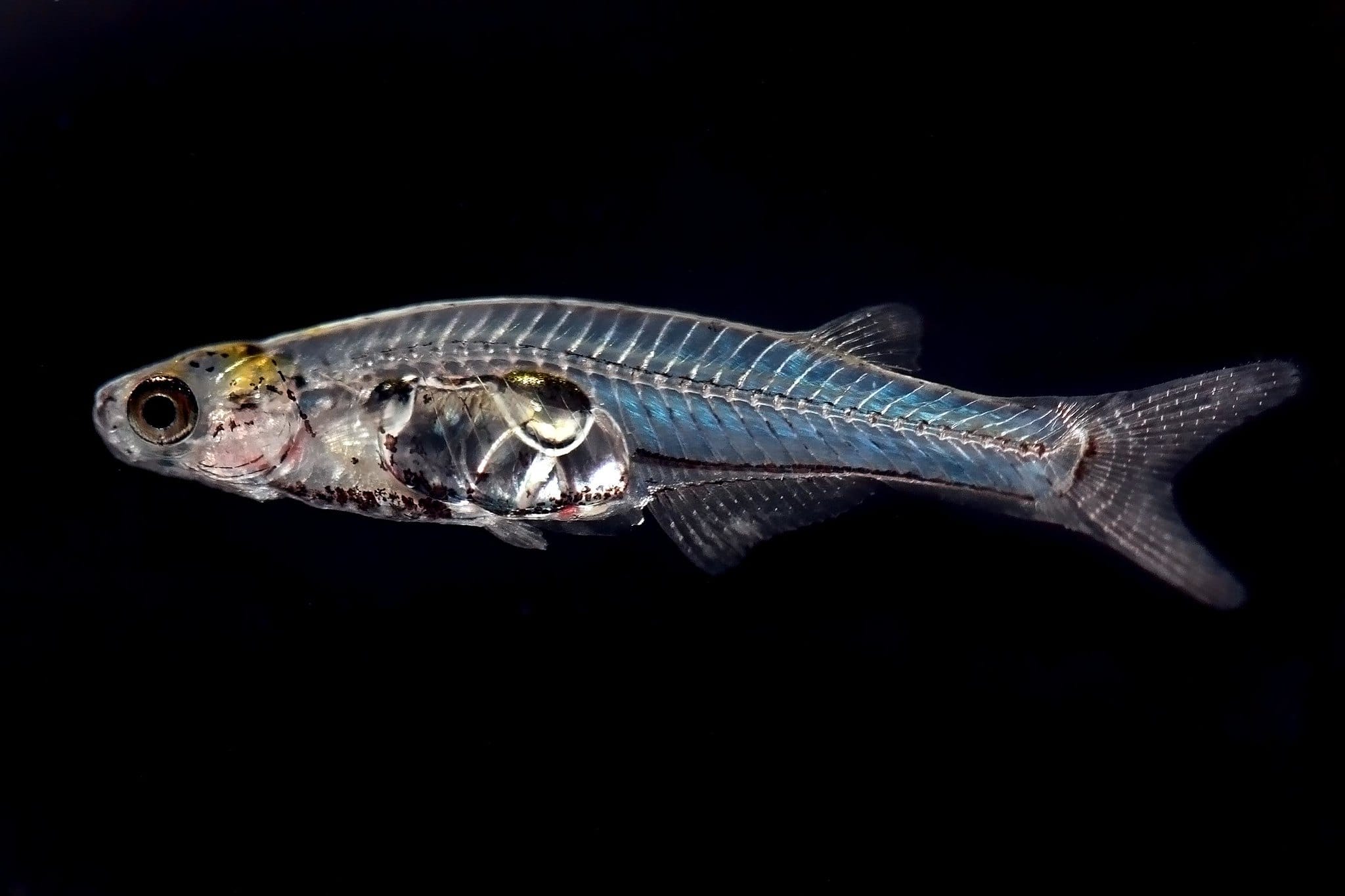
A tiny transparent fish may become one of the most important tools in the future of neuroscience.
Researchers at the Howard Hughes Medical Institute’s Janelia Research Campus are making a major investment in transparent fish brain research, betting that a little-known species called Danionella could help answer some of biology’s biggest unanswered questions. By combining advanced imaging technology with artificial intelligence, scientists hope to observe entire brains functioning in real time and uncover how neural activity generates behavior.
The ambitious initiative represents one of the largest neuroscience research efforts focused on understanding how brain circuits drive social interaction, memory, learning, and decision-making.
Why Transparent Fish Brain Research Is Capturing Scientists’ Attention
The species at the center of this effort is Danionella cerebrum, a tiny freshwater fish whose unique anatomy offers researchers a rare opportunity.
Additional information about the research institution can be found at Janelia Research Campus.
Unlike most animals, Danionella possesses transparent skin and lacks portions of the skull that typically obstruct direct observation of brain activity. This allows researchers to see neurons functioning inside a living adult animal without invasive procedures.
Scientists have long relied on model organisms such as mice, zebrafish, and fruit flies to study the brain. However, each model comes with limitations. Rodents have opaque skulls and complex brains that are difficult to image completely. Zebrafish are transparent only during early development.
Danionella offers a unique combination of transparency and behavioral complexity, making it an increasingly attractive model for neuroscience research.
Because the species was only formally classified in recent years, scientists are still uncovering its full potential as a research organism.
Artificial Intelligence Will Help Decode Massive Brain Data
One of the biggest challenges in transparent fish brain research is not collecting information—it is analyzing it.
Information about neuroscience and biological research supported by the institute is available at Howard Hughes Medical Institute.
Researchers plan to monitor activity across thousands of neurons simultaneously, generating enormous amounts of biological data. Traditional analysis methods would struggle to process information at the scale required for whole-brain observation.
Artificial intelligence is expected to play a central role in identifying patterns, mapping neural activity, and helping scientists understand how specific brain circuits influence behavior.
The project builds on previous achievements involving neural mapping in fruit flies, where researchers successfully created detailed maps of millions of neural connections.
By expanding these techniques to Danionella, scientists hope to create comprehensive neural atlases that reveal how information flows through an entire vertebrate brain.
The integration of AI with neuroscience could accelerate discoveries that might otherwise require decades of manual analysis.
Understanding How the Brain Creates Behavior
The ultimate goal of the initiative extends far beyond studying a single species of fish.
Scientific resources related to brain research can be explored through National Institute of Neurological Disorders and Stroke.
Researchers aim to tackle one of neuroscience’s most fundamental mysteries: how electrical signals and neural circuits generate behavior, thoughts, memories, and social interactions.
Although scientists understand many individual components of the brain, they still struggle to explain how entire networks of neurons work together to create complex behaviors.
Because humans, fish, and many other vertebrates share important evolutionary characteristics, discoveries made in Danionella could provide insights relevant to human brain function.
Researchers believe observing complete neural activity in real time may reveal principles that apply broadly across species.
A New Era of Whole-Brain Neuroscience
The project also includes plans to dramatically expand infrastructure dedicated to Danionella research.
Information about neuroscience initiatives and brain-mapping technologies can be found at The BRAIN Initiative.
Janelia Research Campus plans to significantly increase laboratory space devoted to fish research, creating room for thousands of additional tanks and supporting a growing community of scientists focused on the species.
Future goals include creating a complete map of every neural connection in the fish brain and developing technologies capable of monitoring brain activity in freely swimming animals rather than immobilized laboratory specimens.
Achieving these objectives will require major advances in imaging systems, computational tools, and engineering solutions.
If successful, transparent fish brain research could open an entirely new chapter in neuroscience, providing unprecedented insight into how brains function and helping researchers better understand the biological foundations of behavior across the animal kingdom.