
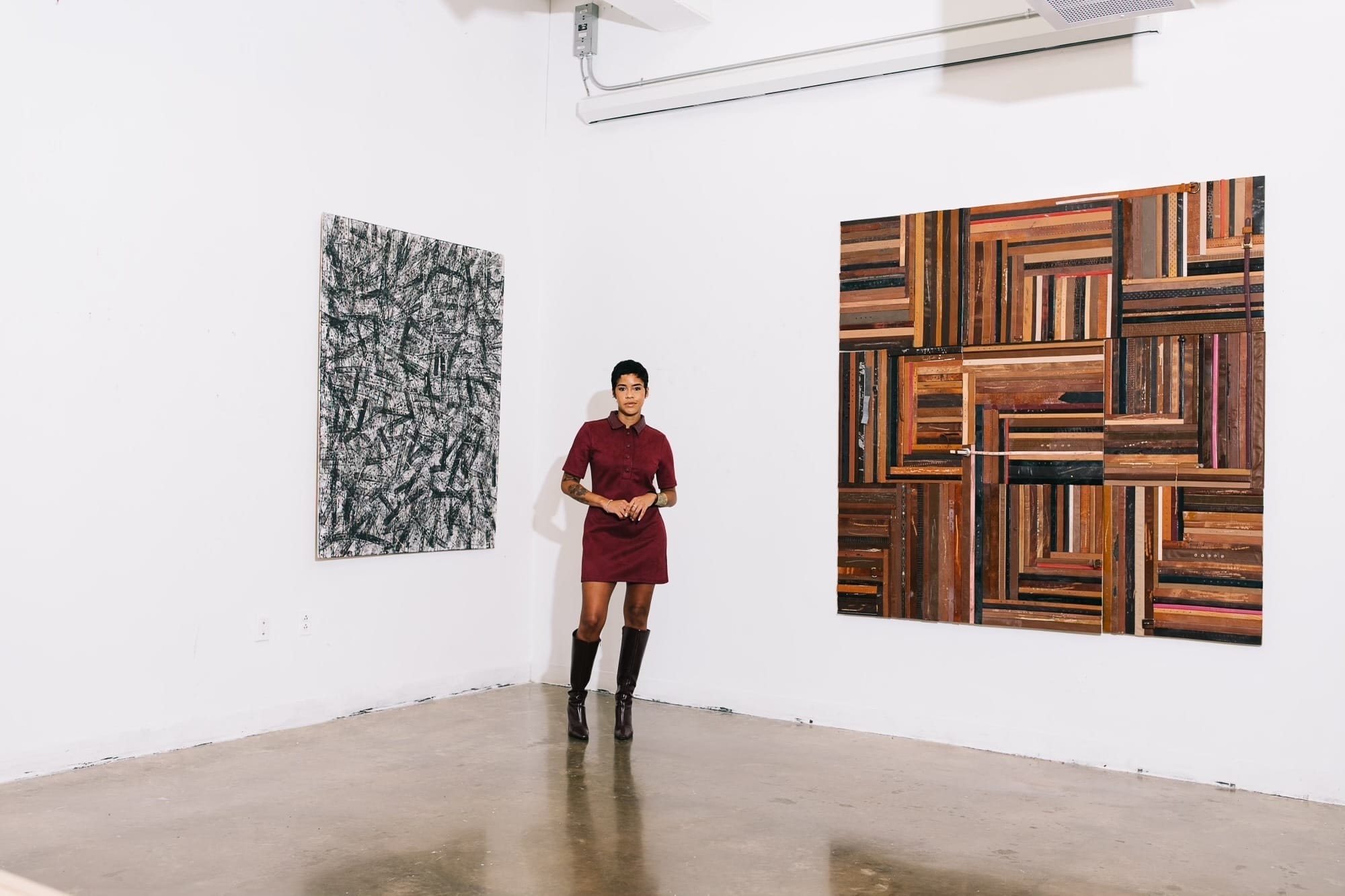
Multidisciplinary artist Lex Marie is drawing national attention for a striking body of work that transforms a familiar household object into a powerful symbol of memory, parenting, discipline, and cultural history.
Through large-scale installations, painted surfaces, and mixed-media works, Lex Marie art examines the complex role corporal punishment has played in many Black households. Her work has sparked widespread discussion online, with thousands of people sharing personal stories and reflections about childhood discipline, family dynamics, and evolving parenting practices.
By incorporating belts directly into her artwork, Marie invites viewers to confront difficult conversations that often remain private while exploring how experiences from one generation continue to influence the next.
Lex Marie Art Turns Everyday Objects Into Cultural Commentary
At the center of Marie’s artistic practice is the belt, an object that carries different meanings depending on personal experience and cultural context.
Information about contemporary art exhibitions and educational programs can be found at Katzen Arts Center.
Inside her studio, belts appear not only as materials but also as symbols. Some are carefully arranged across canvases to create geometric patterns and visual narratives. Others become tools used in the creative process itself.
For several works, Marie dips belts into paint and strikes the canvas repeatedly, creating bold marks that communicate movement, force, and emotion. The resulting compositions blur the line between performance, painting, and storytelling.
Her artistic approach transforms ordinary objects into vehicles for discussing childhood memories, family relationships, and the ways discipline can shape identity.
The work resonates with audiences because it connects deeply personal experiences to larger cultural conversations.
Exploring the History of Discipline in Black Households
One of the central themes throughout Marie’s work is the history and evolution of discipline in Black households.
Additional resources related to African American history and culture are available through National Museum of African American History and Culture.
Marie explores how disciplinary practices have been passed through generations and how attitudes toward parenting continue to change.
As both an artist and a mother, she often reflects on the differences between the way she was raised and the values she brings to parenting today. These personal reflections have become an important source of inspiration for her artwork.
Her work also engages with broader historical discussions about corporal punishment and its relationship to systemic structures of control that affected Black communities throughout American history.
Scholars and historians have examined how physical punishment became embedded in social and cultural practices over time. Marie’s art does not attempt to provide simple answers but instead creates space for dialogue and reflection.
By placing these conversations in a public artistic setting, she encourages viewers to examine how history, family traditions, and personal experiences intersect.
“Watch Your Tone” and the Visual Language of Memory
Among Marie’s most recognized works is a large installation titled “Watch Your Tone.”
Information about contemporary Black artists and cultural programming can be found at National Endowment for the Arts.
The piece consists of dozens of belts arranged across a large canvas. Variations in color, texture, and placement create a visually striking composition while also symbolizing different skin tones and experiences.
The title references a phrase commonly associated with authority and discipline within families. Through the work, Marie explores the relationship between language, power, and physical punishment.
Another notable piece, “Because I Love You,” focuses on the emotional complexity often associated with corporal punishment. Using a belt dipped in paint, Marie repeatedly struck a painted surface, creating marks that resemble scars, bruises, or traces of memory.
The physical act of creating the piece became part of the artwork itself, allowing the artist to engage directly with the emotions connected to the subject matter.
These works challenge viewers to consider how expressions of love, discipline, protection, and control can become intertwined in family relationships.
Social Media Expands the Conversation
The impact of Lex Marie art extends far beyond gallery walls.
Resources supporting contemporary artists and public engagement initiatives can be found through Smithsonian Institution.
Videos featuring her creative process have gained significant attention across social media platforms, where audiences have responded with deeply personal reflections.
Thousands of comments have appeared beneath her posts, with people sharing stories about childhood experiences, family traditions, and changing perspectives on parenting.
Some viewers describe the work as healing and validating, while others express discomfort or disagreement. For Marie, these varied reactions demonstrate the importance of addressing subjects that are often difficult to discuss openly.
Her growing body of work continues to spark conversations about discipline, generational trauma, cultural history, and the ways families navigate care and accountability.
Through art, Marie has created a space where personal memories become part of a larger dialogue about identity, history, and the evolving nature of parenting in contemporary society.