
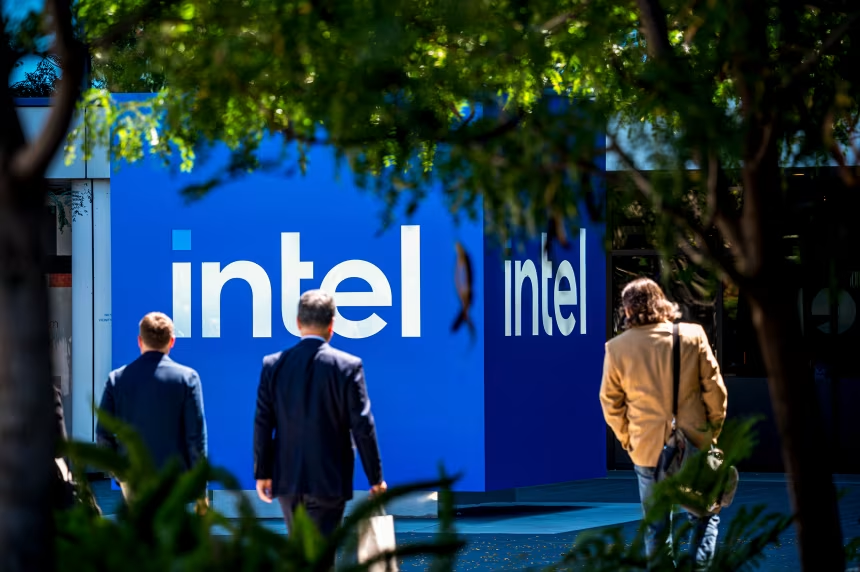
The Tim Cook iPhone prices rise warning is drawing attention across the technology industry as growing semiconductor costs collide with renewed efforts to expand chip manufacturing inside the United States. The discussion intensified after President Donald Trump announced that Intel had reached an agreement with Apple to begin producing computer chips domestically, a move that could reshape portions of the company’s supply chain while reducing dependence on overseas manufacturing.
The announcement arrived just days after Apple Chief Executive Officer Tim Cook acknowledged that higher component costs are increasingly difficult for the company to absorb. Demand for advanced memory and storage technologies, fueled by the artificial intelligence boom, has pushed chip prices higher across the sector, creating pressure that may eventually reach consumers.
The semiconductor industry remains one of the most strategically important sectors in the global economy, with manufacturing investments and supply chain development tracked through organizations such as <a href=”https://www.semiconductors.org/“>Semiconductor Industry Association</a>.
Tim Cook iPhone Prices Rise Concerns Reflect Growing Chip Costs
For years, Apple has managed to shield customers from many of the cost increases affecting electronics manufacturing. That balancing act is becoming more difficult.
According to Cook, the surge in demand for advanced semiconductor components has contributed to rising production expenses. Artificial intelligence infrastructure, cloud computing expansion, and increased demand for high-performance processors have placed additional strain on the global chip market.
The concern is particularly significant because semiconductors sit at the center of nearly every Apple product. iPhones, iPads, Mac computers, and wearable devices all depend on increasingly sophisticated processors and memory systems.
Industry analysts note that the pressure extends beyond Apple. Many technology manufacturers are facing similar challenges as AI-related investments accelerate worldwide. Semiconductor research and market trends continue to be monitored by institutions including <a href=”https://www.iea.org/“>International Energy Agency</a>, which regularly evaluates technology supply chains and industrial development trends connected to advanced manufacturing.
While Apple has not announced specific product price increases, Cook’s remarks suggest that maintaining current pricing may become increasingly difficult if component costs continue rising.
Apple and Intel Push for Expanded US Semiconductor Manufacturing
Trump’s announcement places Intel at the center of a broader effort to strengthen domestic semiconductor production.
Apple has traditionally relied heavily on manufacturing partners in Asia, particularly for advanced chip fabrication. Producing a larger share of components within the United States could help diversify supply chains while reducing exposure to geopolitical risks and international manufacturing disruptions.
The administration has made semiconductor independence a major policy objective, arguing that domestic production is critical for economic competitiveness and national security.
Intel has spent recent years investing heavily in research facilities, fabrication plants, and advanced manufacturing technologies designed to compete more aggressively in the global semiconductor market. Information about federal initiatives supporting domestic chip production can be found through <a href=”https://www.nist.gov/chips” >CHIPS Program Office</a>.
Investors reacted quickly to the news. Intel shares surged in premarket trading following Trump’s announcement, reflecting optimism that closer ties with Apple could strengthen the company’s long-term position in advanced chip manufacturing.
The reported agreement also highlights the growing importance of strategic partnerships as technology companies seek reliable access to increasingly scarce high-performance semiconductor capacity.
Government Investment and Industry Growth Drive New Momentum
The reported Apple-Intel arrangement comes after significant government support aimed at accelerating domestic semiconductor development.
Last year, the federal government acquired a stake in Intel as part of a broader effort to secure advanced chip production capabilities within the United States. Officials argued that strengthening domestic manufacturing would help reduce vulnerabilities associated with overseas supply chains while supporting future technological innovation.
Since then, Intel’s market value has increased dramatically, fueled by investor enthusiasm surrounding artificial intelligence, advanced computing, and expanding semiconductor demand.
The broader technology sector continues to view chip manufacturing as a critical competitive advantage. Economic and manufacturing policy developments tied to domestic technology production are frequently analyzed through <a href=”https://www.commerce.gov/“>U.S. Department of Commerce</a>, which oversees several initiatives designed to strengthen American industrial capacity.
As demand for artificial intelligence infrastructure continues growing, the relationship between semiconductor producers and major technology companies is becoming increasingly important. Rising costs, domestic manufacturing expansion, and competition for advanced chip capacity are likely to remain central issues shaping the next generation of consumer electronics and computing products.