
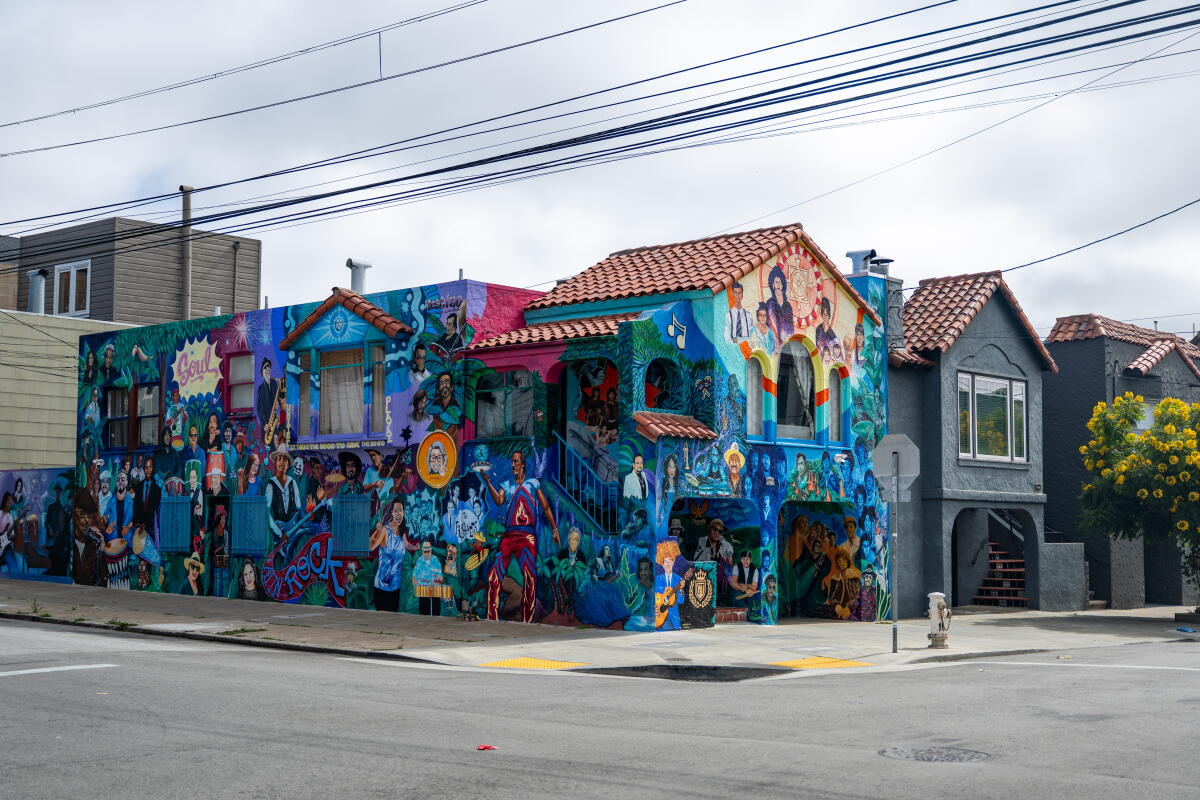
San Francisco’s Latin Rock House, a colorful home covered in murals celebrating Latino culture, music and activism, has officially been designated a historic landmark, protecting it from future alteration or demolition.
The house is impossible to miss. Its exterior is covered with vibrant murals depicting Latino artists, activists and musicians, while a spotted jaguar stretches across the garage door. Around one of its windows, a bold message reads: “It takes the hood to save the hood.”
Known as the Latin Rock House, the property has become a powerful symbol of the history and cultural identity of San Francisco’s Mission District, a neighborhood that has experienced decades of redevelopment and gentrification.
A home becomes a symbol of the Mission District
Last month, San Francisco lawmakers unanimously voted to designate the Latin Rock House as a historic landmark. The decision means future owners and developers cannot paint over, significantly alter or demolish the property without approval from the city.
For Richard Segovia, the 72-year-old owner of the house and a fifth-generation San Franciscan, the designation represents more than the preservation of a building.
“Now we can say this piece of the city is ours,” Segovia said, describing the landmark as a tribute to the community’s culture, music and people.
The house has served as a gathering place for jam sessions, musical creation, community celebrations and youth programs. At the same time, it remains a private residence where Segovia and his wife, Tammy, live.
The cultural history of the Mission
The Mission District is one of San Francisco’s oldest neighborhoods. Its history stretches back centuries, beginning with the Ohlone people and later the arrival of Spanish settlers in the 1700s.
Over generations, the area developed a strong Latino cultural identity, reflected in its music, murals, festivals, businesses and community organizations.
But the neighborhood has also undergone significant demographic and economic changes. Rising housing costs and redevelopment have contributed to the displacement of thousands of Latino residents.
Against that backdrop, the Latin Rock House has taken on a deeper meaning.
Preserving culture in a changing city
Unlike many of San Francisco’s better-known historic residences, the Latin Rock House isn’t celebrated for traditional architecture or a famous event that took place inside. Its significance comes largely from the culture represented on its walls and the community activities that have taken place there.
The designation places it among San Francisco’s hundreds of protected historic landmarks, alongside iconic sites such as the Golden Gate Bridge and Mission Dolores.
For Segovia, preserving the house means preserving a piece of the neighborhood’s identity.
“You see it from the outside and you think wow, such a beautiful painting,” he said. “But then you come inside and you spend some time and you realize all the culture and history that was built here.”
The Latin Rock House now stands not only as a work of public art, but as a lasting reminder that preserving a neighborhood’s history can also mean protecting the people, music and cultural traditions that shaped it.