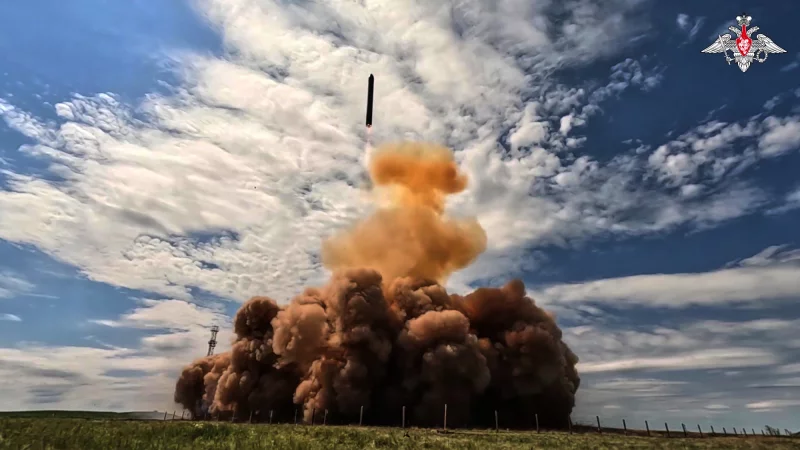
Russia intensified its focus on strategic military modernization this week after President Vladimir Putin praised the successful test launch of the country’s latest intercontinental ballistic missile, the Sarmat. This launch marks another major step in Moscow’s effort to strengthen its nuclear deterrence capabilities. At the same time, it signals continued geopolitical tension with Western powers.
The Russian leader described the missile as one of the most advanced weapons ever developed by the country. He confirmed it is expected to officially enter active military service before the end of the year. According to Kremlin officials, the missile is intended to replace aging Soviet-era systems. It will also become a key element of Russia’s long-term nuclear strategy.
The test comes at a time when the international security environment remains highly unstable. There are growing concerns surrounding arms competition, military alliances and the future of nuclear deterrence policies. Furthermore, discussions surrounding global defense strategies have increasingly focused on the modernization of strategic arsenals. This includes systems tracked by the International Atomic Energy Agency and other international institutions monitoring military developments.
Russia Accelerates Nuclear Modernization Plans
Putin stated that the Sarmat missile offers significantly enhanced precision, range and destructive capability compared with older generations of Russian ballistic weapons. Russian officials claim the missile can carry multiple independently targetable nuclear warheads and travel across enormous distances. In addition, it can evade missile defense systems.
The missile, known in Western military circles as “Satan II,” has been under development for more than a decade. Moscow considers the project a centerpiece of its strategic modernization campaign. Meanwhile, analysts believe the weapon is designed to reinforce Russia’s ability to maintain nuclear parity with the United States and NATO allies.
The launch also highlights the broader transformation of Russia’s defense industry. In recent years, the Kremlin has invested heavily in advanced military technologies. This includes hypersonic weapons, underwater nuclear drones and next-generation missile systems. Information related to global defense spending trends and strategic military programs is regularly monitored. It is tracked through organizations such as the North Atlantic Treaty Organization.
Russian officials argued that expanding missile defense programs in the West forced Moscow to pursue more sophisticated offensive capabilities. In addition, Putin has repeatedly stated that Russia’s strategic systems are intended to ensure balance and prevent any country from gaining overwhelming military superiority.
Global Concerns Over a New Arms Competition
The announcement arrives after the expiration of the last major nuclear arms agreement between Russia and the United States earlier this year. With no remaining treaty limits in place, international security experts have warned about the possibility of a renewed global arms race. This could involve the world’s largest nuclear powers.
Military analysts say the absence of formal restrictions could accelerate weapons development programs on multiple fronts. Several governments have already expanded investments in missile defense, nuclear submarines and long-range deterrence systems. Ongoing global security discussions have also been shaped by reports published by the United Nations regarding nuclear stability and international conflict prevention.
Putin used the latest missile test to reinforce Russia’s position as a dominant military power. He emphasized the country is capable of responding to any strategic threat. Moreover, he argued that maintaining a modernized nuclear arsenal is essential to preserving national security amid evolving geopolitical tensions.
The Kremlin has also emphasized the operational capabilities of other advanced systems currently being developed or deployed. These include the Avangard hypersonic glide vehicle and the Poseidon underwater drone. Both are designed to bypass traditional missile defense networks.
Ukraine War Continues to Shape Military Strategy
The missile test took place only days after Putin suggested that the conflict in Ukraine may be approaching a decisive stage. Despite those remarks, military operations and diplomatic tensions continue to influence defense policies across Europe and beyond.
Since the start of the war in 2022, Russia has repeatedly referenced its nuclear capabilities while warning Western nations against deeper military involvement in the conflict. At the same time, NATO members and allied governments have expanded military assistance programs. Moreover, they have reinforced regional defense cooperation.
Security experts believe Moscow’s continued emphasis on strategic weapons serves multiple purposes, including deterrence, domestic political messaging and international signaling. Defense policy researchers following developments through institutions such as the RAND Corporation note that nuclear modernization programs are increasingly central to global military planning. This is happening on all sides.
Putin insisted that Russia’s new missile systems are necessary to maintain strategic balance in what he described as a rapidly changing international environment. Additionally, Russian authorities maintain that advanced nuclear technology will remain a cornerstone of the country’s military doctrine for years to come.