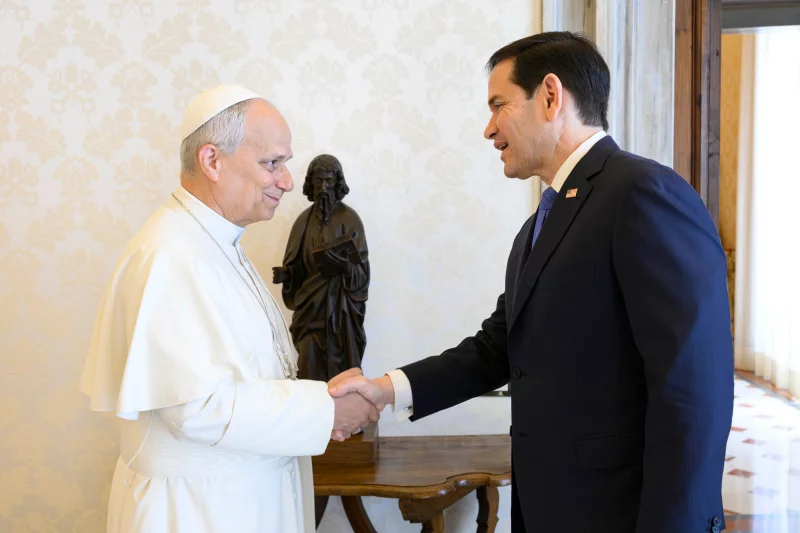
Diplomatic attention turned toward the Vatican this week as U.S. Secretary of State Marco Rubio traveled to Rome for high-level discussions with senior Catholic Church officials during a period of escalating political tension between President Donald Trump and Pope Leo XIV. The visit comes at a delicate moment for relations between Washington and the Holy See, with recent public disagreements exposing deep differences on immigration, international conflicts, and nuclear policy.
Rubio’s meetings at the Vatican lasted several hours and included conversations with Cardinal Pietro Parolin and other officials responsible for the Holy See’s diplomatic affairs. According to statements released after the talks, both sides emphasized their shared interest in promoting peace, protecting human dignity, and maintaining cooperation on humanitarian initiatives around the world.
Despite those diplomatic messages, the timing of the visit has fueled widespread speculation that the Trump administration is attempting to reduce friction with the pope following weeks of increasingly sharp exchanges between the two prominent American-born figures.
The relationship between Trump and Pope Leo XIV has become one of the most closely watched dynamics in global politics, particularly because both men command enormous influence far beyond the borders of the United States. Their disagreements have touched on sensitive international issues, including armed conflict in the Middle East, migration policies, religious freedom, and the global nuclear threat.
Rubio, who is one of the highest-ranking Catholic officials in the Trump administration, has emerged as a key figure in managing the diplomatic relationship with the Vatican while also defending the president’s foreign policy positions.
Vatican Diplomacy Focuses on Peace and Humanitarian Concerns
During the meetings, Vatican officials and American diplomats reportedly discussed humanitarian operations in Latin America, peace negotiations connected to Middle Eastern conflicts, and concerns surrounding escalating geopolitical instability. Both sides highlighted the importance of maintaining international dialogue during periods of rising global tension.
The Vatican has consistently advocated for ceasefires, humanitarian protections, and nuclear disarmament in recent years. Pope Leo XIV has repeatedly used public appearances and religious celebrations to call for diplomacy over military escalation, especially as international conflicts continue affecting civilian populations.
Rubio emphasized the longstanding relationship between the United States and the Holy See while recognizing the Vatican’s global diplomatic influence. The Holy See maintains relations with countries across every continent and frequently participates in international mediation efforts involving war zones, migration crises, and religious persecution.
Discussions also reportedly addressed the defense of <a href=”https://www.state.gov/”>religious freedom</a>, an issue that both the Vatican and the United States continue to prioritize in various international forums. Vatican diplomats have remained especially active in regions where Christian minorities face violence or discrimination.
Observers noted that the visit carried symbolic importance because Rubio himself is the son of immigrants and one of the most visible Catholic members of Trump’s cabinet. His presence at the Vatican signaled an effort to maintain institutional cooperation despite ideological disagreements between the pope and the White House.
The meetings occurred as European leaders and international organizations continue urging diplomatic solutions to several ongoing conflicts. Analysts say the Vatican’s moral authority still carries significant influence in global humanitarian discussions, even when its positions differ from those of major political powers.
Public Disagreements Between Trump and Pope Leo Intensify
The recent tensions between President Trump and Pope Leo XIV have unfolded publicly through speeches, interviews, and social media statements. The disagreements became especially visible after the pope criticized harsh immigration measures and voiced concern about escalating military rhetoric connected to Iran and the Middle East.
Trump responded forcefully in several public remarks, accusing the pope of taking positions that he argued weakened global security. The president specifically criticized Leo’s opposition to nuclear escalation policies and suggested that some Vatican statements underestimated the dangers posed by hostile governments.
Pope Leo defended the Church’s longstanding stance against nuclear weapons and reiterated that the mission of the Catholic Church is centered on peace, reconciliation, and protection of human life. Vatican officials also rejected suggestions that the pope was supporting hostile governments, arguing instead that the Church consistently advocates dialogue over armed confrontation.
The dispute intensified further after Leo condemned threats involving the destruction of entire civilizations during escalating tensions with Iran. Vatican observers described the pope’s language as unusually direct, reflecting growing concern inside the Church regarding international military escalation.
Political analysts say the clash reflects broader divisions between nationalist political movements and religious leaders who emphasize humanitarian priorities, refugee protections, and international cooperation. The Vatican has remained vocal about migrant treatment, particularly regarding border policies and asylum procedures.
Questions surrounding <a href=”https://www.un.org/”>global peace initiatives</a> and humanitarian diplomacy have therefore become central to the broader relationship between Washington and the Holy See. Both sides continue to cooperate on some international matters while openly disagreeing on others.
Rubio Attempts to Stabilize U.S.-Vatican Relations
Although Rubio publicly denied that the trip was intended to repair relations, many Vatican experts believe the meetings were carefully designed to reduce tensions and restore a more traditional diplomatic tone between the two institutions.
Church analysts noted that Vatican diplomacy historically favors quiet negotiations rather than prolonged public confrontation. Rubio’s visit was widely interpreted as an attempt to move discussions away from inflammatory political rhetoric and back toward institutional dialogue.
The secretary of state also acknowledged that the Vatican’s role extends beyond religion because the Holy See functions as an internationally recognized sovereign entity with diplomatic influence across more than 100 countries. That global presence gives the Vatican a unique position in international affairs, especially during humanitarian crises.
In recent years, Vatican officials have expanded engagement on issues including migration, poverty, armed conflict, and climate-related emergencies. International observers continue monitoring how the relationship between the White House and the papacy may shape future diplomatic conversations involving Europe, Latin America, and the Middle East.
Rubio’s meetings in Rome also took place as the Catholic Church continues expanding its humanitarian outreach through organizations involved in refugee assistance, conflict mediation, and aid distribution. Cooperation between the Vatican and international agencies remains active in multiple regions affected by war and displacement.
Analysts following <a href=”https://www.vatican.va/”>Holy See diplomacy</a> believe future interactions between Pope Leo XIV and President Trump could significantly influence debates surrounding migration policy, religious liberty, and global security priorities. Meanwhile, policymakers in Washington continue evaluating how religious institutions may shape international public opinion during periods of geopolitical instability.
The broader diplomatic implications are also being studied by experts connected to <a href=”https://www.cfr.org/”>international relations research</a>, particularly as tensions involving nuclear security and humanitarian crises continue reshaping global political alliances.