
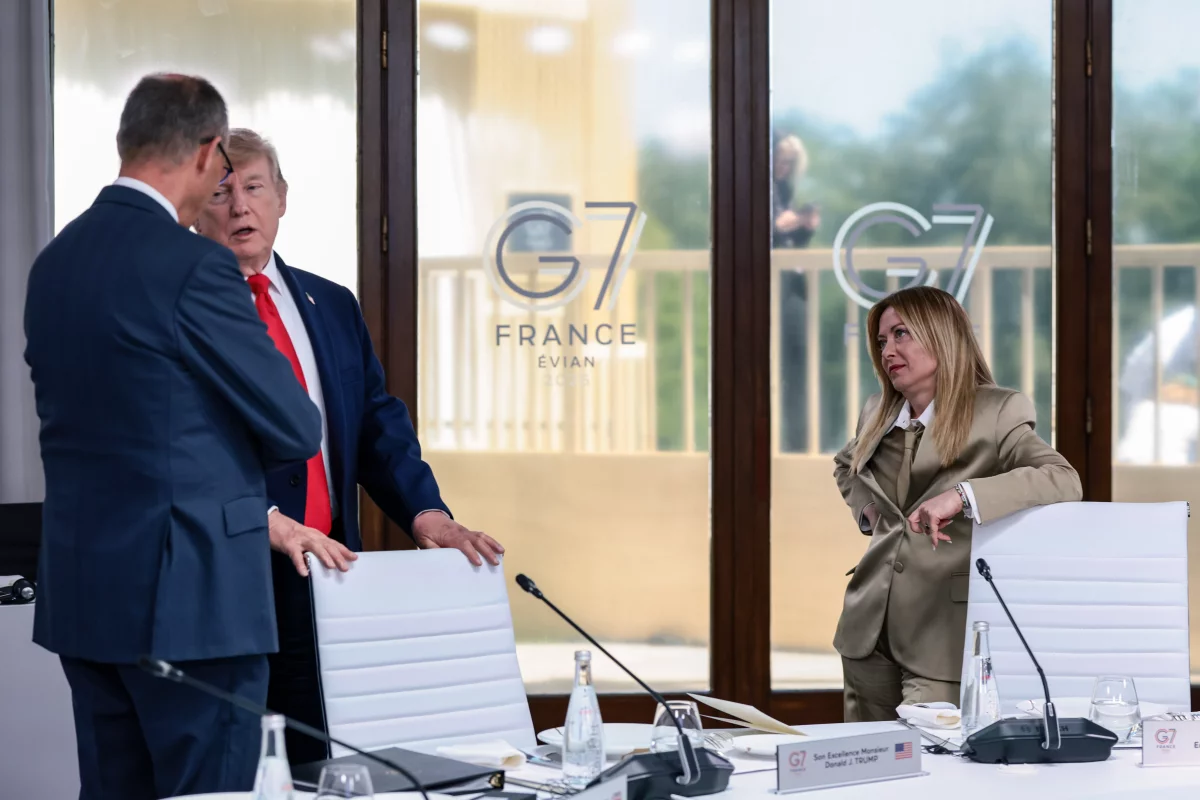
The Giorgia Meloni Trump dispute burst into public view after Italy’s prime minister strongly rejected remarks allegedly made by President Donald Trump regarding their interactions during the recent G7 summit. What had once been viewed as one of the closest political relationships between a European leader and Trump has now become the center of a diplomatic controversy attracting attention on both sides of the Atlantic.
Meloni publicly denied claims that she sought special attention from the US president during the summit, describing the reported remarks as entirely untrue. Her unusually direct response signaled a sharp departure from the cooperative relationship that had characterized much of their previous political engagement.
The dispute emerged shortly after leaders gathered at the G7 summit, an event organized through frameworks that can be reviewed at <a href=”https://www.g7italy.it/“>G7 Presidency Information</a>, where member nations coordinate discussions on global economic and security issues.
Political observers note that public disagreements between allied leaders are not uncommon, but the intensity of the response from Rome has raised questions about the future trajectory of relations between the two figures.
Giorgia Meloni Trump Dispute Marks a Shift in a Once-Close Alliance
For several years, Meloni was widely viewed as one of Trump’s most reliable political partners in Europe.
After becoming Italy’s first female prime minister in 2022, she developed a reputation among conservative leaders as a prominent voice on issues including migration, national sovereignty, and economic policy. That alignment often placed her closer to Trump than many other European leaders.
The relationship appeared particularly strong when Meloni was invited to attend Trump’s second presidential inauguration, a gesture interpreted by many analysts as evidence of mutual political respect.
Recent events, however, suggest that the relationship has become more complicated.
The latest disagreement centers on comments allegedly attributed to Trump following the G7 gathering in France. Meloni responded publicly, rejecting the characterization and expressing frustration over what she described as inaccurate statements.
Information regarding Italy’s government and official statements can be accessed through <a href=”https://www.governo.it/“>Government of Italy</a>, where communications from the prime minister’s office are regularly published.
The controversy quickly expanded beyond the original remarks, evolving into a broader discussion about political alliances, diplomatic respect, and the tone of international leadership.
Italian Political Leaders Unite Behind Meloni
One of the most striking developments has been the reaction inside Italy.
Political figures from across the ideological spectrum rallied behind the prime minister. Support came not only from coalition partners but also from opponents who have frequently criticized her domestic agenda.
Senior government officials described the reported remarks as offensive, while several political leaders argued that criticism directed at the prime minister was also directed at Italy itself.
The response highlighted a rare moment of political unity in a country often marked by intense partisan divisions. Even politicians who disagree sharply with Meloni on economic and social issues publicly defended her position in the dispute.
International diplomatic developments involving Italy and its foreign policy priorities are regularly documented through <a href=”https://www.esteri.it/en/“>Italian Ministry of Foreign Affairs</a>.
The strong domestic reaction suggests that the controversy has evolved beyond a disagreement between two leaders and become a matter of national political significance.
Broader Tensions Had Already Been Emerging Before the Latest Clash
While the current Giorgia Meloni Trump dispute has captured headlines, several observers note that signs of strain had already begun to emerge months earlier.
Differences became increasingly visible on foreign policy issues, particularly regarding international conflicts and responses from religious and political leaders. Public disagreements over diplomatic priorities created distance between two figures who had previously appeared closely aligned.
Analysts point out that international relationships often evolve as political circumstances change. Leaders who share common positions on some issues may diverge sharply on others, especially when domestic political considerations become more prominent.
The dispute also arrives during a period of heightened geopolitical uncertainty, when cooperation among Western allies remains a central topic in international diplomacy. Organizations focused on transatlantic relations and global policy discussions, including <a href=”https://www.nato.int/“>NATO</a>, continue to emphasize the importance of coordination among partner nations facing shared security and economic challenges.
For now, the public exchange has introduced a new level of tension into a relationship that was once regarded as one of the strongest links between Washington and a major European capital, leaving political observers closely watching how both leaders navigate the fallout in the weeks ahead.