
The Kennedy Center Trump’s name dispute is continuing in federal court after the performing arts complex said it will not attempt to add President Donald Trump’s name to its facade before September 8.
The latest development comes as the Kennedy Center faces a legal challenge from Rep. Joyce Beatty, D-Ohio, an ex-officio member of the center’s board. The dispute centers on the board’s decision to add Trump’s name to the building and rename portions of the complex.
Kennedy Center Board Outlines Plans for Trump’s Name
In a status report submitted to federal court, the Kennedy Center outlined its plans for new signage on the building.
The proposed wording would identify the facility as “The John F. Kennedy Memorial Center for the Performing Arts, Restored and Renovated by President Donald J. Trump, Endowed by the Trump Kennedy Center Fund.”
The final portion would only be added if the Trump Kennedy Center Fund reaches $100 million in donations.
The board is also seeking to rename the physical grounds surrounding the complex “President Donald J. Trump Plaza.”
However, the Kennedy Center stated that it will not attempt to install Trump’s name on the building’s facade before September 8, giving the federal court additional time to consider the ongoing legal dispute.
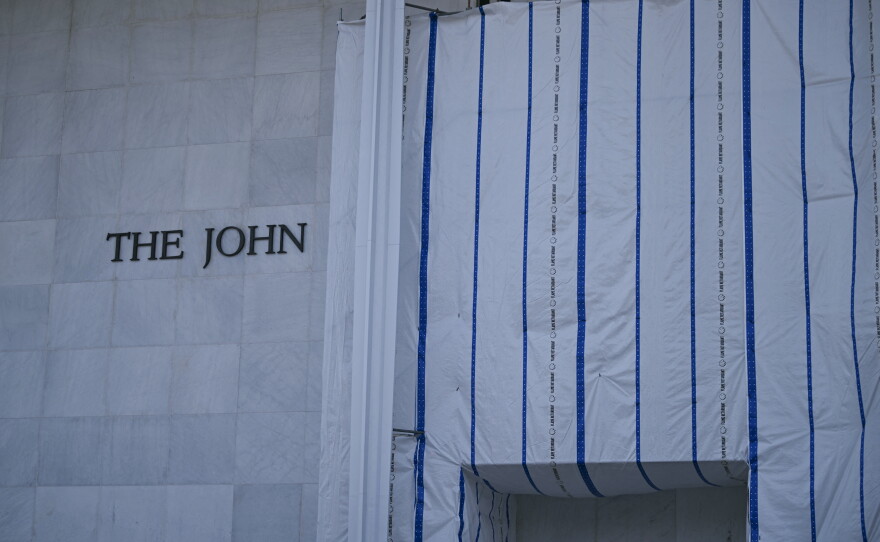
The center also defended the large tarp currently covering the facade’s signage, describing it as part of ongoing construction activities and saying it helps protect the building’s marble paneling during renovations.
Joyce Beatty’s Lawyers Challenge the Kennedy Center’s Plans
Beatty’s legal team is asking U.S. District Judge Christopher R. Cooper to issue a ruling before September 8.
Her attorneys argue that the board could attempt to implement all or part of its latest resolution as soon as that date arrives.
They also questioned whether the tarp is genuinely necessary for construction, arguing that the scaffolding and covering could instead be intended to conceal changes to the facade while the court considers whether the building should continue to serve exclusively as a memorial to President John F. Kennedy.
The legal dispute also involves concerns over the condition of the historic marble facade. Beatty’s lawyers have raised questions about whether previous efforts to attach Trump’s name to the building may already have caused damage.
Several elements of the most recent court filing remain under seal, including construction plans and a consultant’s report.
Kennedy Center Shutdown Plans Raise Additional Questions
The latest filings also reveal that the board was presented with two potential shutdown scenarios prepared by Delta Consulting Group, a Virginia-based consulting firm.
One proposal called for a complete shutdown of the Kennedy Center, while another envisioned a partial closure during the renovation.
Beatty’s attorneys have questioned the firm’s qualifications for the assignment, arguing that Delta Consulting Group does not have experience managing arts organizations.
The Kennedy Center’s renovation plans and the proposed shutdown have added another layer to an already complicated dispute involving the institution’s leadership, programming and future operations.
National Symphony Orchestra Announces a New Performance Strategy
The dispute comes as the National Symphony Orchestra (NSO) prepares for a challenging 2026-27 season.
The orchestra, one of the Kennedy Center’s principal resident organizations, announced plans to perform at six different venues throughout the Washington, D.C., region.
The change comes amid financial difficulties and a broader boycott involving artists and audiences following changes at the Kennedy Center.
Moving performances away from the center could create logistical and financial challenges for the orchestra, particularly because audiences may need to adjust their established routines.
At the same time, performances outside the Kennedy Center could provide an alternative for concertgoers who have chosen not to attend events at the complex during the current controversy.
The future of the Kennedy Center Trump’s name proposal now depends in part on the federal court proceedings, with September 8 emerging as a key date in the dispute over the institution’s facade and identity.