
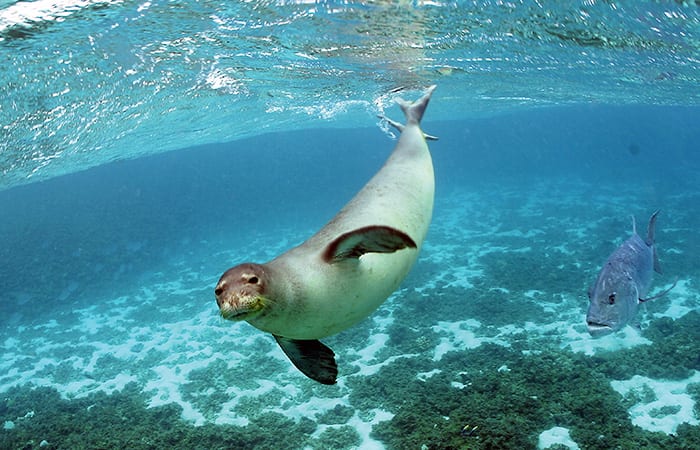
The Science Behind Seal Whiskers and Underwater Detection
Harbor seals possess a remarkable biological adaptation that allows them to thrive as efficient predators beneath the ocean surface. Their whiskers, known scientifically as vibrissae, are not simple facial hairs but highly specialized sensory tools capable of detecting minute changes in water movement. These whiskers enable seals to perceive hydrodynamic trails left behind by swimming fish, even when visibility is extremely low.
Unlike vision-dependent predators, harbor seals rely on these sensory hairs to interpret their surroundings. As fish move through the water, they create subtle disturbances similar to invisible trails. These trails persist for several seconds, allowing seals to track the direction, speed, and even size of their prey. Research has shown that seals can follow these trails with extraordinary precision, making them formidable hunters in environments where sight is limited.
For more on marine ecosystems and predator-prey dynamics, explore https://www.noaa.gov and https://oceanservice.noaa.gov
How Seals Decode Complex Water Movements
The hunting process becomes even more fascinating when prey attempt to escape. Certain fish, such as rainbow trout, use evasive swimming techniques that generate complex water patterns designed to confuse predators. By bending their bodies into curved shapes and rapidly changing direction, these fish create vortex rings—circular currents that move through the water in different directions.
These vortex rings act like misleading signals, potentially sending predators off course. However, harbor seals have demonstrated the ability to distinguish between these hydrodynamic cues. Studies involving trained seals show they can differentiate between subtle variations in vortex size and direction, allowing them to identify the correct path of escape.
This capability highlights an advanced level of sensory processing. The seal’s whiskers detect fine-scale differences in water pressure and flow, while the brain interprets this information to reconstruct the movement of prey. This combination of physical sensitivity and neural processing enables seals to overcome even sophisticated escape strategies.
To understand more about animal sensory systems, visit https://www.nationalgeographic.com and https://www.sciencedaily.com
Implications for Science and Technology
The discovery of how seals use their whiskers extends beyond marine biology and has significant implications for technology and environmental research. Scientists believe that understanding these natural sensing mechanisms could inspire the development of advanced underwater sensors for robotics. Such systems could be used in underwater exploration, archaeology, and environmental monitoring, especially in conditions where cameras and traditional sensors are ineffective.
Additionally, this research sheds light on how environmental changes might impact marine predators. Increased ocean turbulence, caused by extreme weather or human activity, could interfere with the hydrodynamic signals seals rely on. Disruptions in these signals may affect hunting efficiency and, ultimately, survival.
By studying how harbor seals interpret their environment through whisker-based sensing, researchers gain valuable insight into both biological adaptation and potential technological innovation. These findings demonstrate that even the smallest features in nature can hold the key to solving complex challenges in science and engineering.