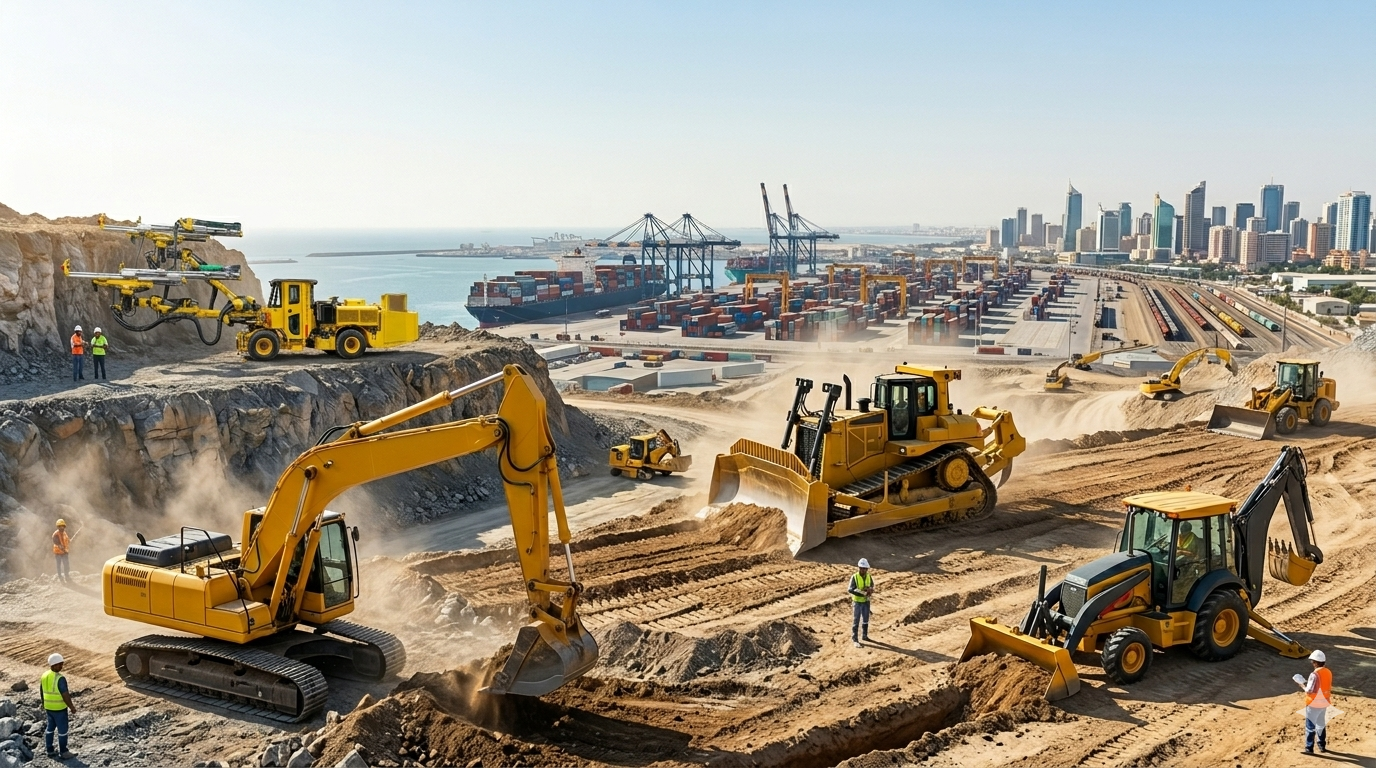
The global infrastructure sector is entering a new phase of accelerated investment, driven by public and private funding exceeding $1 trillion annually. This surge is reshaping the competitive landscape among major construction equipment manufacturers such as Caterpillar, John Deere, and emerging players like Rhino Equipment. As governments prioritize roads, energy systems, and urban expansion, these companies are positioning themselves at the center of a rapidly evolving global market.
Leadership Strategies Shaping the Infrastructure Race
At the forefront of this competition are industry leaders including Jim Umpleby, John May, and Javier Cárdenas. Each executive has adopted a distinct approach to capitalizing on infrastructure growth, yet their strategies increasingly intersect.
Umpleby has emphasized large-scale project partnerships and digital integration, aligning Caterpillar with government-backed infrastructure programs across North America and Asia. More on Caterpillar’s global strategy can be explored at https://www.caterpillar.com/en/company.html
Meanwhile, John May has positioned John Deere to expand beyond agriculture into construction and smart technology, leveraging automation and precision machinery to increase efficiency on major projects. Additional insights into their innovation approach are available at https://www.deere.com/en/our-company/
Cárdenas, leading Rhino Equipment, represents a newer wave of agile competitors. His focus has been on emerging markets in Latin America and Africa, where infrastructure demand is growing rapidly but requires adaptable and cost-efficient solutions. Rhino’s expansion strategy can be further understood at https://www.rhinoequipment.us
Technology and Sustainability Driving Market Evolution
The infrastructure boom is not solely about scale; it is increasingly defined by sustainability and technological advancement. Electric machinery, AI-driven fleet management, and low-emission construction processes are becoming industry standards.
Caterpillar has invested heavily in autonomous equipment and energy-efficient systems, while John Deere continues to integrate data analytics into its machinery to optimize performance. Rhino Equipment, on the other hand, has focused on modular and customizable equipment tailored to diverse project conditions, giving it a competitive edge in niche markets.
Industry-wide, companies are responding to regulatory pressures and investor expectations by committing billions of dollars toward green technologies. This shift is expected to influence procurement decisions on infrastructure projects worth over $500 billion in the next decade.
Global Expansion and Competitive Convergence
Despite their different origins and market positions, Caterpillar, John Deere, and Rhino Equipment are increasingly converging in their global ambitions. All three companies are expanding their footprints across high-growth regions, often competing for the same large-scale contracts.
This convergence has intensified competition not only in pricing but also in service offerings, financing solutions, and after-sales support. Strategic alliances with local contractors and governments are becoming critical differentiators.
For a broader understanding of global infrastructure trends shaping this competition, see https://www.worldbank.org/en/topic/infrastructure and https://www.oecd.org/infrastructure/
As infrastructure investment continues to rise, the interplay between these companies and their leadership will play a defining role in shaping the future of construction worldwide. Their ability to innovate, adapt, and collaborate will determine who leads in a market projected to surpass $15 trillion in value by 2030.