Federal Court Declines to Halt Trump’s Executive Order on Mail-In Voting Restrictions
A federal judge in Washington, D.C., has declined to temporarily block President Donald Trump’s executive order aimed at reshaping how mail-in voting is administered in federal elections. The ruling allows the controversial order to remain in place while multiple lawsuits challenging its legality continue moving through the courts.
The decision represents an important development in the ongoing national debate over election administration, presidential authority and voting access ahead of future federal elections. Critics argue the order could significantly alter voting by mail procedures across the country, while supporters say it is intended to strengthen election integrity and prevent unlawful voting.
The ruling was issued by U.S. District Judge Carl Nichols, who stated that the plaintiffs challenging the order had not yet demonstrated enough immediate harm to justify a preliminary injunction. However, the judge left open the possibility that future legal challenges could succeed if federal agencies implement specific measures tied to the executive order.
The case is one of several legal battles now unfolding in federal courts over the scope of presidential authority in election-related matters. Additional rulings connected to similar lawsuits are expected in the coming weeks.
Readers interested in election law and federal voting policies can explore U.S. Department of Justice, U.S. Election Assistance Commission, National Conference of State Legislatures and United States Postal Service for additional information on election administration and mail-in voting regulations.
Trump’s Executive Order Targets Mail-In Ballot Procedures
President Donald Trump signed the executive order on March 31 as part of a broader effort focused on election administration and voter eligibility verification. The order directs several federal agencies to coordinate with state election officials regarding voter information and mail-in ballot distribution.
One section of the order calls for the Department of Homeland Security and the Social Security Administration to create lists identifying adult U.S. citizens within each state. Those lists would then be shared with election officials responsible for voter registration and ballot management.
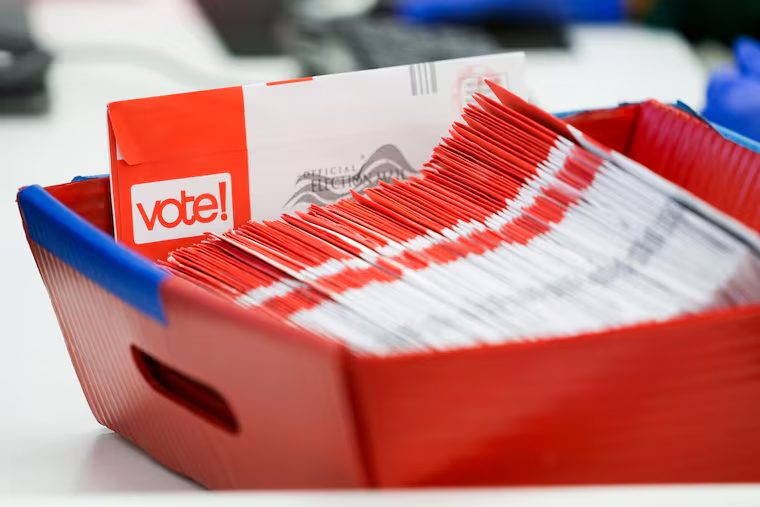
Another section instructs the United States Postal Service to develop procedures tied to voter eligibility verification before delivering mail-in ballots. Critics argue this portion of the order could dramatically alter the traditional role of USPS in election administration and potentially create new barriers for voters who rely on absentee voting.
The administration has stated that the order is intended to protect election integrity and prevent noncitizen voting in federal elections. Trump has repeatedly argued that stronger voter verification measures are necessary despite multiple studies and election reviews finding that cases of noncitizen voting remain extremely rare nationwide.
Mail-in voting expanded significantly during recent election cycles and has become an increasingly important voting method across the United States. While voters from both major political parties use absentee ballots, national surveys indicate Democratic voters have relied more heavily on mail-in voting in recent federal elections.
Legal experts say the executive order could ultimately test constitutional limits on presidential authority over elections, especially because the Constitution grants substantial election-related powers to Congress and state legislatures.
Lawsuits Argue the President Lacks Constitutional Authority
The executive order immediately triggered lawsuits from Democratic officials, voting rights organizations and numerous states challenging its legality in federal court.
Plaintiffs argue that Article I of the Constitution grants authority over federal election rules primarily to Congress and state governments rather than the executive branch. Legal filings also contend that the order improperly attempts to direct independent agencies and exceeds the president’s constitutional authority.
Several lawsuits specifically challenge the order’s provisions involving the United States Postal Service. Opponents argue that requiring USPS to determine voter eligibility or limit ballot delivery would go beyond the agency’s legally authorized responsibilities.
The plaintiffs additionally claim the order could create confusion among voters and election officials during ongoing election cycles, potentially affecting voter participation and ballot access in future federal contests.
Judge Nichols acknowledged in his ruling that future actions by federal agencies implementing the order could create more direct legal conflicts. However, he concluded that because many details of implementation remain undecided, immediate court intervention was not justified at this stage.
The ruling does not resolve the broader constitutional questions raised by the lawsuits. Instead, it primarily addresses whether the order should be temporarily blocked while litigation continues.
Legal scholars expect the cases to continue through appeals courts and potentially reach the Supreme Court if major constitutional questions regarding executive authority remain unresolved.
Election Policy Battles Intensify Ahead of Future Voting Cycles
The court battle surrounding Trump’s executive order reflects a broader national conflict over voting rules, election access and federal oversight of elections. Mail-in voting has remained one of the most politically divisive election issues in the United States since the 2020 presidential election.
Republican officials in several states have pushed for stricter voter identification laws, tighter absentee ballot regulations and expanded voter verification systems. Democrats and voting rights groups, meanwhile, argue that many of those measures disproportionately affect elderly voters, disabled voters and individuals with limited access to in-person polling places.
The ongoing lawsuits also highlight increasing tensions between federal and state authority over election administration. Historically, states have maintained broad control over voter registration systems, absentee voting procedures and election logistics.
At the same time, Congress and federal agencies have periodically introduced nationwide election standards related to civil rights protections, voting accessibility and election security.
The Trump administration has indicated that federal agencies are still determining how to fully implement the executive order. Officials from the Department of Justice have stated publicly that coordination among agencies is continuing as they evaluate next steps.
Meanwhile, separate lawsuits filed in Massachusetts are expected to produce additional rulings in the near future. Those decisions could shape whether portions of the executive order are eventually paused, modified or permanently blocked.
As legal challenges continue, the dispute is expected to remain central to national conversations about voting rights, executive power and the future of mail-in voting in the United States.