
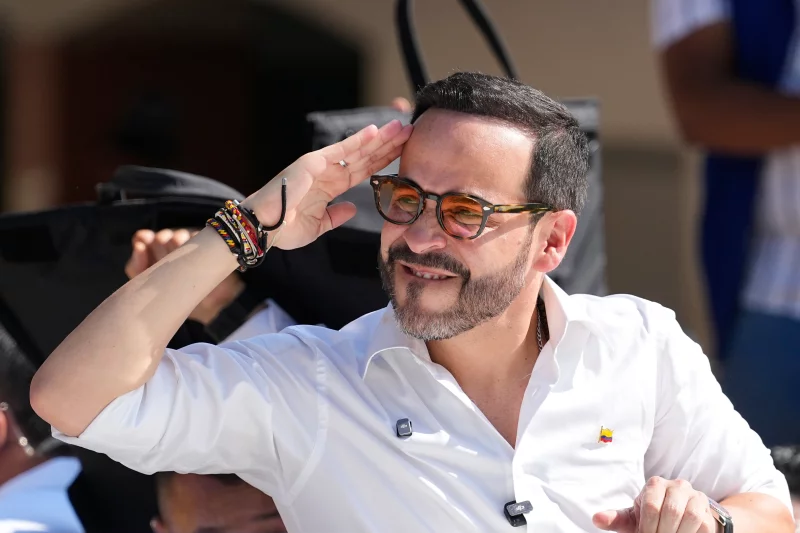
The Colombia presidential election is heading toward a decisive runoff. This comes after conservative outsider Aberaldo de la Espriella narrowly finished ahead of progressive candidate Iván Cepeda in a tense and highly polarized first round of voting. Because neither candidate secured an outright majority, Colombians will return to the polls in June to determine the country’s next president.
Preliminary results released by electoral authorities showed de la Espriella obtaining 44% of the vote compared with 41% for Cepeda after nearly all ballots had been counted. As a result, the outcome immediately intensified political tensions. Members of the current administration questioned the credibility of the vote-counting process without presenting public evidence of manipulation.
The runoff now sets the stage for one of the most consequential political confrontations in recent Colombian history. The country remains sharply divided. Some voters demand stronger military action against criminal organizations, while others support continued negotiations aimed at reducing decades of armed conflict.
Election procedures and voter information continue to be managed through https://www.registraduria.gov.co/
De la Espriella, widely known by supporters as “El Tigre,” rapidly gained political momentum during the final weeks of the campaign. He did this by promising aggressive security crackdowns against guerrilla groups, cartels, and organized criminal networks operating across rural Colombia.
Cepeda, meanwhile, campaigned on continuing many of the social and peace-oriented policies promoted by outgoing President Gustavo Petro. Petro’s administration pursued negotiations with multiple armed organizations under a strategy labeled “total peace.”
Colombia Presidential Election Reveals Deep Divide Over Security and Peace
The Colombia presidential election increasingly became a referendum on how the country should respond to resurging violence. This occurred nearly a decade after the historic peace agreement signed with the Revolutionary Armed Forces of Colombia, commonly known as FARC.
Although the agreement initially reduced conflict levels in several regions, armed groups have since regained influence in strategic territories tied to drug trafficking, illegal mining, and smuggling routes. Security concerns escalated dramatically during the election season. This followed multiple violent incidents targeting political figures and public events.
De la Espriella built his campaign around promises to restore order through expanded military operations, prison construction projects, and tougher anti-crime policies inspired by El Salvador’s controversial crackdown on gangs under President Nayib Bukele.
The conservative candidate also sought closer political alignment with U.S. President Donald Trump, portraying himself as a defender of traditional security policies and stronger law enforcement cooperation across the region. Diplomatic and regional policy updates involving Colombia and Latin America continue to be published through https://www.state.gov/
Political analysts believe de la Espriella could benefit significantly in the runoff by consolidating support from voters who backed eliminated conservative candidates during the first round. Moreover, that dynamic may create additional challenges for Cepeda despite his strong support among progressive and urban voters.
The ideological split reflects broader political shifts occurring across Latin America. Many voters are frustrated with insecurity and economic instability. As a result, they have increasingly supported candidates advocating harsher approaches toward organized crime.
Violence, Polarization and Economic Anxiety Shape Colombia’s Future
The Colombia presidential election unfolded amid growing public anxiety over violence, corruption, and economic uncertainty. Notably, rural communities have experienced increasing attacks involving armed groups, including drone strikes, extortion schemes, kidnappings, and territorial disputes between criminal organizations.
Many Colombians remain divided over whether negotiations with armed groups represent a realistic path toward peace or a strategy that unintentionally strengthens criminal organizations. This happens by allowing them additional time to expand operations.
Supporters of Cepeda argue that abandoning negotiations entirely could push Colombia back toward prolonged cycles of military confrontation. Historically, these confrontations produced massive humanitarian consequences. In addition, they also point to social reforms implemented during Petro’s administration, including increases to the minimum wage and investments in public services.
Economic indicators and development initiatives connected to Colombia’s public policy environment continue to be tracked through https://www.banrep.gov.co/en
At the same time, critics of Petro’s administration argue that armed organizations exploited ongoing negotiations to strengthen territorial control. Meanwhile, violence continued escalating in several departments across the country.
The election also highlighted concerns about democratic stability and institutional trust. Statements questioning the legitimacy of vote counting increased tensions following the release of preliminary results. Particularly, social media platforms saw intense political polarization.
International observers are expected to monitor the runoff closely as Colombia approaches one of its most uncertain political transitions in years. Additionally, regional governance and electoral monitoring information continues to be available through https://www.oas.org/en/