
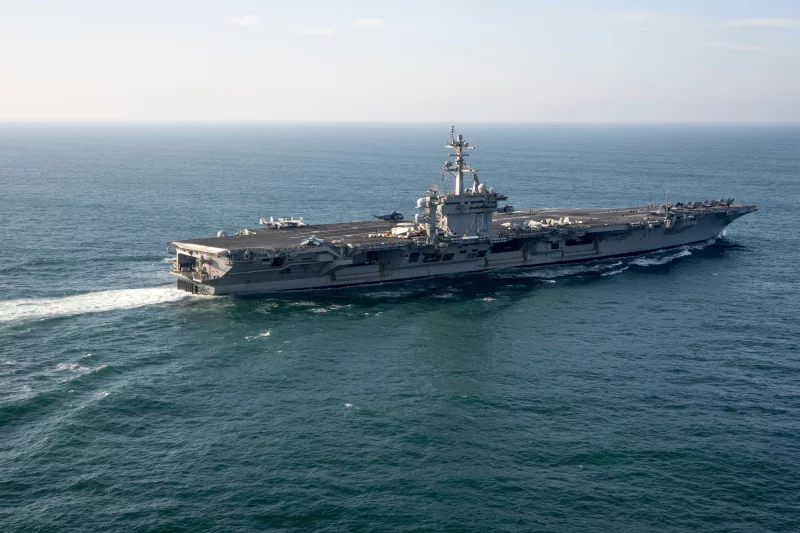
The USS George Washington is heading toward the Middle East as the USS Abraham Lincoln approaches the end of an unusually long deployment. This puts fresh attention on the strain facing U.S. sailors and the Navy’s ability to sustain operations around Iran.
The Lincoln has spent more than 260 days at sea while supporting U.S. military operations. Reports have raised concerns about supplies, morale and mental health aboard the carrier. Defense Secretary Pete Hegseth has rejected the most serious descriptions of conditions aboard the ship, calling them “completely misrepresented.”
The timing of the Washington’s movement is significant. The carrier left Da Nang, Vietnam, last week and is now moving west through Southeast Asia toward the Indian Ocean. The U.S. Navy had previously identified the George Washington as its forward-deployed carrier in the Indo-Pacific.
The deployment also highlights a difficult trade-off. Moving a carrier from the Pacific to the Middle East strengthens U.S. naval power near Iran. However, it temporarily reduces the carrier presence available in a region where China remains the central strategic concern.
USS George Washington moves toward the Middle East
The USS George Washington left Da Nang after a scheduled port visit with its carrier strike group. The Navy confirmed that the carrier arrived in Vietnam on July 30 with the USS Robert Smalls cruiser. In addition, the USS Shoup destroyer was present.
Its movement through the Singapore Strait and Strait of Malacca puts the carrier on a route toward the Indian Ocean. Ultimately, it heads toward the Middle East.
The Washington is expected to relieve the USS Abraham Lincoln. However, officials have described the carrier rotation as part of a broader deployment plan rather than simply an emergency response to the controversy surrounding the Lincoln.
That distinction matters.
The Lincoln left San Diego in November 2025 and reached the Middle East in January. This was before the U.S. war with Iran began in February. What was expected to be a normal deployment was extended as the conflict continued.
The carrier has now spent more than 260 consecutive days at sea. U.S. Central Command says the strike group has completed more than 10,000 aircraft flights. Moreover, it expended 1.5 million pounds of ordnance during the deployment.
The length of the mission has created a second problem beyond combat operations: keeping the ship, its equipment and its crew functioning under conditions that were never intended to continue indefinitely.
The U.S. Navy’s account of the George Washington’s Vietnam visit described the carrier as the Navy’s forward-deployed aircraft carrier in the Indo-Pacific. Its movement toward the Middle East therefore carries implications well beyond the relief of one ship.
For the Lincoln’s sailors, however, getting home is the immediate issue.
Lawmakers demand answers over conditions aboard the Lincoln
Democratic lawmakers have called for greater scrutiny of the Lincoln’s prolonged deployment.
Sen. Richard Blumenthal of Connecticut, a member of the Senate Armed Services Committee, has asked Navy leadership for answers about the length of the mission. Additionally, he wants to know about the conditions faced by the crew.
Sen. Ruben Gallego of Arizona, a Marine Corps veteran, has also said he wants to organize a bipartisan congressional visit to the ship.
The concerns include reports of shortages involving food and personal supplies, problems with plumbing and questions about the mental health of sailors. These issues have surfaced after months without a normal port call.
The Navy has disputed several of the claims.
In a statement, the service said it had not observed an increase in suicidal ideation or suicide attempts aboard the carrier. Officials have declined to release specific mental-health figures. They cite privacy and operational-security concerns.
A sailor did go overboard in early August and was recovered quickly, according to a U.S. official. The sailor received medical treatment and was later transferred off the ship for additional care. Officials have not publicly characterized the incident as a suicide attempt.
That leaves a difficult gap between what families and lawmakers say they are hearing and what the Pentagon says it can confirm.
Hegseth has defended the Navy’s support for the Lincoln’s crew. He has also said he wants the sailors brought home and the crew rotated as quickly as possible.
The Pentagon’s position is that the demands of wartime deployments should not be confused with evidence that the Navy has abandoned the sailors aboard the ship.
The latest Pentagon response to the Lincoln controversy shows how sharply the two sides disagree over the severity of the situation.
The Navy has also acknowledged that combat operations disrupted traditional supply routes. The service said food and hygiene supplies were prioritized over mail when access to normal logistics hubs became difficult.
That may explain some of the shortages without resolving the larger question. Specifically, how long can a carrier crew maintain an intense operational tempo before fatigue begins affecting readiness?
The issue is not unique to the Lincoln.
The USS Gerald R. Ford returned home in May after an 11-month deployment, the longest U.S. carrier deployment since the Vietnam War. It also supported operations connected to the Iran conflict and encountered mechanical problems during its mission.
The USS Harry S. Truman previously faced an extended deployment while operating against Houthi forces in the Red Sea and surrounding waters.
Those examples suggest the Navy is dealing with a broader problem rather than a single troubled ship.
The carrier rotation exposes a wider strain on U.S. naval power
The arrival of the George Washington may relieve pressure on the Lincoln. However, it does not make the underlying strategic problem disappear.
Aircraft carriers are among the most valuable and complex assets in the U.S. military. Keeping one deployed for months requires a huge supporting network of aircraft, ships, maintenance crews, fuel, ammunition and personnel.
When a conflict lasts longer than expected, that system has to absorb the extra demand.
The Middle East is now competing directly with the Indo-Pacific for naval resources. Sending the George Washington west creates a temporary gap in the Pacific carrier presence. This happens at a time when Washington continues to regard China as its main long-term military competitor.
At the same time, the U.S. has continued its pressure campaign against Iran, including a naval blockade affecting Iranian ports and shipping routes around the Strait of Hormuz.
That creates a straightforward strategic dilemma. The Navy needs enough forces in the Middle East to sustain pressure on Iran. At the same time, it also needs enough forces in the Pacific to maintain deterrence against China.
There is no easy way to solve that problem simply by moving ships around.
A carrier can replace another carrier. It cannot replace the time needed for maintenance, training and crew recovery.
The Navy’s own material on the Abraham Lincoln illustrates how much preparation and specialized equipment are required to keep a carrier crew ready for emergencies at sea.
That readiness becomes harder to maintain when deployments stretch far beyond their original schedules.
The George Washington’s movement therefore offers an immediate solution for one ship while exposing a larger question for the Navy. How many extended deployments can the fleet sustain at the same time?
For the sailors aboard the Lincoln, the answer is more personal. After months at sea and a mission that has repeatedly been extended, the promised rotation is no longer just a matter of fleet planning.
It is the difference between continuing the deployment and finally going home.
The U.S. Central Command website provides the military command’s public information on operations in its area of responsibility. This includes the broader campaign that has kept the Lincoln strike group deployed.