
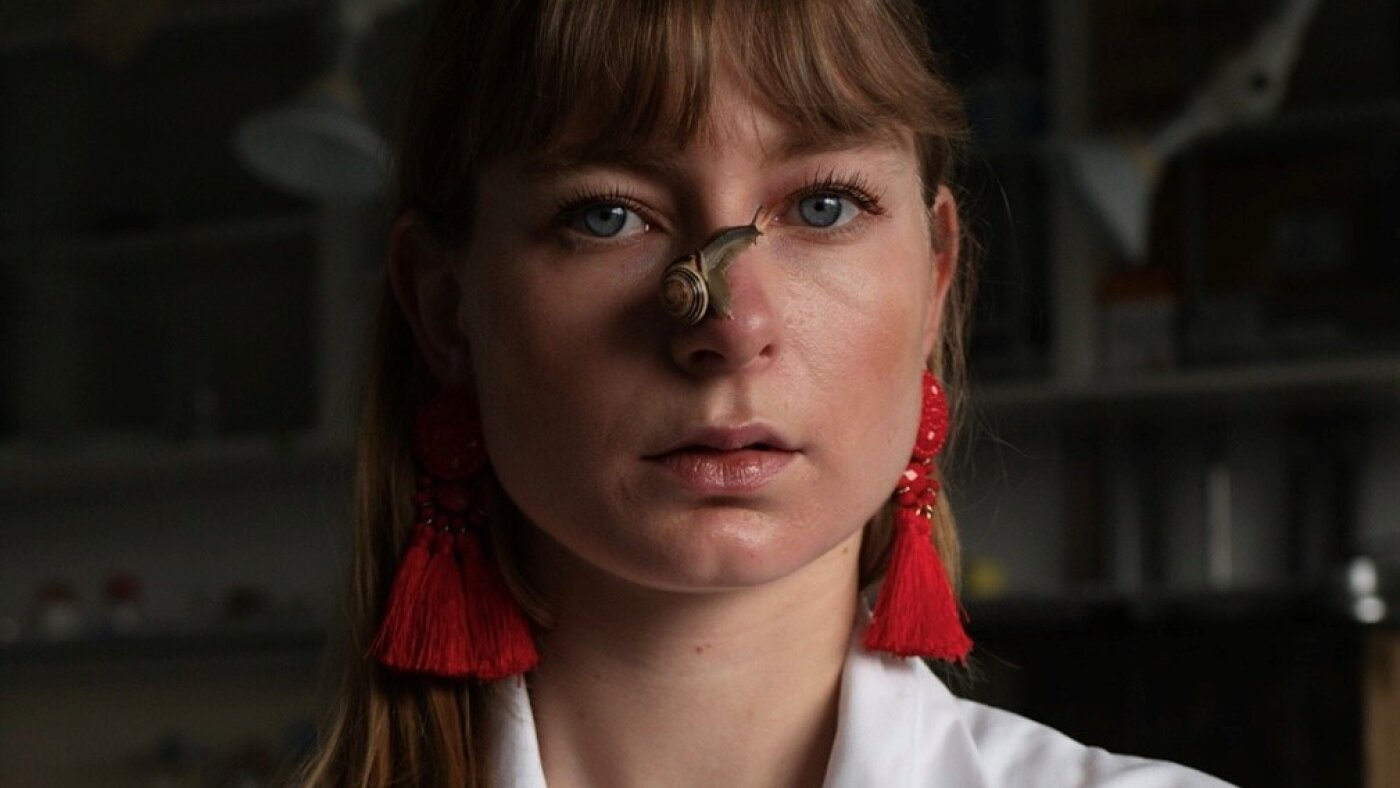
Snails may move slowly, but their slime is surprisingly sophisticated.
Scientists have discovered that the brown-lipped snail, Cepaea nemoralis, can produce five different types of mucus, each with distinct physical properties and specific biological functions.
The discovery could eventually inspire new materials for medicine, drug delivery, wound treatment and other technologies.
Snail Slime Is More Complex Than It Looks
Slime is common throughout the animal kingdom. Hagfish can rapidly release enormous quantities of mucus when threatened, while some marine worms produce specialized mucus for protection.
But terrestrial snails have developed an especially versatile system.
Mariella Gabler, a physical chemistry researcher at Germany’s Max Planck Institute of Colloids and Interfaces, describes snail mucus as an exceptionally complex natural material.
Her research team wanted to understand how Cepaea nemoralis, commonly known as the brown-lipped snail, changes its mucus depending on what it needs.
Their findings, published in the journal Science, show that the animals can modify the relative amounts of proteins and ions in their mucus, effectively creating different materials from the same basic ingredients.
Five Types of Snail Mucus
The researchers identified five distinct types of mucus produced by the snails.
1. Lubricating Mucus
Snails need to move across surfaces without damaging their soft bodies.
Their locomotion mucus performs two seemingly contradictory jobs: it helps the animal stick to a surface while also reducing friction.
This allows the snail to glide across wet and uneven surfaces while maintaining enough traction to move forward.
2. Defensive Mucus
When threatened, the brown-lipped snail can produce defensive mucus with different properties.
One variety forms a foam that can help remove small pests from the animal’s body. Another becomes highly adhesive and can immobilize potential threats.
The ability to switch between these materials gives the snail multiple ways to respond to danger.
3. Protective Mucus
The snails also produce a specialized mucus for periods when they remain inside their shells.
This material helps protect the animal during winter and creates a physical barrier against the outside environment.
Researchers found that this mucus contains tiny calcite crystals, which contribute to its hardness and brittleness.
4. Adhesive Mucus
Another variety functions as a powerful natural adhesive.
It allows the snails to attach themselves to surfaces ranging from wood to glass and aluminum.
The ability to create a strong bond while remaining biologically compatible makes this type of mucus particularly interesting to materials scientists.
How Can One Snail Make So Many Materials?
The researchers discovered that the five mucus varieties contain many of the same basic proteins.
The difference comes largely from their relative concentrations.
The snails can also alter the amounts of calcium and other ions incorporated into the mucus, as well as how the material is secreted.
These subtle changes produce dramatically different physical properties.
Higher levels of collagen and calcium, for example, can make the mucus stiffer, more cohesive and more adhesive.
In effect, the snail has developed a tiny biological materials laboratory capable of producing different substances when needed.
Scientists See Potential Medical Applications
The discovery could have applications far beyond snail biology.
Materials scientist Kausik Mukhopadhyay of the University of Central Florida, who was not involved in the research, points to possibilities including cancer research, cosmetics and drug delivery.
The lubricant mucus could potentially inspire coatings that reduce friction in medical devices such as catheters.
Meanwhile, the adhesive properties of snail mucus could help researchers develop new materials for closing or sealing wounds.
Scientists are particularly interested because the snail produces these different materials naturally from a relatively small set of basic components.
Snail Slime Could Inspire Future Biomaterials
The research demonstrates how much engineering potential can be found in biological systems.
Instead of creating an entirely new material for every application, engineers could potentially learn from the snail’s strategy: modify the proportions and organization of a few basic ingredients to produce different results.
That approach could eventually lead to new bio-inspired materials designed for specific medical or industrial applications.
The researchers still have much to learn about how snails control their mucus at the molecular level.
But their work highlights an important lesson in biomaterials science: nature can solve complex engineering problems using surprisingly simple ingredients.
For an animal that spends much of its life crawling slowly across surfaces, the brown-lipped snail has developed an remarkably sophisticated material-production system.
Its slime may look simple, but scientists are discovering that it is anything but.