LAUSD Introduces New Restrictions on Classroom Screen Use
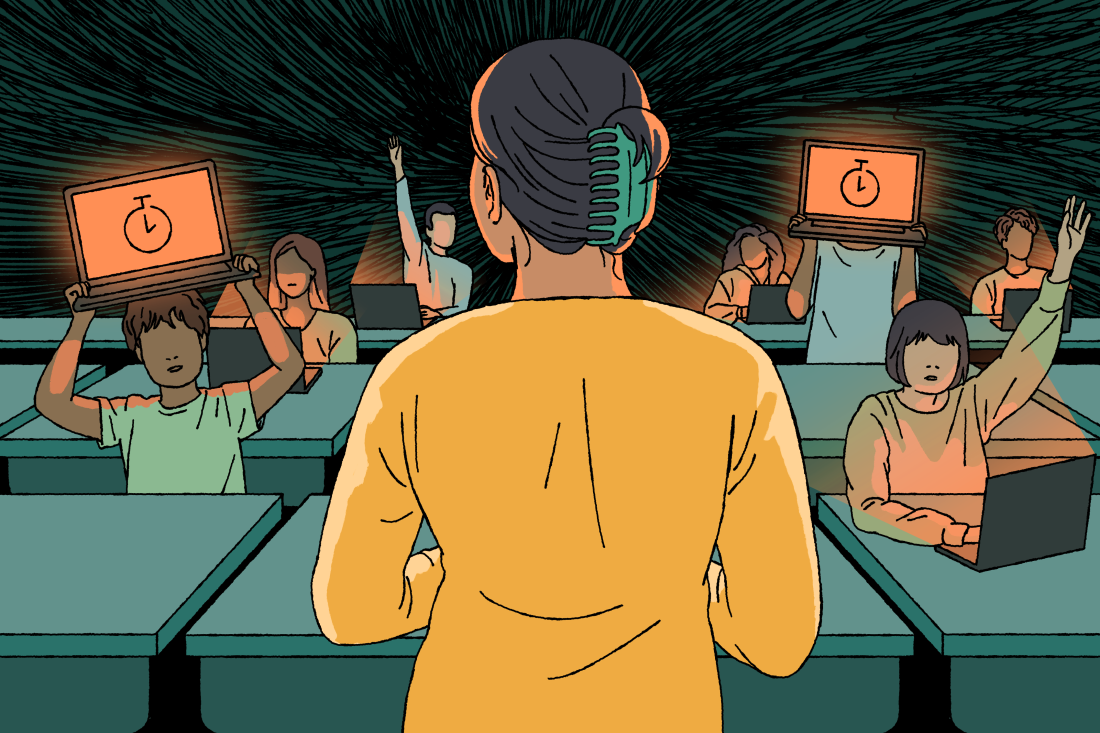
As the new school year begins in Los Angeles, teachers and students are facing a major change: significantly less screen time in classrooms.
The Los Angeles Unified School District (LAUSD), the nation’s second-largest school district, is introducing new limits on the use of digital devices for students across more than 400,000 learners.
The policy represents a significant shift for a school system that only a few years ago was considered a national leader in bringing technology into classrooms.
For teachers such as Armaghan Khan, the transition could be particularly challenging.
“This is going to be a big impact for me,” said Khan, a science teacher at Johnnie L. Cochran Middle School. He estimates that approximately 75% of his classroom work previously involved some type of screen-based activity.
How LAUSD’s New Screen Time Policy Works
The restrictions are being introduced in phases throughout the school year.
Beginning this week, students in first grade and younger will have no screen time during school. Later in the fall, restrictions will expand to other elementary grades, followed by middle and high school students.
Some educational uses will remain exempt, including virtual textbooks.
Students will also have software installed on their school devices that tracks their weekly screen usage. However, the technology will not automatically shut down a device once a student reaches the permitted limit.
Instead, the district plans to collect the data and analyze it at the end of the school year.
Officials hope the information will help determine whether the policy is working and identify adjustments that may be necessary.
Teachers Say the Transition Is Difficult
For some teachers, the biggest challenge is not necessarily the concept of limiting screen use but the speed at which the policy is being implemented.
Khan says technology has become an important part of his science classroom because it allows students to conduct simulations and experiments that would otherwise be difficult to provide.
For example, students can use laptops to simulate car crashes and explore concepts such as Newtonian forces.
Without those digital tools, teachers may need alternative resources that are not always available.
“We have a lab space, but we do not have a lab budget,” Khan explained.
He also expressed frustration about the lack of detailed guidance surrounding the new restrictions.
“I don’t feel like I’m being set up for success,” he said.
LAUSD Calls This a Transition Year
Pia Sadaqatmal, LAUSD’s chief academic officer, acknowledges that implementing a policy across such a large district will not be simple.
The district serves more than 400,000 students, making the scale of the initiative unusually large.
“There is no perfect solution on how to roll out to a school district the size of ours,” Sadaqatmal said.
She has encouraged teachers to view the 2026-27 academic year as a transition period in which the district will learn what works and what needs to change.
The data collected from students’ devices is expected to play an important role in that process.
Teachers Wonder What Will Replace Screen Time
Reducing screen use creates another challenge: deciding what students should do instead.
Kirti Baranwal, a teacher librarian at William Jefferson Clinton Middle School, generally supports screen time restrictions but says educators need practical alternatives.
The district previously implemented a ban on student cellphones. Baranwal subsequently taught students about screen addiction and asked them to track their daily device use.
Some students reported spending eight or even ten hours a day on screens.
That raises a broader question for educators: If students are spending less time on digital devices at school, what meaningful activities will take their place?
The Challenge Goes Beyond the Classroom
The debate over screen time is not limited to schools.
For children who do not have access to organized sports, arts programs or other extracurricular activities, digital devices can occupy a significant portion of their free time.
Simply removing screens without providing alternative opportunities could therefore create another problem.
Baranwal believes reducing excessive screen use is important, but she also wants educators to focus on what students should be doing instead.
“We know that we don’t want students on phones,” she said. “But then, what is it that we want kids doing?”
A New Direction for Digital Learning
LAUSD’s new screen time rules reflect a broader national debate over how much technology belongs in schools.
Across the United States, school districts and state governments are increasingly reconsidering the role of phones, tablets and computers in education.
The challenge for Los Angeles will be finding the right balance.
Technology can provide access to simulations, digital textbooks, research tools and educational resources that traditional classrooms cannot always offer. At the same time, excessive screen use can compete with hands-on learning, social interaction and other forms of student development.
For LAUSD, the coming school year will serve as a large-scale experiment.
The district now has to determine whether limiting screen time can improve the classroom experience — and, perhaps more importantly, how schools can replace digital activities with learning experiences that are equally engaging and effective.