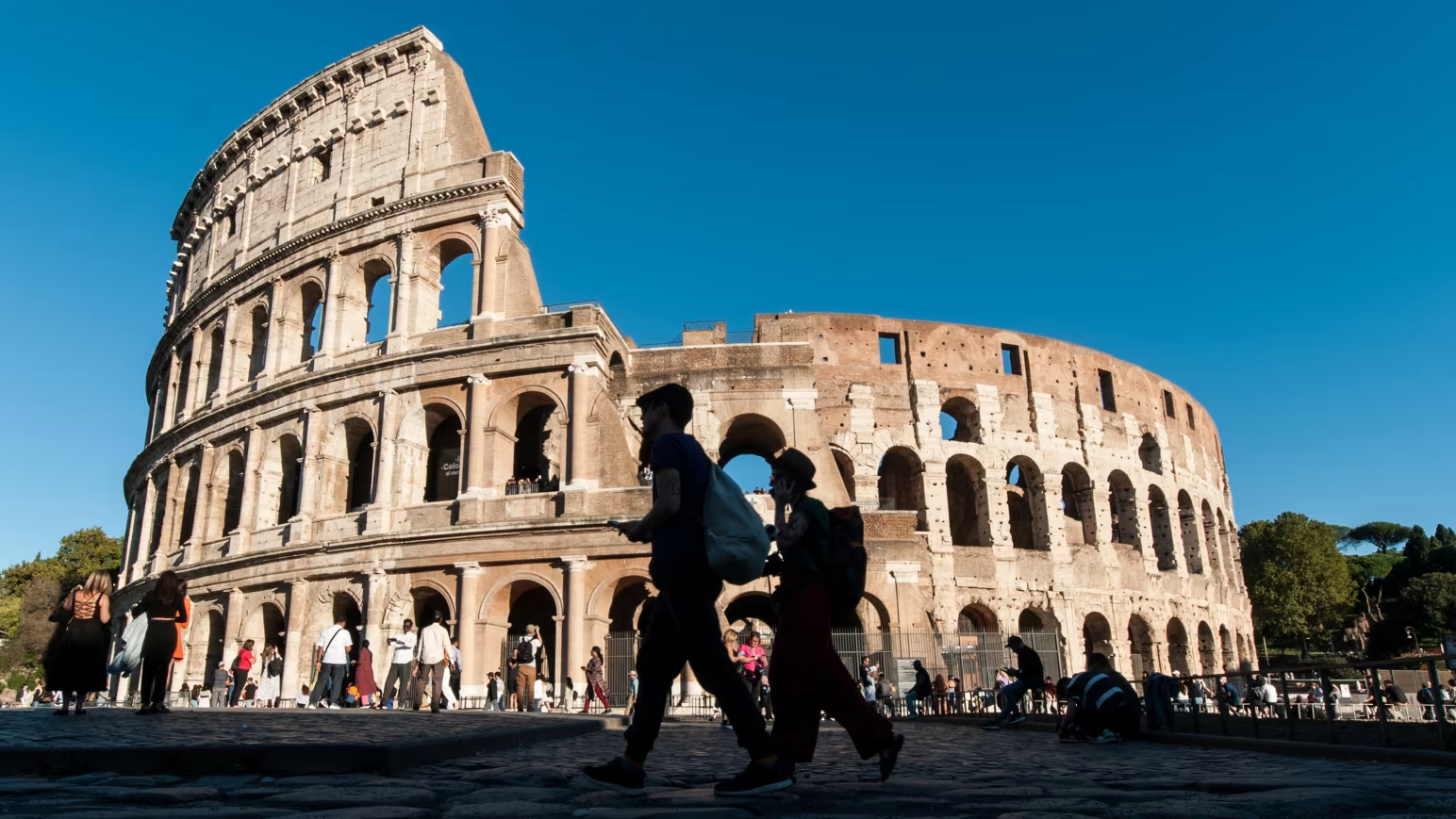
Rome has designated the area surrounding the Colosseum as a security “red zone” following a series of violent incidents and concerns about street crime in one of the Italian capital’s busiest tourist districts. The measure took effect August 24 and will remain in place for four months, extending through December 24.
The new security zone covers the Colosseum, the Imperial Forums and Colle Oppio. Authorities say the decision responds to persistent problems involving predatory crime, drug dealing and urban disorder. As a result, additional security personnel are assigned to protect residents and visitors.
The move comes during a period when Rome has been intensifying security operations in several high-traffic areas. The city has also maintained or expanded security measures around Termini station and other major tourist and religious destinations. The Rome Prefecture lists the August 24 “enhanced protection zones” ordinance among its current public-order measures. Rome Prefecture security measures
Why the Colosseum became a security “red zone”
The decision followed a particularly serious incident on July 1, when a group of about 50 people became involved in an unauthorized gathering near the Colosseum. According to the prefectural order, local police officers were surrounded and two sustained minor injuries.
The incident became one of the clearest examples of the security problems authorities say have affected the historic center during the summer. In addition, police operations have focused on other forms of street crime, including theft and drug-related activity.
Rome Prefect Lamberto Giannini said the area continues to face problems associated with predatory crime and drug dealing. The official order describes the existing security measures as insufficient to address what it characterizes as a serious public-security emergency.
The measure gives security officers broader powers to remove certain people from the designated area. Rather than simply increasing patrols, the red-zone system allows authorities to use exclusion measures against individuals whose behavior is considered a threat to public safety.
The Colosseum is one of the most heavily visited landmarks in Italy. Therefore, security around its entrances, surrounding archaeological areas and nearby transportation is particularly important. The decision also illustrates the tension created when large tourist flows overlap with ordinary urban activity.
Authorities have linked part of the recent change in the area’s dynamics to the opening of the new Roma Colosseo station on Metro Line C. The station opened in December 2025. It provides a new connection between the historic center and eastern parts of Rome.
The official framework for Rome’s enhanced-protection zones is based on Italian public-security legislation that permits authorities to restrict access or order individuals to leave designated areas under specific circumstances. Italy’s public-security legislation
Extra police and military presence around major tourist sites
The Colosseum is not the only major attraction receiving additional security. Authorities have also increased measures around Termini railway station, St. Peter’s Basilica and the Basilica of Santa Maria Maggiore.
The additional deployment includes local police operating around the clock, alongside military personnel already assigned to protect important tourist locations. Soldiers have previously been stationed at strategic sites using vehicles, barriers and temporary checkpoints.
Termini has been a particular focus of security operations. In August, authorities conducted an interagency operation in the area surrounding the station, involving police, financial investigators, social services and municipal workers. The operation followed reports of street crime in the district.
The expansion of enhanced-protection zones reflects a broader effort to address security concerns in central Rome. Instead of concentrating resources exclusively around the Colosseum, the city takes a wider approach.
The timing is significant because Rome has continued to attract large numbers of visitors. During August, Italian authorities also experimented with extended evening opening hours at the Colosseum and other major monuments. This created additional opportunities for tourists to visit after sunset. Rome’s extended monument opening program
For visitors, the security measures do not mean that the Colosseum itself is closed or that tourism has been suspended. Instead, the red zone increases police powers and surveillance in the surrounding public spaces.
The practical impact for tourists is likely to be most noticeable through a heavier security presence, additional patrols and greater scrutiny around areas where large crowds gather.
Rome will assess the impact through Christmas Eve
The new Colosseum security zone is scheduled to remain in effect until December 24. That gives authorities several months to assess whether the stronger measures reduce street crime and disorder in the area.
The approach also expands an existing security strategy already being used elsewhere in Rome. The Esquilino and San Lorenzo areas, including the surroundings of Termini station, have seen their enhanced-protection measures confirmed and expanded. In contrast, a previous red zone covering Valle Aurelia-Cornelia has been revoked.
The policy is therefore part of a wider reorganization of security priorities across the capital. Authorities are concentrating resources on locations where large crowds, transportation hubs, nightlife and tourist activity overlap.
The Colosseum presents an especially visible test for the strategy because of its international profile. Millions of visitors pass through the surrounding archaeological area. Meanwhile, the streets and public spaces remain part of the everyday life of Rome.
The security challenge also extends beyond violent incidents. Pickpocketing and other forms of opportunistic theft can affect visitors even when police are heavily present. However, tourists have reported seeing theft occur in busy areas despite existing security measures. This underscores the difficulty of preventing crimes that can happen quickly in crowded environments.
Rome’s prefecture has continued publishing new public-order measures and interagency operations as authorities increase attention on areas associated with tourism, nightlife and transportation. Prefecture of Rome public-order updates
The effectiveness of the Colosseum red zone is expected to become clearer as authorities review crime and security data over the coming months. The measure is currently scheduled to remain in force through Christmas Eve.