
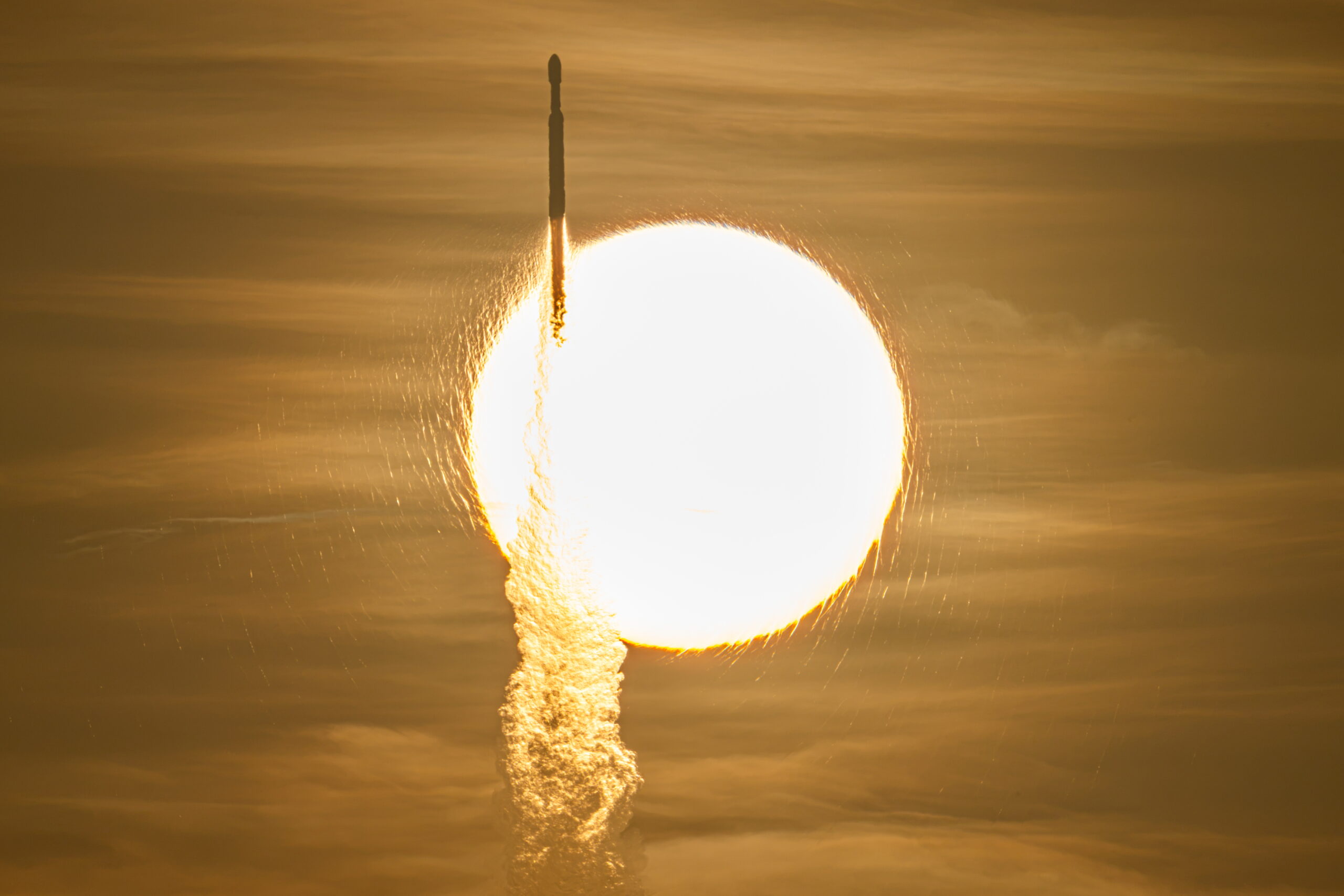
The Nancy Grace Roman Space Telescope will investigate dark matter, dark energy and some of the biggest mysteries in modern astronomy
NASA’s newest space telescope has left Earth and begun its journey into space. This marks a major milestone in the agency’s effort to better understand some of the universe’s greatest mysteries.
The Nancy Grace Roman Space Telescope launched Sunday morning from NASA’s Kennedy Space Center in Florida aboard a SpaceX Falcon Heavy rocket. The spacecraft lifted off at 7:26 a.m. ET. It is beginning a journey of roughly one million miles to its destination in space.
“What a glorious dawn launch,” said Jackie Townsend, Roman’s project manager at NASA, shortly after liftoff. She described the launch as magnificent and said the spacecraft had been placed exactly where mission controllers wanted it.
Shortly after reaching space, Roman successfully began deploying its solar panels and other equipment. NASA reported that ground controllers at the Goddard Space Flight Center were receiving telemetry. Moreover, the spacecraft’s systems appeared to be operating normally.
A telescope designed to transform our view of the universe
The Roman Space Telescope is roughly the size of a tour bus and weighs approximately 18,000 pounds. Once operational, it will give astronomers a powerful new tool for studying the structure and evolution of the cosmos.
One of its most important missions will be investigating dark energy and dark matter. These are two of the biggest unanswered questions in astronomy.
Although scientists know that dark matter plays a major role in holding galaxies and larger cosmic structures together, its exact nature remains unknown. Meanwhile, dark energy is associated with the accelerating expansion of the universe.
By surveying enormous areas of the sky, Roman could provide scientists with new evidence. This evidence may reveal how these mysterious components have shaped the universe.
A telescope with an enormous field of view
Roman combines image quality comparable to the Hubble Space Telescope with a dramatically larger field of view.
NASA says Roman will be capable of viewing areas of the sky at least 100 times larger than Hubble can capture in a single image. That capability will allow astronomers to survey vast regions of the universe much more efficiently.
Instead of focusing on relatively small sections of the sky, Roman will be able to map enormous cosmic landscapes. This will help researchers identify distant galaxies, stars and other astronomical phenomena.
The telescope is also expected to help scientists study exploding stars known as supernovas. It will investigate the history of cosmic expansion and search for clues about planets beyond our solar system.
From spy telescope to scientific observatory
Roman’s origins are unusual.
The spacecraft was initially designed as a potential reconnaissance telescope for the U.S. National Reconnaissance Office before being transferred to NASA. It was eventually transformed into a major scientific mission.
The telescope was named after Nancy Grace Roman, NASA’s first chief astronomer and one of the key figures responsible for making the Hubble Space Telescope a reality.
Roman became known as the “Mother of Hubble” because of her role in championing the space telescope. She also helped establish NASA’s major space-based astronomy program.
Her legacy now continues through an observatory designed to expand humanity’s ability to see and understand the cosmos.
A new era for space astronomy
The successful launch represents only the beginning of Roman’s mission. After completing its journey and preparing its instruments, the telescope will begin an ambitious scientific program. This program could reshape scientists’ understanding of the universe.
With its combination of a wide field of view, advanced instruments and enormous survey capabilities, Roman is expected to complement existing observatories rather than replace them.
For astronomers, the promise is enormous: billions of years of cosmic history could soon be examined in unprecedented detail.
The journey has begun, and NASA’s newest space telescope could soon give humanity an entirely new perspective on the universe.