
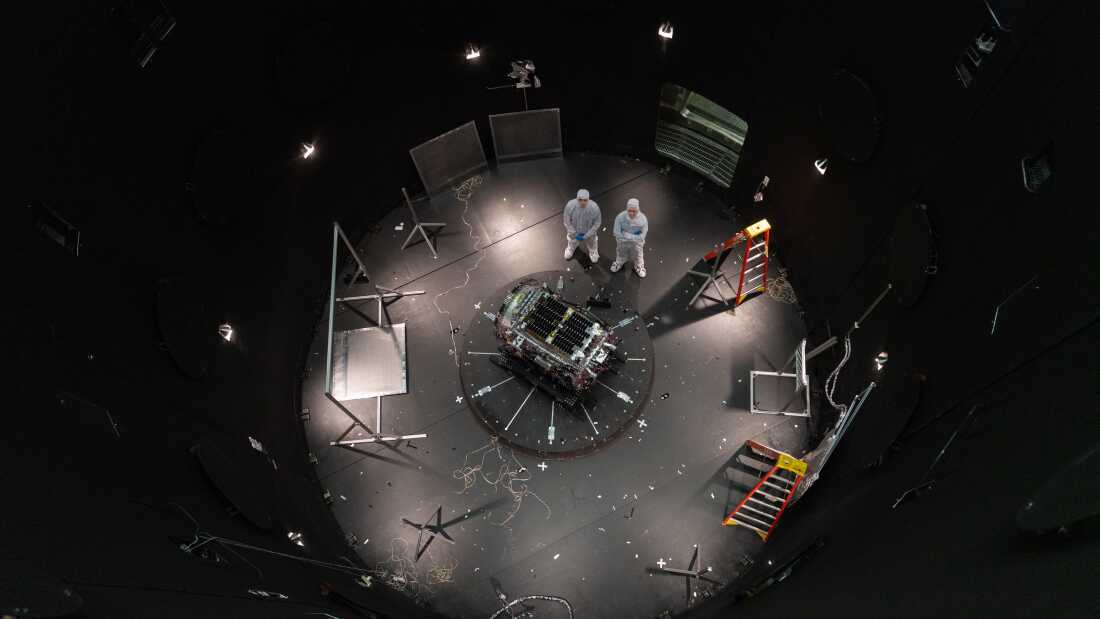
The NASA Swift Observatory is at the center of an ambitious orbital rescue mission as engineers work to prevent one of the agency’s most valuable space observatories from falling back toward Earth sooner than expected. The spacecraft, formally known as the Neil Gehrels Swift Observatory, has spent years helping scientists investigate some of the universe’s most energetic and short-lived cosmic events.
To preserve the observatory and demonstrate a new generation of satellite servicing technology, NASA has partnered with a private aerospace company to launch an autonomous robotic spacecraft designed to rendezvous with Swift and raise its orbit. If successful, the mission could represent a significant milestone in the future of spacecraft maintenance and orbital sustainability.
Swift Observatory Plays a Critical Role in Space Research
Since its launch, the Neil Gehrels Swift Observatory has been one of NASA’s fastest-response space telescopes. Unlike many astronomical observatories that continuously survey fixed regions of the sky, Swift can rapidly reposition itself to observe unexpected cosmic events almost immediately after they are detected.
The spacecraft has contributed to major discoveries involving gamma-ray bursts, supernovae, neutron stars, black holes, and other high-energy astronomical phenomena. Its ability to react quickly allows scientists to capture valuable data during the earliest moments of these short-lived events, providing insights into some of the universe’s most extreme physical processes.
Maintaining the observatory in orbit would allow researchers to continue benefiting from its unique scientific capabilities while avoiding the cost and time required to develop and launch a replacement mission.
Robotic Spacecraft Could Pioneer Satellite Servicing
To extend Swift’s operational life, NASA is testing an innovative orbital servicing concept using a robotic spacecraft known as Link. Roughly the size of a household refrigerator, the autonomous vehicle is designed to meet the observatory in low Earth orbit and perform an orbital boost that raises the satellite to a more stable altitude.
Rather than replacing the spacecraft, the servicing mission focuses on preserving an existing scientific asset through in-space maintenance. If the demonstration succeeds, similar technology could eventually be used to extend the lifespan of satellites supporting scientific research, communications, navigation, and Earth observation.
The mission also represents a growing collaboration between NASA and the commercial space industry as both sectors pursue technologies capable of making future space operations more efficient and sustainable.
Future Missions Could Transform Satellite Operations
Orbital servicing has long been considered one of the next major advances in space exploration. Instead of allowing functional satellites to become obsolete after orbital decay or fuel depletion, future servicing spacecraft may be capable of refueling, repairing, upgrading, or repositioning valuable assets already operating in space.
Such capabilities could significantly reduce mission costs, decrease orbital debris, and improve the long-term sustainability of space operations. As governments and private companies launch increasing numbers of satellites, technologies that prolong spacecraft lifespans are expected to become increasingly important for maintaining critical infrastructure in orbit.
The Swift rescue mission therefore serves not only as an effort to preserve an important scientific observatory but also as a test of technologies that may redefine how satellites are managed throughout their operational lives. Success could open the door to a new era in which spacecraft receive routine maintenance rather than being retired once their original missions conclude.