
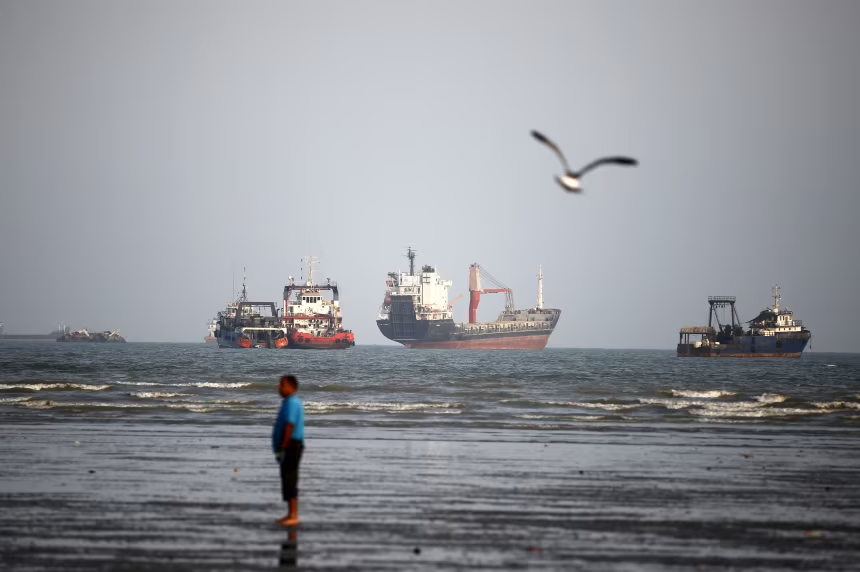
An Iranian commercial vessel was struck in the Strait of Hormuz, killing one person and injuring several others, according to Iranian state media, as the United States and Iran continue their confrontation over the strategic waterway. The incident near Qeshm Island adds another threat to commercial shipping in a passage already experiencing a severe collapse in maritime traffic.
Iranian state-run media said the vessel was hit near Qeshm and that one person was killed. Reports differed on the number of injured, with some Iranian accounts initially citing three wounded and others reporting four. The Associated Press also reported that Iranian state media blamed a “terrorist enemy” for the attack, while the United States had not immediately accepted responsibility.
The incident occurred as Iran-backed Houthi forces in Yemen expanded their activity around another critical maritime chokepoint, the Bab el-Mandeb Strait. That parallel development has increased concerns about the security of commercial shipping on both sides of the Arabian Peninsula.
The Strait of Hormuz is particularly important to global energy markets because it connects the Persian Gulf with the Gulf of Oman and the wider Arabian Sea. Before the war, roughly 20 million barrels of oil passed through the waterway each day. Traffic has since fallen dramatically, leaving energy traders and governments watching each new maritime incident for signs of a broader disruption.
Recent shipping data showed only a small fraction of normal vessel movements through the strait, reflecting the risks facing commercial operators. Reuters reported that traffic over the weekend was well below the 10-day average, while oil flows remained under severe pressure.
The attack near Qeshm therefore carries significance beyond the individual vessel. It highlights the continuing difficulty of maintaining safe commercial navigation through a waterway that has become a central theater of the wider conflict.
Iranian vessel attack adds to Strait of Hormuz tensions
The reported strike occurred near Qeshm Island, a strategically important Iranian territory located close to Bandar Abbas and the eastern entrance to the Strait of Hormuz.
Iranian officials said the vessel was struck around the waters near Qeshm and Hengam islands. Qeshm Governor Amir Teymouri blamed what Iranian state television described as a “terrorist enemy,” but the reports did not initially establish independent evidence identifying the attacker.
The United States had previously targeted Iranian-flagged vessels as part of its effort to enforce a blockade of Iranian ports. At the same time, American forces have faced the threat of Iranian ballistic missiles directed toward U.S. warships.
That combination has made commercial shipping increasingly difficult to separate from the broader military confrontation. Merchant vessels operating through the strait must navigate an environment in which military activity, maritime restrictions and threats to shipping overlap.
The situation has also produced conflicting accounts surrounding individual incidents.
One of the most closely watched cases involves the MT El Gaia, a Panama-flagged vessel carrying 14 Indian crew members. India’s Ministry of External Affairs said the vessel was attacked off the Omani coast and that 13 of the 14 Indian crew members had been rescued, while search-and-rescue operations continued for the missing crew member.
Iranian military officials later said the vessel struck a sea mine while transiting the Strait of Hormuz. The U.S. military rejected that explanation and said the vessel had instead been struck by an Iranian drone. The competing claims have not been independently reconciled.
The continuing uncertainty illustrates the wider problem facing shipping companies in the region. Operators must assess not only physical hazards such as projectiles and mines, but also conflicting information about what caused an incident and which parties may be responsible.
The International Maritime Organization has previously warned of the severe navigational risks created by the conflict, including mines and degraded maritime conditions. Its evacuation planning has also addressed thousands of seafarers stranded in the Gulf region.
A second vessel is hit as regional shipping risks spread
A separate maritime incident was reported around the same period in the Strait of Hormuz.
The United Kingdom Maritime Trade Operations center said it received information that a vessel was struck by an unknown projectile while transiting the strait. A fire subsequently broke out aboard the vessel, and local authorities assisted with evacuating crew members.
UKMTO did not immediately identify the vessel’s flag or provide details about who was responsible. It advised vessels operating in the area to proceed with caution and report suspicious activity while authorities investigate.
The second incident is significant because it demonstrates that the threat is not limited to Iranian-flagged ships. Commercial vessels using the waterway face a broader security environment in which the identity of the attacker and the nature of the threat may remain unclear.
The distinction between the two reported incidents also remains important. Iranian authorities described a deadly strike near Qeshm, while UKMTO separately reported an unidentified projectile hitting another vessel. It was not immediately established that the two reports involved the same ship or the same attack.
For international shipping companies, repeated incidents can have consequences even when individual attacks cause limited physical damage. Operators may delay voyages, reroute vessels or keep ships outside dangerous waters when the risks become difficult to assess.
The maritime disruption is already visible in traffic figures. Before the conflict, the Strait of Hormuz handled around 125 vessel transits a day and carried roughly one-fifth of global crude oil and liquefied natural gas supplies. Recent traffic has fallen far below those levels.
That reduction matters for energy markets because the strait remains one of the world’s most important pathways for crude oil and other petroleum products. When vessels cannot move normally, exporters must depend more heavily on alternative routes, storage and other logistical arrangements.
The pressure extends beyond Hormuz. In the Red Sea region, Iran-backed Houthi forces have increased their activity around the Bab el-Mandeb Strait, another strategically important maritime passage. Reuters reported that Houthi advances and additional attacks have compounded concerns about regional energy flows.
The combination of threats in Hormuz and the Red Sea creates a wider security problem for commercial shipping. Rather than facing a single isolated chokepoint, operators are confronting risks across multiple routes connecting Gulf energy producers with international markets.
Why the Strait of Hormuz matters to global oil markets
The Strait of Hormuz has long been one of the world’s most consequential energy chokepoints because of the volume of oil and gas that normally passes through it.
Its importance becomes especially clear during periods of conflict. Even when some exports continue, a sharp reduction in vessel traffic can tighten global markets because buyers and sellers must find alternative ways to move supplies.
The current disruption has already contributed to heightened oil-market volatility. Brent crude recently moved above $100 a barrel as traders assessed the impact of continuing attacks, reduced shipping and disruptions elsewhere in the region.
Alternative routes can reduce some of the pressure, but they cannot immediately reproduce the capacity and geographic advantages of Hormuz. Gulf producers have increasingly relied on pipelines, different ports and other logistical arrangements, while some shipments have continued through the strait under unusually high security risks.
Saudi Arabia’s East-West pipeline has become particularly important because it can move oil toward the Red Sea without requiring every barrel to pass through Hormuz. Yet even alternative infrastructure has proved vulnerable during the conflict. A recent attack temporarily halted the pipeline, adding another layer of uncertainty to global energy flows.
That vulnerability means the consequences of maritime attacks can extend well beyond the vessels directly involved. Oil producers, refiners, shipping companies and governments must all account for the possibility that disruptions could persist or spread to alternative routes.
For consumers, prolonged pressure on energy transportation can eventually translate into higher costs for fuels and other goods. The effect depends on the duration of the disruption, the amount of oil that remains available through alternative routes and how quickly shipping activity can recover.
The latest attack therefore comes at a particularly sensitive moment. Commercial traffic through the Strait of Hormuz remains deeply depressed, another vessel has reportedly been struck by an unidentified projectile, and security concerns are simultaneously growing around the Bab el-Mandeb Strait.
The combination leaves the world’s energy markets exposed to further disruption as military forces, commercial operators and governments continue to navigate an increasingly dangerous regional maritime environment.
<a href=”https://www.apnews.com/article/aa034da0d8226f5a3b4794b10afb8b3b” target=”_blank” rel=”noopener noreferrer”>Associated Press coverage of the Hormuz vessel attack</a>
<a href=”https://www.reuters.com/business/energy/new-report-attack-strait-hormuz-shipping-fans-fears-threats-oil-supplies-2026-09-13/” target=”_blank” rel=”noopener noreferrer”>Reuters analysis of regional shipping risks</a>
<a href=”https://www.imo.org/en/MediaCentre/HotTopics/Pages/Strait-of-Hormuz.aspx” target=”_blank” rel=”noopener noreferrer”>International Maritime Organization maritime information</a>
<a href=”https://www.ukmto.org/” target=”_blank” rel=”noopener noreferrer”>UK Maritime Trade Operations</a>