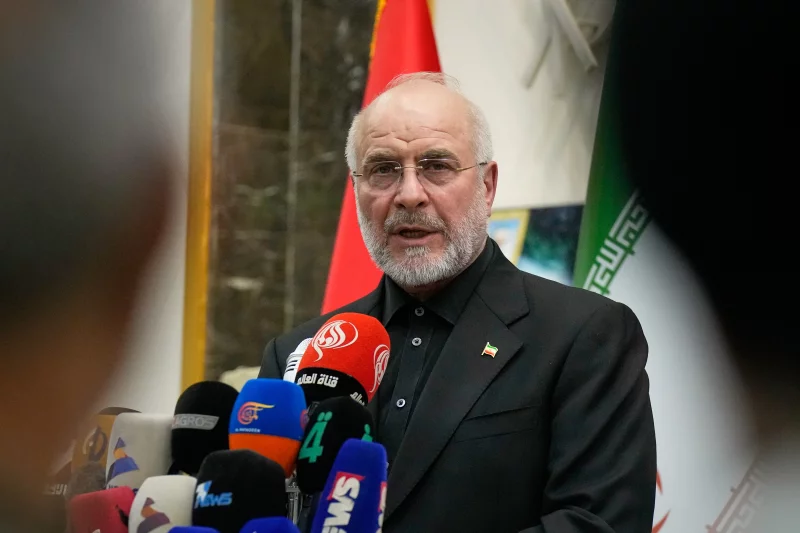
Iran economic warfare has become the latest focus of the confrontation between Washington and Tehran, with senior Iranian officials arguing that President Donald Trump’s threats demonstrate that the United States has been unable to achieve its objectives through military pressure. Iran’s parliamentary speaker, Mohammad Baqer Qalibaf, said Friday that Washington and Israel had shifted toward economic and “cognitive” warfare because they could not prevail in a conventional military conflict.
Qalibaf made the comments during a visit to neighboring Iraq, where he described Trump’s threat of an “economic D-Day” as evidence of a change in U.S. strategy. He argued that years of sanctions had failed to force Iran to abandon its position and that a new escalation of economic pressure would produce the same result.
The comments came as Washington prepares to expand its campaign against Iran’s economy. Treasury Secretary Scott Bessent has warned that the United States intends to impose unprecedented economic isolation on Tehran and has indicated that the pressure could extend beyond Iranian companies to foreign governments, financial institutions and businesses that continue conducting transactions with Iran.
The U.S. Treasury has already expanded sanctions enforcement this year, including measures targeting Iranian oil revenue, procurement networks and financial channels. In August, the department announced another action against networks that it said enabled Iran to move hundreds of millions of dollars through its shadow banking system. U.S. Treasury sanctions enforcement against Iran shows the breadth of the campaign now being pursued by Washington.
The dispute is unfolding while diplomatic efforts to revive negotiations have stalled. The 60-day memorandum of understanding referenced in the original account expired without producing an agreement to end the conflict, leaving economic pressure and control of strategic trade routes at the center of the confrontation.
Iran Says Economic Pressure Cannot Force a Political Surrender
Qalibaf’s comments reflect Tehran’s broader argument that sanctions have become a long-term feature of the Iranian economy rather than a temporary pressure mechanism capable of forcing a political capitulation.
Iranian Foreign Minister Abbas Araghchi has similarly rejected Trump’s economic strategy, describing it as “economic terrorism” and arguing that intensifying sanctions would deepen anti-American sentiment rather than produce concessions from Tehran.
The Iranian position is that economic restrictions have already been used extensively against the country. Tehran has developed mechanisms to maintain trade and access to foreign currency despite restrictions, although the U.S. government argues that its sanctions campaign has imposed significant costs on Iran and continues to disrupt revenue channels.
Washington’s position is substantially different. The Treasury Department has repeatedly described its campaign as an effort to deprive the Iranian government and its military of financial resources. In June, U.S. officials announced sanctions against individuals and entities involved in procurement networks connected to Iran’s military, including actors based in China and Hong Kong. Treasury’s Economic Fury sanctions campaign illustrates how Washington has expanded the economic campaign beyond direct restrictions on Iranian institutions.
The dispute therefore involves more than another round of conventional sanctions. The Trump administration is signaling that it wants to increase the cost for foreign companies and governments that continue providing Iran with financial or commercial access to the international economy.
Trump has warned that countries allowing their financial institutions, businesses, airports or government entities to provide what he describes as a “lifeline” to Iran could face severe economic consequences. Bessent has separately described the planned pressure as potentially the largest coordinated economic isolation campaign ever attempted.
That approach places the issue of secondary sanctions at the center of the next phase. Unlike measures directed exclusively at Iranian entities, secondary sanctions can threaten foreign organizations that maintain business relationships with Tehran.
For Iran, that creates a difficult economic environment. For Washington, however, enforcing such measures against major trading partners could create a separate diplomatic challenge.
The question is particularly important in China’s case.
China Faces Pressure as Washington Targets Iran’s Oil Trade
China has emerged as a critical factor in the U.S. strategy because it remains a major buyer of Iranian oil. Bessent specifically raised China’s role when discussing the next stage of economic pressure, saying that Chinese buyers had historically accounted for the overwhelming majority of Iran’s oil exports.
He did not say whether China would be directly targeted by new measures.
Beijing has already rejected the broader strategy of using sanctions and economic pressure to resolve the dispute. Chinese Foreign Ministry spokesperson Lin Jian said Friday that sanctions and pressure tactics are not the solution and called on the parties to pursue dialogue and negotiations instead. China’s Foreign Ministry statement on Iran sanctions confirms Beijing’s opposition to unilateral economic pressure and its call for diplomatic negotiations.
China’s position complicates Washington’s attempt to create a unified international economic front against Tehran. If major Chinese companies continue buying Iranian oil, the effectiveness of secondary sanctions could depend on how aggressively the United States is willing to enforce them against Chinese financial and commercial interests.
The potential consequences extend beyond the bilateral relationship between Washington and Beijing. Iran’s energy exports are tied to international oil markets, while the Strait of Hormuz remains a crucial route for global energy shipments.
The original account says the United States maintains a blockade while Iran continues to heavily restrict traffic through the waterway. That combination adds an energy-security dimension to the economic confrontation because disruptions around the Strait can affect trade well beyond Iran’s borders.
The United States has already demonstrated that it intends to target networks supporting Iranian oil sales. Treasury actions announced earlier this year included sanctions against Iranian oil-smuggling networks and entities involved in generating revenue for the country’s military infrastructure. Treasury action targeting Iranian oil revenue shows how oil remains a central component of Washington’s economic pressure strategy.
The next stage could therefore depend less on whether the United States can impose additional restrictions on Iran itself and more on whether it can persuade or compel third countries to comply with those restrictions.
That is where the strategy becomes significantly more complicated. Secondary sanctions can increase pressure on Tehran, but they can also force countries such as China to choose between maintaining commercial relationships with Iran and limiting exposure to the U.S. financial system.
For Tehran, the political calculation is equally difficult. Sina Toossi, a senior fellow at the Center for International Policy in Washington, said ideological hardliners now control parts of Iran’s government and that economic considerations may have less influence over decision-making when leaders perceive the confrontation as an existential threat.
Her assessment suggests that the effectiveness of economic pressure cannot be measured only through economic indicators. If Iranian leaders are prepared to accept substantially higher economic costs in exchange for what they view as regime survival, additional sanctions may produce severe economic damage without necessarily generating the political concessions Washington is seeking.
The immediate next step is expected to come from the U.S. Treasury. Bessent is expected to hold a press conference Monday to outline how the administration intends to implement Trump’s “economic D-Day” strategy, including the mechanisms that could determine how foreign governments, companies and financial institutions are treated.
The outcome will depend not only on the pressure Washington can impose on Tehran, but also on how allies and major trading partners respond to the threat of secondary sanctions. China has already called for negotiations, while Iran is rejecting the premise that increased economic pressure can force it to surrender politically.