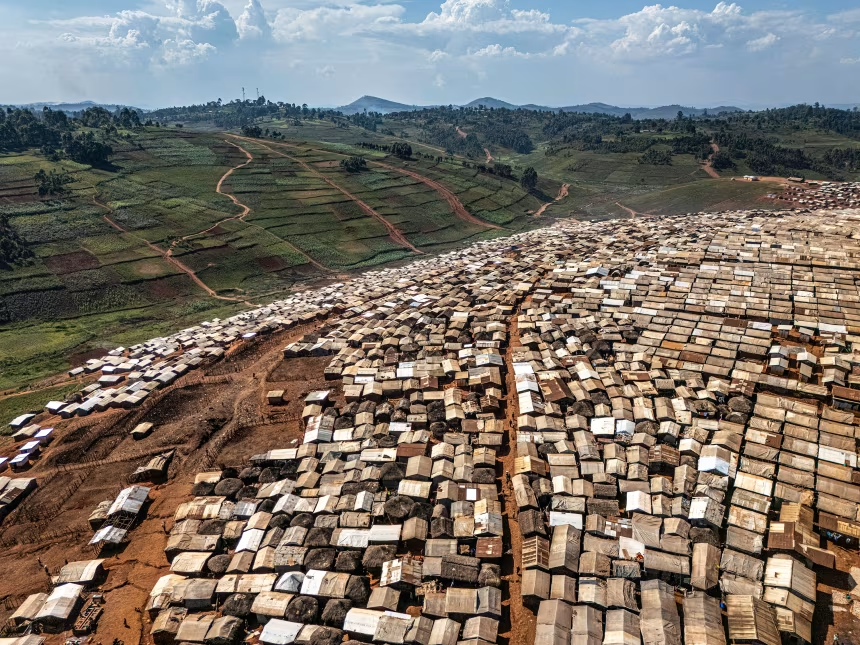
Health authorities in the Democratic Republic of Congo have confirmed a new Ebola outbreak in the country’s eastern Ituri province. This raises concerns among regional and international health organizations about the possibility of cross-border transmission and additional infections in neighboring countries. The outbreak has already resulted in dozens of deaths and hundreds of suspected cases in remote communities. Unfortunately, healthcare access remains limited in these areas.
Africa’s leading public health agency announced that the outbreak has primarily affected the Mongwalu and Rwampara health zones. These are areas known for mining activity, population movement, and persistent insecurity. Officials reported that at least 246 suspected infections and 65 deaths have been identified so far. Meanwhile, laboratory testing continues to determine the precise strain of the virus involved in the outbreak.
The Ebola virus remains one of the world’s deadliest infectious diseases due to its high fatality rate and its ability to spread through direct contact with infected bodily fluids, including blood, vomit, and other secretions. In addition, health experts fear that the outbreak’s location near international borders could complicate containment efforts if surveillance systems fail to identify cases quickly enough.
Health Authorities Rush to Contain the Virus
Medical teams and emergency response units have already been deployed to affected communities as authorities attempt to trace contacts and isolate infected individuals. Initial laboratory testing confirmed Ebola in multiple patient samples. However, specialists are still conducting genetic sequencing to determine whether the outbreak involves the Ebola Zaire strain or another variant.
The situation became more alarming after Uganda confirmed the death of a Congolese national who tested positive for Ebola after being hospitalized in Kampala. Moreover, Ugandan officials stated that the case was imported from Congo and emphasized that no confirmed local transmission has yet been detected inside Uganda.
Regional authorities immediately began quarantine procedures for individuals who may have come into contact with the infected patient. Public health teams also intensified monitoring at border crossings and transportation routes frequently used between eastern Congo and neighboring countries.
International organizations are supporting the response effort as concerns grow over the outbreak’s location in a region affected by armed violence and difficult logistics. According to the World Health Organization, emergency personnel have been dispatched to assist local authorities with laboratory analysis, surveillance coordination, and outbreak investigation efforts.
The WHO also confirmed that Congo maintains emergency stockpiles of Ebola treatments and approximately 2,000 doses of the Ervebo vaccine. However, specialists cautioned that the vaccine’s effectiveness depends on the exact strain involved in the outbreak. If the outbreak involves a strain other than Ebola Zaire, additional medical strategies may be required.
Health experts say the coming days will be critical in determining whether the virus can be contained before spreading further into densely populated areas. Therefore, rapid diagnosis, isolation of infected individuals, and community education are considered essential tools in limiting transmission.
Border Regions and Conflict Increase Risks
The outbreak’s location in eastern Congo presents serious challenges for containment efforts. Ituri province lies more than 1,000 kilometers from Kinshasa and is characterized by weak infrastructure, limited transportation networks, and continuing violence involving armed groups operating throughout the region.
Public health officials fear that mining-related mobility and frequent population movement could accelerate the spread of the virus. Many workers travel between mining zones and neighboring countries. As a result, the possibility of cross-border infections increases if monitoring systems fail to identify symptomatic individuals quickly.
The Africa Centres for Disease Control and Prevention warned that insecurity in the affected zones may disrupt contact tracing operations and delay medical interventions. In addition, authorities also expressed concern about gaps in surveillance capabilities and the difficulty of reaching isolated communities.
Regional coordination efforts have intensified as Congo, Uganda, and South Sudan work alongside international agencies to strengthen border health controls and emergency response planning. Officials are prioritizing laboratory support, infection prevention measures, risk communication campaigns, and safe burial procedures to reduce further transmission.
The outbreak comes at a difficult moment for eastern Congo, where communities are already facing instability linked to armed rebel groups and humanitarian crises. In particular, Ituri province has experienced repeated attacks attributed to militant organizations, further complicating healthcare delivery and emergency logistics.
Organizations including the United Nations Children’s Fund are also expected to support awareness campaigns focused on hygiene, community protection, and public health education in vulnerable regions. During outbreaks, misinformation can spread rapidly in these areas.
Congo Faces Another Major Public Health Challenge
The newly confirmed outbreak marks the 17th recorded Ebola outbreak in Congo since the virus was first identified in the country in 1976. Over the decades, Congolese health authorities have developed extensive experience responding to Ebola emergencies. However, each outbreak presents unique logistical and medical difficulties.
One of the deadliest outbreaks occurred between 2018 and 2020 in eastern Congo, killing more than 1,000 people and overwhelming regional healthcare systems. Earlier epidemics in West Africa also demonstrated how quickly Ebola can spread when healthcare systems are unprepared or under-resourced.
Despite Congo’s growing expertise in outbreak management, experts say rapid deployment of personnel and equipment remains essential. Public health specialists stress that laboratories, protective equipment, transportation systems, and trained staff must be mobilized quickly. Otherwise, infections may expand into urban areas.
Medical professionals involved in previous Ebola responses noted that Congo already possesses experienced epidemiologists and laboratory networks capable of supporting emergency investigations. However, insecurity and difficult terrain continue to slow access to remote communities where cases are being reported.
The current outbreak has also intensified concerns about healthcare funding and emergency preparedness across Central Africa. Institutions such as the Centers for Disease Control and Prevention continue monitoring the situation closely as regional authorities work to strengthen surveillance and containment operations in affected border regions.