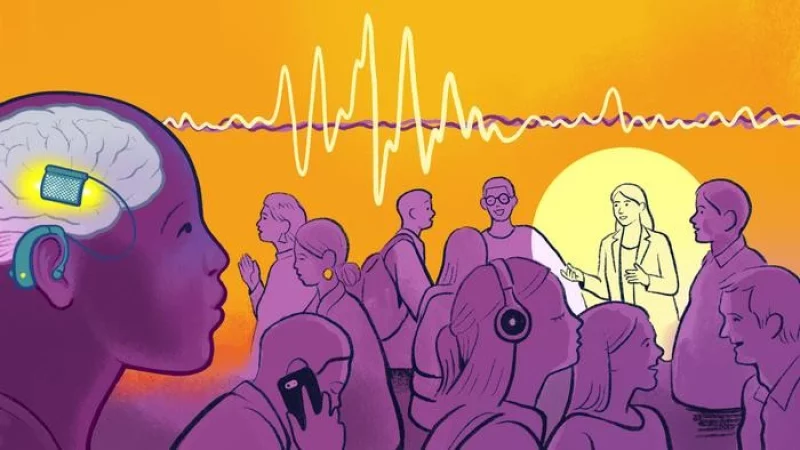
Scientists are developing a new generation of hearing technology that could dramatically improve how people with hearing loss navigate noisy environments. The experimental system, described in recent neuroscience research, uses brain activity to determine which voice a person wants to focus on. It then amplifies that specific sound while reducing surrounding noise.
The breakthrough addresses what researchers call the “cocktail party problem,” a long-standing challenge in hearing science. In crowded spaces filled with overlapping conversations, most people with typical hearing can naturally focus on one speaker while filtering out competing voices. However, for individuals who rely on hearing aids, distinguishing speech from background chatter can become exhausting and frustrating.
Researchers believe the new technology could eventually lead to smarter hearing aids, cochlear implants and assistive listening systems. These devices would be capable of adapting directly to a listener’s brain signals in real time. Experts say the concept represents a major shift in how hearing devices may function in the future.
Researchers decode how the brain selects voices
The project builds on years of research into how the human brain processes sound. Scientists studying auditory perception discovered that specific patterns of brain waves emerge when a person concentrates on a particular voice in a noisy environment. As a result, those neural signals effectively reveal which speaker the listener intends to follow.
The research team, led by experts in neural acoustic processing, focused on activity within the auditory cortex — the region of the brain responsible for interpreting sound. By monitoring electrical signals generated during listening tasks, the scientists were able to identify distinct patterns associated with focused attention.
According to researchers involved in the project, the brain naturally amplifies the target voice while suppressing unrelated sounds. That discovery allowed scientists to create a system capable of detecting the listener’s intention and adjusting audio output automatically.
The work contributes to a growing field of neuroscience research involving brain signal analysis and the development of advanced medical technologies designed to improve communication and sensory function. Additionally, specialists say understanding how the brain prioritizes speech could also influence future research involving cognitive disorders and speech recognition systems.
To test the concept, scientists conducted experiments involving volunteers already undergoing neurological monitoring for epilepsy treatment. Because the participants already had implanted electrodes as part of their medical care, researchers were able to observe highly detailed brain activity. This occurred while the individuals listened to competing conversations.
Experimental system improves speech comprehension
During the experiments, participants listened to two different conversations played simultaneously through separate speakers positioned nearby. At equal volume levels, following either discussion proved difficult because the voices overlapped and competed for attention.
Researchers then activated the brain-controlled system, which analyzed neural activity in real time and increased the volume of the conversation the participant appeared to be focusing on. At the same time, the competing audio streams were simultaneously reduced to minimize distraction.
The system reportedly identified the desired speaker with an accuracy rate approaching 90%. Participants also demonstrated improved speech comprehension and reduced listening fatigue when the technology was enabled.
Scientists involved in the project say the findings could help shape the next generation of intelligent hearing devices. Existing hearing aids already include sophisticated background noise reduction features. However, they often struggle in environments where multiple people are speaking simultaneously.
Advancements in hearing and communication technology have increasingly focused on personalized listening experiences. However, experts say current systems still lack the ability to fully understand a user’s listening intent. Brain-guided audio processing could provide a more direct solution.
The researchers also noted that the technology may eventually integrate with artificial intelligence systems capable of learning behavioral patterns and predicting which sounds a user is most likely trying to hear. Moreover, combining neural decoding with machine learning could significantly improve real-world performance in crowded settings such as restaurants, airports or public transportation.
Future challenges remain before clinical use
Despite the promising early results, researchers caution that the technology remains experimental and faces important limitations. The current testing involved only four participants, all of whom had typical hearing rather than hearing impairment.
Some experts believe the system may encounter greater difficulty interpreting brain activity in individuals with hearing loss because auditory signals reaching the brain can already be weakened or altered. Therefore, additional studies will be needed to determine how effective the technology can become outside controlled laboratory conditions.
There are also practical challenges involving how brain signals would be captured in everyday use. The current experiments relied on implanted electrodes, which are not realistic for standard hearing aid users. Scientists are now exploring less invasive approaches capable of detecting neural activity through wearable sensors or advanced external monitoring systems.
Interest in hearing innovation continues to grow as global populations age. Organizations such as the World Health Organization estimate that hearing impairment affects hundreds of millions of people worldwide. Furthermore, prevalence increases significantly among older adults.
Medical researchers say improving speech understanding in noisy environments remains one of the most important unmet needs in hearing care. Difficulties separating speech from background noise are often associated with social isolation, communication fatigue and reduced quality of life.
Meanwhile, institutions including Columbia University continue expanding research into neural engineering and auditory science. Scientists work toward practical real-world applications for brain-guided hearing systems.