Lidar Technology Captures the Living Dynamics of the Desert
A groundbreaking project in the Sonoran Desert is redefining how scientists and the public understand desert ecosystems. Using advanced Lidar scanning technology, researchers and artists have created highly detailed 3D models that document the subtle and often invisible changes occurring in one of the most biodiverse desert environments in the world.
The initiative, hosted by the Desert Botanical Garden in Phoenix, combines art and science to produce immersive visualizations of desert life. Millions of laser pulses are fired into the landscape daily, generating precise digital reconstructions—referred to as “digital dust”—that capture everything from plant growth to environmental shifts.
These scans recorded the full life cycle of a towering saguaro cactus, from vitality to collapse, offering an unprecedented look at how desert organisms evolve over time. The data not only creates striking visual art but also provides a scientific archive that can be analyzed for years to come.
For more on remote sensing technologies and environmental monitoring, visit https://www.usgs.gov y https://earthdata.nasa.gov.
Art and Science Merge to Document Environmental Change
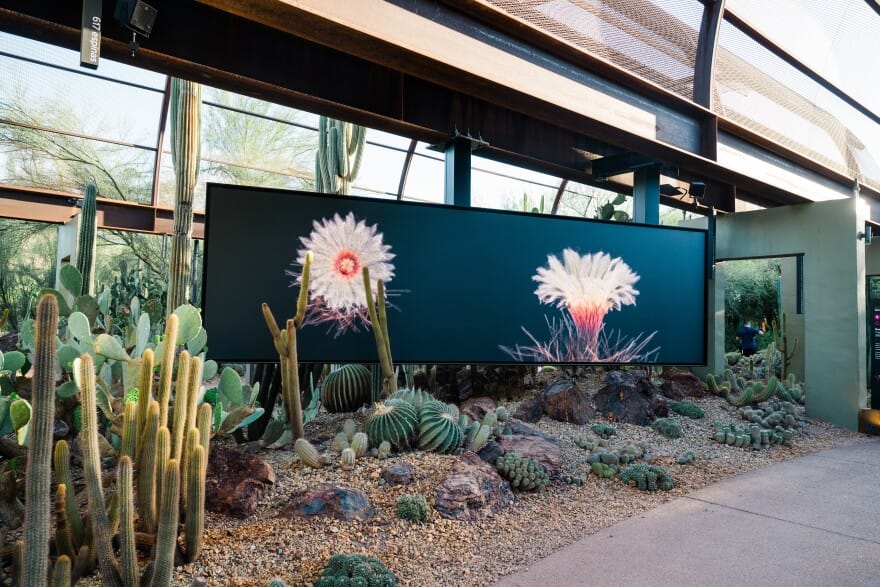
The project, developed in collaboration with ScanLAB Projects, is presented through an immersive exhibition that blends scientific data with artistic storytelling. The installation, titled “Framerate: Desert Pulse,” transforms raw lidar scans into dynamic visual narratives projected across multiple surfaces, placing viewers inside the desert ecosystem.
Beyond showcasing natural elements such as saguaros, prickly pear, and cholla cacti, the scans also capture human activity encroaching on the desert. Expanding housing developments, industrial sites, and urban infrastructure appear alongside natural landscapes, highlighting the tension between growth and conservation.
This dual perspective serves as both a celebration of biodiversity and a warning about sustainability. By visualizing how ecosystems change over time, the project encourages audiences to consider the long-term impact of human decisions on fragile environments.
Explore more about environmental art and sustainability at https://www.unep.org y https://www.nationalgeographic.com.
Data-Driven Discoveries Could Transform Conservation Efforts
Beyond its visual impact, the project is generating valuable scientific insights. Researchers have already identified previously unknown plant behaviors, such as agave leaves folding and unfolding in response to environmental conditions—an adaptation that may help regulate temperature and water retention.
The lidar data also tracks micro-level changes in the environment, including soil movement, plant hydration levels, and interactions between species. This level of detail offers new opportunities for conservationists to understand how desert ecosystems respond to climate variability and human pressure.
Scientists believe these datasets could play a critical role in protecting keystone species like the saguaro cactus, whose decline could have cascading effects on desert biodiversity. By analyzing long-term patterns, researchers may be able to predict stress factors and develop strategies to preserve these iconic plants.
Additional resources on conservation science and biodiversity can be found at https://www.worldwildlife.org y https://www.iucn.org.
Long-Term Implications for Climate and Ecosystem Research
The implications of this work extend far beyond the Sonoran Desert. The ability to continuously scan and analyze ecosystems in high resolution opens new frontiers in climate science, agriculture, and land management. Similar technologies could be deployed in forests, coastal regions, and other vulnerable environments to monitor change in real time.
Importantly, the project demonstrates how interdisciplinary collaboration—combining art, technology, and science—can lead to deeper public engagement and more innovative research outcomes. By making complex data accessible and emotionally resonant, it bridges the gap between scientific discovery and public awareness.
As researchers continue to process the vast amounts of information collected, the project stands as a model for how emerging technologies can be used not only to document the natural world, but to actively protect it for future generations.