The phrase “Colombia’s untapped wonder: The Mavecure Mountains” captures a destination that remains largely unknown outside specialist travel circles. However, it possesses some of the most dramatic landscapes in South America. Rising abruptly from the dense Amazon rainforest near Colombia’s eastern border with Venezuela, the Cerros de Mavecure appear almost surreal against the endless green horizon.
Travelers arriving in the region quickly discover that reaching the site requires effort. Flights are limited, roads are virtually nonexistent and river transport remains an essential part of daily life. Yet that isolation is precisely what gives the mountains much of their appeal.
Colombia’s Untapped Wonder: The Mavecure Mountains Rise Above the Amazon Rainforest
For visitors willing to make the journey, the reward is a landscape where towering rock formations, Indigenous traditions and untouched rainforest coexist. This rare coexistence has become increasingly uncommon across the continent.
At first glance, the surrounding Amazon appears almost perfectly flat. Then the mountains emerge. The three massive rock formations that make up the Cerros de Mavecure rise roughly 2,000 feet above the jungle floor. This creates one of Colombia’s most striking natural landmarks.
The mountains are composed primarily of ancient sandstone, quartz and shale formations that have endured for millions of years. Their rounded summits and steep slopes create a visual contrast that immediately captures attention.
The region also holds deep cultural significance. Indigenous Puinave and Curipaco communities regard the mountains as sacred places. Spiritual ceremonies and traditional offerings have taken place there for generations. Cultural and environmental information about Indigenous territories continues to be documented through institutions such as UNESCO. Importantly, UNESCO recognizes the importance of preserving cultural heritage linked to natural landscapes.
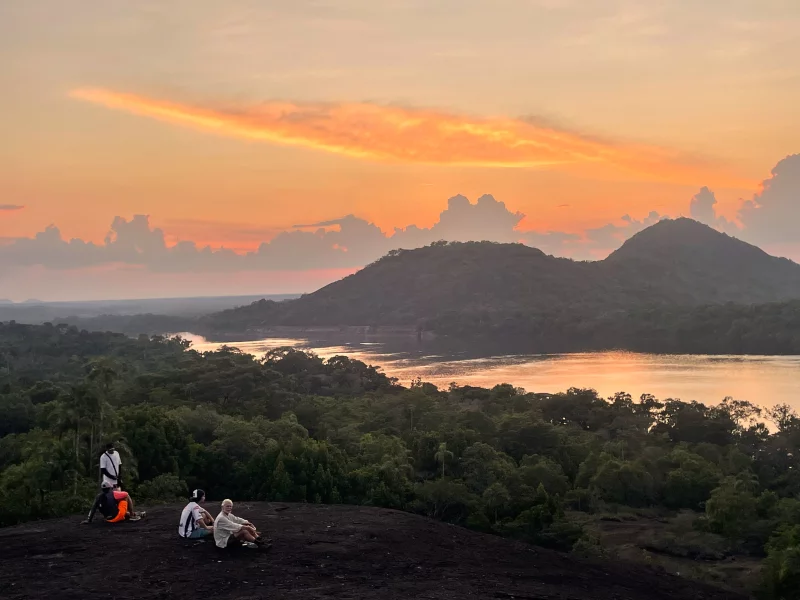
The climb to the summit of the smallest peak can take several hours under intense tropical heat. Guide ropes, ladders and lookout points assist visitors along the route. However, the experience remains physically demanding. Those who reach the top are rewarded with sweeping views of the rainforest and the winding Inírida River stretching toward the horizon.
Tourism Is Transforming Local Communities Around Mavecure
For decades, Colombia’s tourism potential remained overshadowed by armed conflict and security concerns. The situation changed significantly following the peace agreement signed in 2016. This opened previously inaccessible regions to both domestic and international visitors.
Communities surrounding Mavecure have experienced the effects directly. Tourism has gradually replaced activities such as informal gold mining. As a result, new economic opportunities have been provided while reducing environmental pressure on local rivers and forests.
Regional development initiatives continue to receive attention from organizations including UN Tourism. This agency promotes sustainable tourism models capable of generating income while protecting fragile ecosystems.
Many residents now work as guides, boat operators, artisans, beekeepers and hostel owners. Families that once depended on extractive industries increasingly see tourism as a more stable source of income.
Local leaders argue that the growth remains manageable and has not yet produced the overcrowding seen in more established destinations. Visitors often spend hours exploring trails or riverbanks without encountering large tour groups, a rarity in many popular ecotourism regions.
Remote Access Keeps Mavecure One of Colombia’s Best-Kept Secrets
Despite growing interest, Mavecure remains difficult to reach. The lack of major transportation infrastructure continues to limit visitor numbers and preserve the area’s remote character.
Unlike destinations connected by highways and large airports, access depends largely on small aircraft and river transportation. Infrastructure planning in the broader Amazon region is frequently monitored through entities such as Ministry of Commerce, Industry and Tourism of Colombia . Environmental agencies including National Natural Parks of Colombia also oversee these developments.
The limited accessibility has become both an obstacle and an advantage. Tourism operators would like to attract more visitors. Nevertheless, many travelers appreciate the absence of large hotels, crowded viewpoints and commercial development.
Wildlife encounters remain part of the experience. Visitors frequently spot colorful birds, monkeys and countless rainforest species while hiking or traveling by boat. Colombia’s position as one of the world’s most biodiverse countries is especially evident in this corner of the Amazon.
At the summit, the view reveals why many travelers consider Mavecure one of the country’s most extraordinary natural destinations. Vast rainforest stretches in every direction. Meanwhile, the remaining granite-like peaks rise above the canopy, creating a landscape that feels far removed from modern urban life and remarkably unchanged by time.