
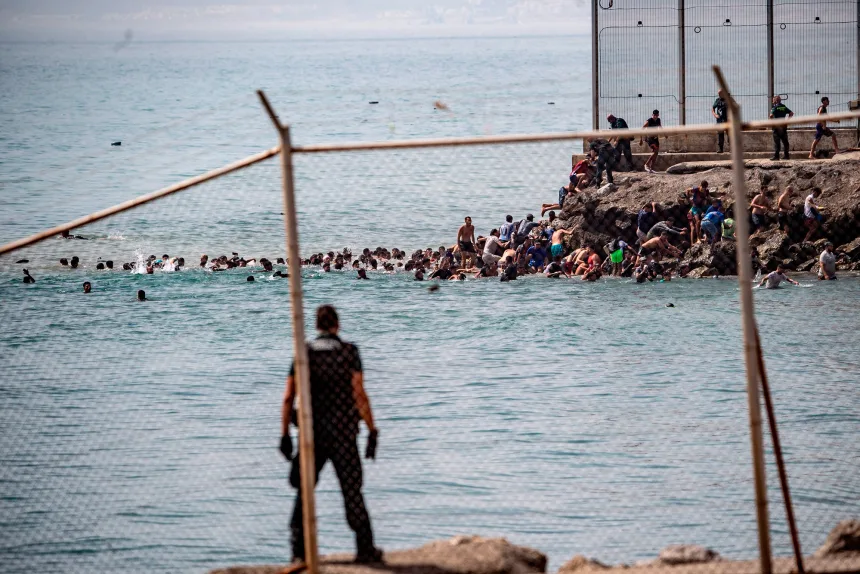
Spanish Prime Minister Pedro Sánchez has rejected accusations that his government ignored warnings before an unprecedented mass border crossing from Morocco into Ceuta, insisting that Ceuta border crisis was not predicted in either its probability or its eventual scale.
Speaking to Spain’s parliament on Thursday, Sánchez said the government had reviewed messages, reports and verbal communications from the country’s security services before the events of July 30 and 31. He maintained that none constituted a specific alert about the possibility of tens of thousands of people attempting to enter the Spanish enclave.
“I can assure you that none of them went any further than a description of the data or routine reporting,” Sánchez said, adding that no report predicted either the probability or the scale of what eventually occurred.
More than 72,000 people crossed into Ceuta during the mass influx, according to Spanish authorities. Most subsequently returned to Morocco, but thousands remained in the enclave weeks after the crisis, placing significant pressure on accommodation, public services and local authorities. Sánchez’s parliamentary statement on the Ceuta crisis
The episode has become one of the most serious political challenges faced by Sánchez’s government this year. Opposition parties have questioned whether Spanish authorities were sufficiently prepared, while demonstrations have taken place in Ceuta and other Spanish cities.
Sánchez said the government would publish a dossier containing the reports and information available to officials before the border crossing. He argued that making the documents public would demonstrate that the administration had not withheld warnings about an imminent mass movement.
What Spain knew before the Ceuta border crisis
The dispute over advance warnings has become a central part of the political battle surrounding the Ceuta border crisis.
Sánchez said authorities had observed an increase in attempts by people to enter Ceuta by swimming during July. However, he argued that the increase was not sufficient to establish that a mass crossing involving tens of thousands of people was about to occur.
The distinction matters because the government is facing questions not only about the border’s physical security but also about the flow of intelligence between security agencies and political authorities.
Spanish officials have maintained that there was no warning capable of anticipating the scale of the July operation. Sánchez repeated that position in parliament, saying that routine information about rising crossings was fundamentally different from a specific prediction that 70,000 or more people would arrive within hours.
At the same time, the investigation into what happened on the Moroccan side has complicated the political debate. A police report commissioned by a Spanish High Court judge has indicated that Moroccan security forces were deployed in relatively small numbers during part of the crisis and did not initially make a significant effort to disperse the crowds.
That finding does not establish that Morocco organized the border crossing. Sánchez has continued to say that the Spanish government has no definitive evidence that Moroccan authorities planned or executed the mass movement.
He has, however, acknowledged that Moroccan police allowed crossings to continue during a peak period on July 30. The question of whether that reflected deliberate inaction, a lack of capacity or another circumstance remains part of the investigation. Latest reporting on Morocco’s role in the investigation
The Spanish government has also sought to explain the crisis as a complex event involving multiple factors rather than a single coordinated operation. That position contrasts with allegations from political opponents who have demanded greater accountability over whether authorities should have anticipated the movement.
The scale of the influx made the question particularly significant. Ceuta has a permanent population of roughly 80,000 people, meaning that the arrival of tens of thousands of people in a short period placed extraordinary pressure on an already limited urban infrastructure.
Although most of those who crossed subsequently returned to Morocco, the humanitarian and political effects continued well beyond the initial border emergency.
Spain seeks greater EU involvement at Ceuta and Melilla
The government is now looking to European institutions for additional support at Ceuta and Melilla, Spain’s two North African territories bordering Morocco.
Sánchez said Spain would seek a permanent Frontex presence in Ceuta and a special Europol mission to monitor irregular migration. Madrid has already requested stronger involvement from European agencies in processing migrants who remained in the enclave after the July crisis.
Spain’s Interior Ministry previously requested additional support from Frontex, Europol and the European Union Agency for Asylum to help manage the identification and processing of migrants still in Ceuta. The government has also asked for stronger coordination and warning mechanisms with Morocco.
The issue has a broader European dimension because Ceuta and Melilla form part of Spain while occupying a geographically unusual position on the North African coast.
The government has also raised the possibility of seeking a different EU status for the two territories. Sánchez said Spain would ask the European Union to recognize Ceuta and Melilla as outermost regions, a designation that has implications for their relationship with the EU customs system.
The debate over Schengen has generated additional confusion. Some European politicians have called for measures involving Spain’s participation in the visa-free area, but the legal position is more complicated than simply treating Ceuta as outside Schengen.
European Union institutions have stated that the Schengen acquis applies to Spain as a whole, including Ceuta and Melilla, while special rules govern movements between the territories and mainland Spain or other Schengen countries. European Parliament clarification on Ceuta and Schengen
The distinction is significant because the border between Ceuta and Morocco is an external border of the Schengen area, even though special arrangements apply to movement involving the enclave.
The crisis has nevertheless strained relations between Spain and Morocco. Sánchez has rejected claims that Morocco definitively orchestrated the influx, but he has acknowledged that bilateral cooperation on border management must change following the events.
Spain is seeking additional European involvement partly to ensure that Ceuta and Melilla are treated as strategic external borders rather than relying primarily on bilateral arrangements with Morocco.
The European dimension also reflects the broader political sensitivity surrounding migration into Spain. The country’s North African territories are among the most direct points of contact between the EU and Africa, making sudden changes in migration flows capable of quickly becoming both domestic and European political issues. Frontex and European border-management framework
Sánchez’s government now faces two parallel challenges: responding to the humanitarian consequences of the Ceuta border crisis and addressing the political dispute over whether the warning systems in place before July 30 were sufficient.
The prime minister has promised to make the available reports public while continuing to seek greater European support for the border. He has also acknowledged that Spain cannot guarantee that its borders will ever be completely sealed, arguing that migration pressures are driven by inequality and the search for economic opportunity.
The government will therefore have to reconcile stronger border controls with the practical limits of preventing sudden movements of people across one of Spain’s most sensitive external borders.