
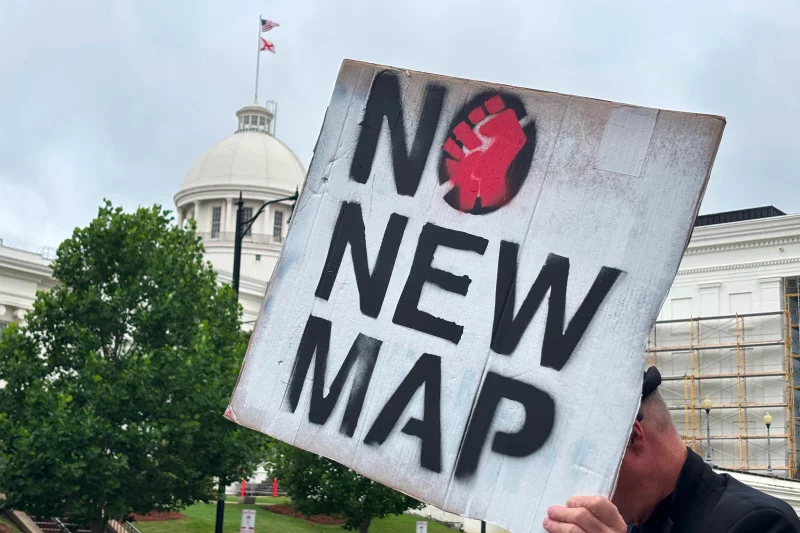
Alabama is preparing for an unusually divided election season. This comes after a new ruling from the U.S. Supreme Court cleared the way for the state to revive a disputed congressional map. The map could significantly reshape political representation in the Deep South.
The decision has triggered a special primary election for four of Alabama’s seven congressional districts. As a result, confusion among voters is growing. The ruling is also intensifying a national debate over voting rights, redistricting and the future balance of power in the U.S. House of Representatives.
Republican leaders in Alabama celebrated the ruling as a victory for state authority over election boundaries. Meanwhile, voting rights advocates warned that the decision could weaken minority representation and accelerate similar political efforts across other Republican-led states.
The legal dispute centers on a congressional map initially proposed in 2023. It includes only one majority-Black congressional district in a state where Black residents make up more than a quarter of the population. Lower federal courts had previously blocked that map. They argued that it likely violated protections established under the Voting Rights Act.
However, the Supreme Court’s latest intervention dramatically altered the political landscape. It also reopened a battle over how congressional districts should be drawn in states with significant minority populations.
Supreme Court Decision Revives Controversial Map
The legal shift followed a recent ruling involving Louisiana that weakened key interpretations of the Voting Rights Act. This was particularly regarding the creation of majority-Black congressional districts.
After that decision, Alabama officials quickly requested permission to return to the earlier 2023 congressional map. The Supreme Court’s conservative majority ultimately sided with the state. They vacated a lower court order that had required Alabama to maintain a second district where Black voters could strongly influence election outcomes.
The court’s three liberal-leaning justices opposed the ruling. They argued that the decision could undermine decades of federal protections designed to prevent racial discrimination in elections.
Republican Gov. Kay Ivey defended the outcome. She argued that state leaders are best positioned to determine how congressional districts should be organized.
The revised map now affects Alabama’s 1st, 2nd, 6th and 7th congressional districts. Two of those districts are currently represented by Black Democratic lawmakers, while the remaining seats are held by Republicans.
Because absentee voting for the state’s regular primary election had already begun before the Supreme Court ruling, Alabama officials decided to split the election process into two separate stages. The standard statewide primary will continue as planned. Meanwhile, voters in the affected congressional districts will participate in a special primary later this summer.
Election administrators across the state are now working to update voting information, polling procedures and district guidance before the new special election date.
According to the Alabama Secretary of State, officials are coordinating with county election offices to minimize voter confusion. They also aim to ensure absentee ballots and registration records align with the revised district boundaries.
Voting Rights Advocates Challenge Election Changes
Civil rights groups and voting rights organizations immediately criticized Alabama’s decision to implement the revised congressional map while the election process was already underway.
Several advocacy organizations filed emergency motions in federal court. They argue that changing district lines after absentee ballots had already been distributed could create uncertainty for voters and damage confidence in the election system.
Opponents of the new map argue that Alabama’s plan reduces Black voting power by concentrating minority voters into a single district. This, they claim, happens rather than allowing broader representation across multiple congressional seats.
Legal experts say the dispute could become one of the most influential redistricting battles in the country. This is because it may establish how aggressively states can redraw districts following the Supreme Court’s evolving interpretation of federal voting protections.
The controversy also reflects broader national divisions over how race should factor into congressional map design. Supporters of majority-minority districts argue they remain essential for fair representation. On the other hand, critics contend that race-based districting can itself create constitutional concerns.
Organizations monitoring election fairness, including the NAACP Legal Defense Fund, warned that the Alabama ruling could encourage additional efforts to dismantle minority-heavy districts in other states.
Meanwhile, election law scholars say the timing of the court’s intervention has added another layer of complexity. Normally, courts avoid major election changes close to active voting periods to prevent administrative disruption and voter confusion.
Still, Alabama leaders insist the revised map is lawful and reflects the state’s constitutional authority to establish district boundaries.
National Political Stakes Continue Growing
The Alabama dispute is unfolding during a period of heightened national attention surrounding congressional redistricting and partisan control of the House of Representatives.
Republicans currently view the revised Alabama map as a potential opportunity to gain an additional congressional seat in future elections. Political analysts say even small district adjustments could become highly significant in closely divided national races.
The impact may extend far beyond Alabama. Republican-controlled legislatures in states such as Louisiana and South Carolina are reportedly evaluating whether to revisit congressional maps that previously expanded Black representation under earlier interpretations of federal law.
Democratic lawmakers and civil rights organizations fear the Supreme Court’s recent rulings may gradually weaken the practical reach of the Voting Rights Act. This is particularly true in Southern states with long histories of racial discrimination in elections.
At the same time, conservative legal advocates argue that states should have greater flexibility in designing districts without federal courts imposing racial quotas or mandatory demographic targets.
The political tension surrounding redistricting has become increasingly intense nationwide as parties seek every possible advantage before upcoming congressional elections. Election experts note that control of even a handful of districts could influence future debates over immigration, economic policy, healthcare and federal spending.
The dispute has also renewed public focus on the role of the U.S. Supreme Court in shaping election law and voting access. Recent decisions involving district maps, ballot access and federal oversight have expanded the court’s influence over how American elections are conducted at both the state and national levels.