
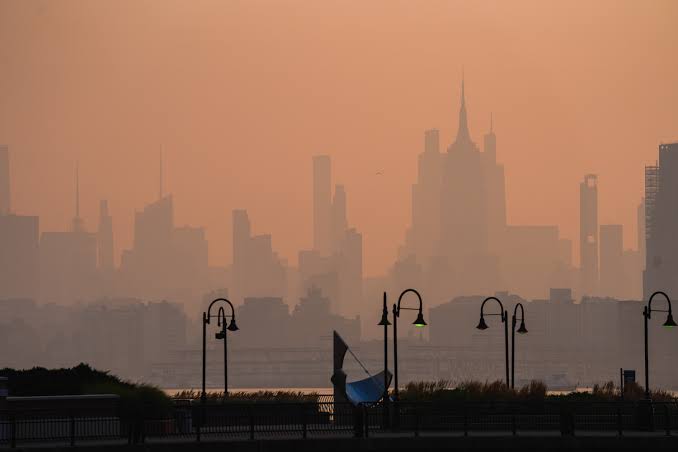
Air quality conditions are gradually improving across the Northeast and Mid-Atlantic, but residents in parts of the Midwest continue to experience hazardous levels of smoke as hundreds of active wildfires burn across Canada and northern Minnesota.
According to the National Weather Service (NWS), rainfall and thunderstorms are helping clear the atmosphere in eastern states, while a new wave of wildfire smoke is expected to move into portions of the Midwest.
Smoke Shifts Toward the Midwest
Forecasters say smoke concentrations are decreasing in cities along the East Coast, including Washington, D.C., New York City, and northern New Jersey.
However, communities across:
- Upper Michigan
- Eastern Wisconsin
- Illinois
- Indiana
- Chicago metropolitan area
are expected to experience elevated levels of fine particulate pollution through the weekend as smoke continues drifting south.
Although haze may linger into next week across parts of the East Coast, pollution levels are expected to be significantly lower than those recorded earlier in the week.
Hundreds of Wildfires Continue Burning
More than 900 active wildfires remain burning across Canada, particularly in the provinces of Manitoba and Ontario, near the U.S. border.
In northern Minnesota, the Bear Trap Fire and Thumb Fire have crossed into Canadian territory, prompting ongoing coordination between U.S. and Canadian wildfire agencies.
Firefighters on both sides of the border continue aerial suppression efforts using water-dropping aircraft to slow the spread of the fires.
Political Debate Over Wildfire Management
The continuing smoke has also fueled political discussion over wildfire prevention and forest management.
President Donald Trump criticized Canada’s handling of its forests and suggested the economic impact of smoke drifting into the United States should factor into future trade discussions.
Meanwhile, several Republican lawmakers from Michigan urged Canadian officials to explain what additional wildfire mitigation measures are being taken near the shared border.
Canadian Prime Minister Mark Carney responded that wildfire prevention and climate-related challenges require cooperation between both countries.
Health Experts Urge Precautions
Medical experts warn that wildfire smoke contains microscopic particles capable of penetrating deep into the lungs.
Health officials recommend:
- Staying indoors when air quality is poor.
- Using HEPA air purifiers when available.
- Keeping windows and doors closed.
- Wearing a properly fitted N95 respirator if spending time outdoors.
- Monitoring local air quality reports before exercising outside.
Individuals most vulnerable to wildfire smoke include:
- Children.
- Older adults.
- Pregnant women.
- People with asthma, heart disease, or other respiratory conditions.
Climate Change and Increasing Wildfire Risk
Scientists continue to link rising global temperatures with longer wildfire seasons and more intense fires across North America.
As wildfire activity increases, smoke events have become more frequent and now affect millions of people far beyond the immediate burn areas, highlighting the growing public health and environmental challenges associated with extreme wildfire seasons.