
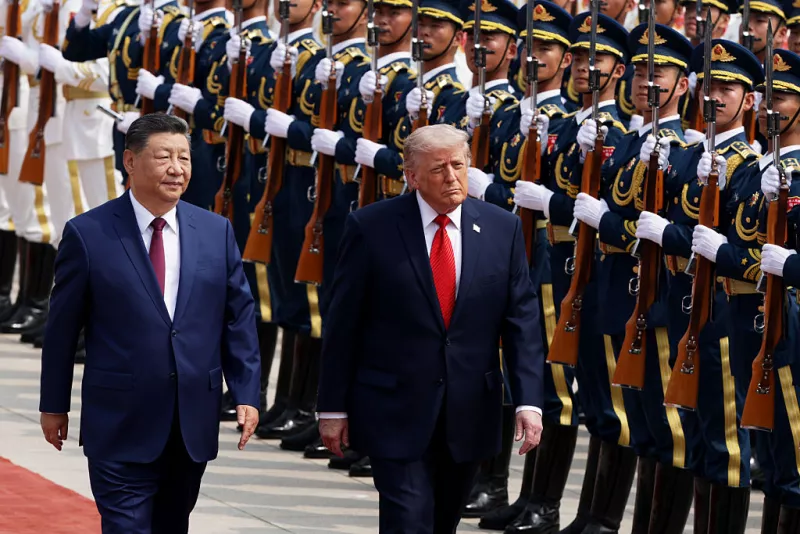
President Donald Trump’s visit to Beijing has placed global attention back on the fragile relationship between the United States and China, as both governments attempt to manage growing tensions over trade, Taiwan and international security. The Trump Xi Beijing summit is a pivotal event during this trip, marking the first official visit by a sitting U.S. president to China in nearly a decade and coming at a time when both nations are navigating increasingly complex geopolitical disputes.
The summit between Trump and Chinese President Xi Jinping included formal meetings, a state banquet in Beijing and high-level diplomatic discussions that reflected the strategic priorities of both governments. While public statements from each side projected stability and cooperation, the official summaries released afterward revealed major differences in emphasis and messaging.
Chinese officials focused heavily on Taiwan and regional sovereignty concerns, while the White House highlighted economic issues, Middle East stability and international trade. Analysts say the contrast demonstrates how Washington and Beijing continue to approach the relationship from fundamentally different perspectives despite efforts to maintain diplomatic engagement.
Taiwan remains central to China’s message
During the private discussions, President Xi reportedly warned that the Taiwan issue remains the most sensitive topic in relations between the two global powers. According to Chinese state media, Xi emphasized that mishandling Taiwan-related policies could seriously damage bilateral relations and create long-term instability between Washington and Beijing.
China has consistently opposed any moves that could strengthen diplomatic or military ties between the United States and Taiwan. Beijing considers the island part of its territory under the “One China” principle, while the United States maintains unofficial relations with Taiwan through legislation such as the Taiwan Relations Act.
The topic has become increasingly contentious over the last several years as military activity in the Taiwan Strait intensified and both governments expanded their strategic positioning across the Indo-Pacific region. Chinese leaders continue to argue that foreign involvement in Taiwan affairs threatens regional peace and sovereignty.
Observers noted that China’s official summary of the summit devoted significant attention to Taiwan while giving comparatively less detail to economic matters. Experts believe this reflects Beijing’s determination to ensure the issue remains at the center of all major diplomatic engagements with Washington.
At the same time, officials in both countries attempted to avoid inflammatory rhetoric during the meetings. Diplomatic language from both sides appeared carefully crafted to reduce the possibility of escalating tensions while still reinforcing their respective positions.
Trade and global security dominate the U.S. agenda
The White House account of the summit painted a different picture, focusing primarily on trade negotiations, energy security and instability in the Middle East. According to the U.S. summary, President Trump raised concerns about trade imbalances and emphasized the need for fairer commercial relations between the world’s two largest economies.
Trade disputes have defined much of the modern U.S.-China relationship, particularly after years of tariffs, supply chain disruptions and strategic competition involving technology and manufacturing. American officials continue to push for expanded market access and stronger protections for domestic industries.
Economic analysts say the summit could influence future policy decisions involving imports, exports and industrial production. Institutions including the World Bank have repeatedly warned that prolonged tensions between major economies could slow global growth and increase financial uncertainty.
The White House also stated that both leaders discussed instability in the Middle East, including the importance of maintaining open shipping routes through the Strait of Hormuz. U.S. officials stressed concerns surrounding Iran’s nuclear ambitions and broader regional security risks.
Interestingly, Chinese state media did not specifically mention Iran’s nuclear program in its own readout, instead referring only generally to discussions about Middle East affairs. The omission underscored the diplomatic differences that continue to shape how each government communicates sensitive international issues to domestic and global audiences.
Trump’s administration has repeatedly linked economic security and geopolitical strategy, arguing that trade policy, military positioning and energy stability are deeply interconnected in today’s international environment.
Diplomats see cautious optimism despite major divides
Despite the sharp differences in priorities, veteran diplomats and foreign policy observers described the overall tone of the summit as constructive. Former U.S. officials noted that the calm atmosphere and positive public language exchanged by both presidents suggested a mutual interest in preventing relations from deteriorating further.
Foreign policy specialists argue that major breakthroughs were unlikely during this visit, especially given the scale of the disagreements surrounding trade, military influence and Taiwan. However, the willingness of both sides to maintain direct communication is being viewed as an important signal by global markets and allied governments.
Experts at organizations such as the Council on Foreign Relations have noted that sustained dialogue between Washington and Beijing remains critical as strategic competition continues to intensify across several sectors, including technology, defense and international commerce.
The summit also arrives during a period of broader uncertainty in global diplomacy. Conflicts in Eastern Europe, tensions in the Middle East and economic volatility have increased pressure on world leaders to avoid direct confrontation between major powers.
Some analysts believe China hopes to stabilize relations enough to protect economic growth and international investment, while the Trump administration appears focused on securing trade advantages and reinforcing American geopolitical influence. Others caution that symbolic diplomacy alone will not resolve structural disagreements that have been building for years.
Meanwhile, international observers continue to monitor developments surrounding the U.S. Department of State and China’s foreign ministry as additional meetings and negotiations are expected following the Beijing summit.