
South Korea’s security relationship with the United States entered a new period of uncertainty Tuesday. This followed President Donald Trump’s order for the Pentagon to substantially reduce joint military exercises with Seoul, just as the annual Ulchi Freedom Shield drills were getting underway. The move has revived questions about the strength of the South Korea US alliance. It has also raised questions about whether Washington’s approach to North Korea is beginning to alter the military balance on the Korean Peninsula.
Trump announced the directive through social media shortly before the exercises began. He pointed to his relationship with North Korean leader Kim Jong Un, the cost of the drills, and South Korea’s refusal to join the United States in its conflict with Iran. Trump also argued that the exercises send an unnecessarily hostile message to Pyongyang.
The timing was particularly striking. Ulchi Freedom Shield is not a routine parade of military hardware. Instead, it combines command-post simulations, field training and coordination among military and government organizations. The exercise is designed to test how the allies would respond to a crisis while improving their ability to operate together. The U.S. Forces Korea exercise information describes UFS as a combined, joint and interagency exercise involving live, virtual, constructive and field-based training.
South Korea US alliance faces pressure as drills are scaled back
The immediate uncertainty is not whether the exercise will take place. It has already begun. The question is how much of the planned field component will ultimately be carried out after Trump’s order.
Around 18,000 South Korean troops are participating in this year’s exercise. Meanwhile, the allies had already been reducing the number of large field-training events compared with previous years. Before Trump’s latest directive, the two militaries had planned 14 battalion-level or larger field exercises. They also said they were distributing training throughout the year to maintain readiness.
That distinction matters. Cutting individual exercises does not automatically mean the United States is abandoning South Korea. The alliance still includes a large American military presence, a combined command structure and long-standing defense commitments. But repeated reductions in training can affect how frequently commanders and units practice operating together under realistic conditions.
The issue is especially sensitive because North Korea’s military capabilities have changed. Pyongyang has expanded its nuclear and missile programs, while North Korean forces have gained experience from Russia’s war in Ukraine. The allies had specifically sought to incorporate lessons from recent conflicts into this year’s training. This includes threats involving drones, cyber operations and GPS disruption.
The broader security framework is considerably older than the current dispute. The U.S.-South Korea alliance was formalized through the 1953 Mutual Defense Treaty. More than 28,500 U.S. military personnel have historically been stationed in South Korea. The U.S. Department of State’s security cooperation record describes the alliance as a central element of regional security and notes the role of combined exercises in maintaining deterrence.
For Seoul, however, the latest development is also becoming an argument for greater military independence.
Lee pushes for stronger South Korean defense capabilities
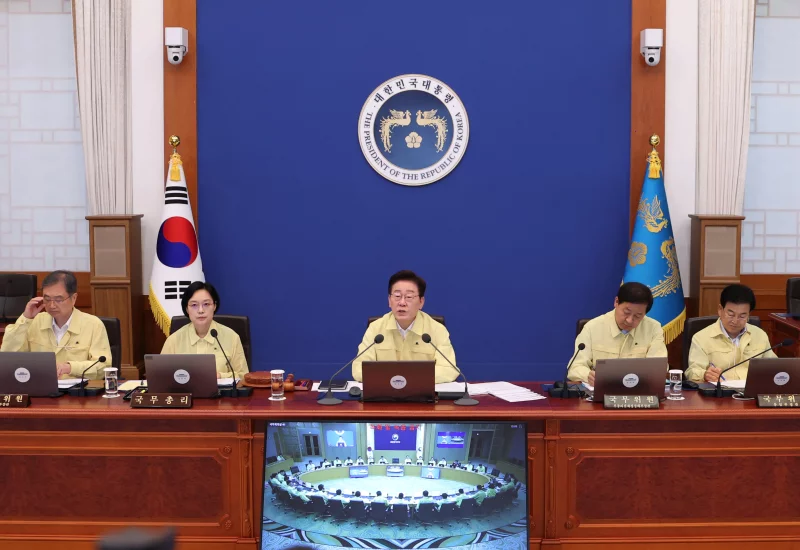
President Lee Jae Myung used a Cabinet meeting Tuesday to reaffirm the importance of maintaining a strong alliance with Washington. He also pressed ahead with plans to strengthen South Korea’s own defense capabilities.
Lee has continued to support the eventual transfer of wartime operational control from the United States to South Korea. His administration has also pushed for faster progress on a nuclear-powered submarine program and stronger domestic military capabilities.
That position creates an unusual overlap between two objectives that are sometimes presented as competing. Seoul wants the U.S. security commitment to remain credible, but it also wants greater control over its own military operations.
The distinction has become more important as questions about Washington’s priorities grow. A South Korean government seeking greater operational independence can use the current uncertainty to accelerate preparations. At the same time, any perception that the alliance is weakening could make that transition more difficult. This could increase pressure on Seoul to compensate for reduced American training or support.
South Korean officials have therefore avoided treating Trump’s decision as an outright break with Washington. The government has emphasized continued coordination with the United States and the defensive purpose of the exercises. The official U.S. Army account of Freedom Shield 2026 likewise highlights combined readiness, interoperability and coordination between American and South Korean forces.
The political debate inside South Korea is sharper.
Conservative opposition figures have accused the Lee administration of allowing the security relationship with Washington to deteriorate. They argue that Seoul should respond to the reduction in exercises by demanding clearer guarantees from the United States. Rather than placing greater emphasis on negotiations with Pyongyang, they urge a different focus.
Lee’s supporters see the situation differently. They argue that stronger South Korean military capabilities can make the country a more capable ally. This would also leave room for diplomacy with North Korea.
Trump, Kim Jong Un and the uncertain path ahead
Trump’s decision also fits into a larger effort to reopen a channel with Kim Jong Un.
Trump has repeatedly emphasized his personal relationship with the North Korean leader. Meanwhile, Kim has remained unwilling to return to the kind of high-profile negotiations that defined their earlier diplomacy. Their previous summit process collapsed in 2019 without an agreement on denuclearization.
The latest American overture therefore carries considerable uncertainty. Reducing military exercises may be intended to remove one of Pyongyang’s longstanding objections to talks. However, there is no guarantee that Kim will respond by returning to negotiations.
North Korea has consistently portrayed U.S.-South Korean military exercises as preparation for an attack. Washington and Seoul maintain that the drills are defensive. That disagreement has persisted for decades, and the military calculations behind it have become more complicated as North Korea’s nuclear arsenal and missile capabilities have expanded.
The Kremlin’s relationship with Pyongyang adds another complication. North Korea has deepened military and diplomatic cooperation with Russia during the war in Ukraine. This gives Kim additional strategic options at a time when Washington is trying to reopen dialogue.
For the South Korea US alliance, the immediate challenge is therefore larger than the number of exercises removed from a training calendar. Seoul must manage its relationship with an American president who sees military commitments partly through the lens of cost and reciprocity. At the same time, Seoul must prepare for a North Korea that has become more heavily armed and more closely connected to Moscow.
That tension is already influencing South Korea’s defense planning. The government is continuing discussions with Washington while pursuing greater operational control and expanded military capabilities at home. The U.S. Navy’s description of Ulchi Freedom Shield underscores the longstanding role of combined training in maintaining interoperability between the two militaries.
The next test will be practical rather than rhetorical. Both countries must see how they adjust the remaining exercises. They must see how Washington defines its wider military commitment to Seoul. And they must see whether Trump’s renewed outreach to Kim produces any substantive response from Pyongyang.