
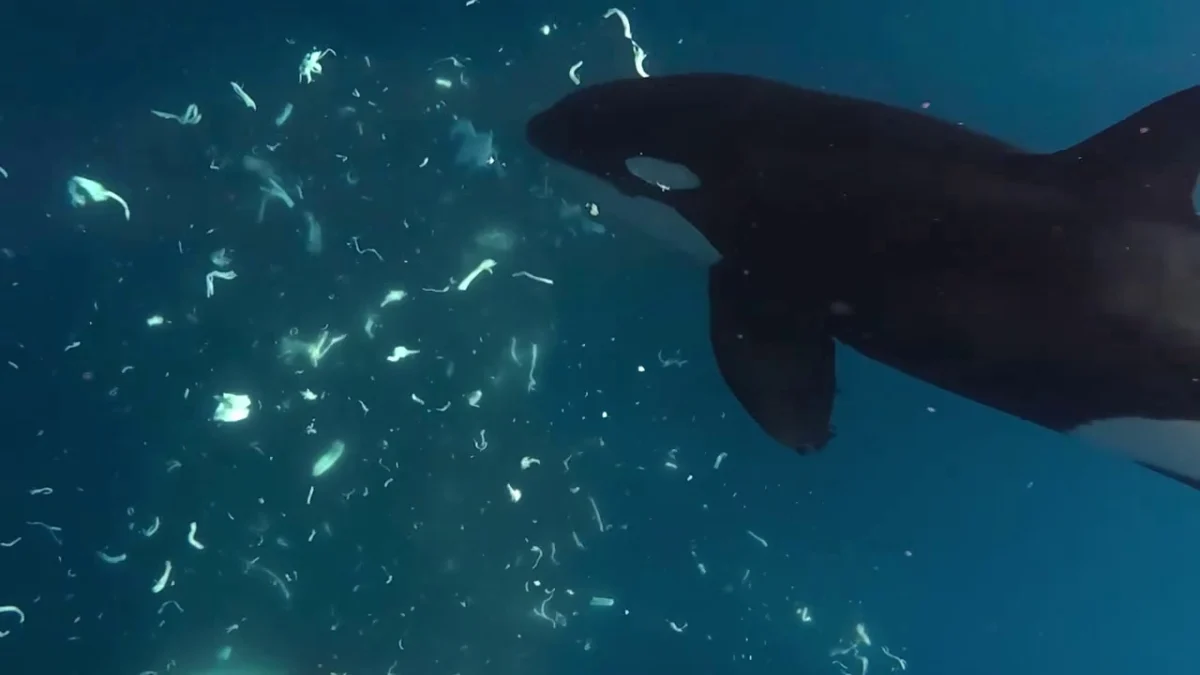
Marine researchers have documented an extraordinary hunting behavior among killer whales off the coast of Baja California. This discovery reveals a previously unknown feeding strategy that highlights the remarkable intelligence and cooperation of these apex predators.
The newly observed behavior involves one orca holding a large ocean sunfish in place. Meanwhile, another accelerates at high speed and strikes the prey with enough force to break it into countless smaller pieces.
Scientists believe the technique may make it easier for whales to consume one of the ocean’s most difficult prey species.
Cooperative Feeding Strategy Revealed
The unusual behavior was recorded during field observations near Cabo San Lucas. Marine scientists were studying orca populations in the eastern Pacific at that time.
Researchers described the process as a coordinated hunting technique. In this technique, one whale stabilizes the massive sunfish while another delivers a powerful impact. As a result, the animal is instantly fragmented into smaller, easier-to-eat portions.
Ocean sunfish are among the largest bony fish in the world. They possess extremely thick, rubber-like skin that makes them challenging prey even for experienced predators.
Breaking the fish into smaller sections may allow younger whales or individuals with worn teeth to feed more efficiently. In addition, it reduces the effort required to tear through the tough exterior.
Intelligence and Social Learning Among Orcas
Scientists say the discovery provides another example of the sophisticated social behavior for which killer whales are known.
Orcas regularly demonstrate cooperative hunting strategies and communicate within family groups. They also pass learned behaviors from one generation to another. Therefore, researchers suspect this newly documented technique could represent a form of cultural knowledge shared among a limited number of pods in the Baja California region.
Only two documented cases of the behavior have been observed so far. This suggests it may be unique to a specific local population.
The coordinated movements also raise questions about whether the activity serves additional social purposes beyond feeding. For example, it could include teaching younger whales important survival skills.
More Research Needed to Understand the Behavior
Although feeding efficiency appears to be the most likely explanation, researchers have not ruled out the possibility that elements of play are involved.
Killer whales have previously been observed engaging in playful interactions with prey. As a result, scientists believe that hunting may sometimes combine practical feeding strategies with social learning and recreation.
Future observations will help determine whether the behavior spreads to other orca populations. Otherwise, it may remain exclusive to whales living in the waters surrounding Baja California.
The discovery adds to the growing body of evidence that killer whales continue to surprise researchers with their adaptability, intelligence, and highly developed cooperative hunting techniques. Ultimately, this reinforces their reputation as one of the most sophisticated predators in the marine world.