
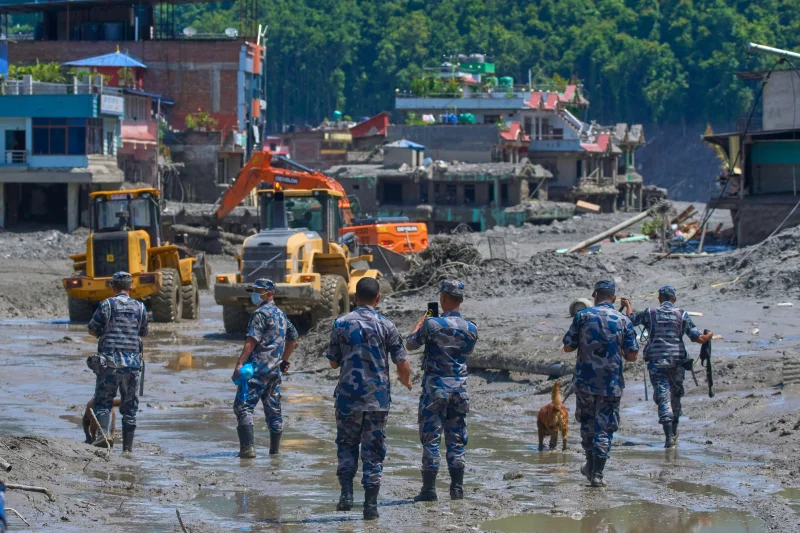
A catastrophic flash flood along the Nepal-Tibet border has killed at least 270 people and left more than 1,500 missing. Meanwhile, rescue teams struggle to reach communities cut off by destroyed roads and bridges.
A devastating flash flood swept through the mountainous border region between Nepal and Tibet early Wednesday. It destroyed roads, bridges and entire villages and left more than 1,500 people missing. At least 270 people have been confirmed dead in Nepal. Meanwhile, Chinese authorities have reported three deaths on the Tibetan side.
The U.S. Geological Survey (USGS) initially reported a 4.4-magnitude seismic event in the region. However, it later determined that the seismic signal was associated with a glacial collapse and debris flow, rather than an earthquake triggering the disaster. The event sent enormous amounts of water, mud, ice and rock downstream.
The latest assessment from the International Centre for Integrated Mountain Development (ICIMOD) says scientists are investigating whether an ice-rock avalanche from a high-altitude area entered the Lhende Khola, a tributary of the Bhote Koshi River. In addition, researchers are also assessing whether debris temporarily blocked the river before releasing a powerful surge downstream.
Entire communities swept away
The flood struck the Nepal-Tibet border region with little warning. A massive wall of mud and debris surged through valleys, carrying vehicles, buildings and infrastructure with it.
Surveillance footage from the Tibetan side showed torrents of mud and water engulfing roads and buildings. At the same time, residents attempted to escape.
In Nepal, the damage has been particularly severe in mountainous areas where access is already difficult. Several roads and bridges were destroyed, leaving rescue teams dependent on helicopters and other limited routes to reach isolated communities.
Santa Tamang, a 25-year-old university student living in one of the affected valleys, told NPR that her family managed to reach higher ground while carrying her elderly grandmother.
Their home, however, was swept away.
“Everything is gone. My childhood, my family, my community,” Tamang said.
The destruction has also complicated efforts to determine how many people remain trapped or missing.
Hundreds of foreign nationals remain unaccounted for
Nepal is a major international tourism destination. Many of those missing are foreign nationals who were traveling through the mountainous region.
According to figures cited in the original report from the Nepal Tourism Board, hundreds of overseas visitors remain unaccounted for. The missing include citizens from the United States, India, the United Kingdom, Australia and Canada.
Across the border in Tibet, Chinese authorities reported hundreds more people missing, including foreign nationals.
Many of those caught in the disaster were Hindu pilgrims traveling toward Kailash Mansarovar. This high-altitude pilgrimage destination is revered by Hindus and Buddhists.
The scale of the missing-person operation means authorities are working not only to find survivors. They are also working to establish the whereabouts of travelers whose families have yet to receive confirmation.
Rescue operations face major obstacles
Search-and-rescue operations are still in their early stages, but the geography of the disaster presents enormous challenges.
Floodwaters destroyed roads and bridges that normally connect communities across the region. Additionally, mud and debris have buried access routes, while damaged infrastructure has made it difficult for emergency teams to move equipment and supplies.
Riaz Lodhi, the World Food Programme’s country director in Nepal, said rescue workers were attempting to dig people out of the mud. At the same time, the government deployed helicopters.
The United Nations said its agencies were mobilizing personnel and supplies to support communities affected by the floods.
Dhruba Gurmachhan of World Vision said more than 30,000 households could be affected by the disaster. Aid workers have expressed particular concern about children, women and people with disabilities who may have been left without shelter, food or sanitation.
Nepal has extensive experience responding to natural disasters, including the devastating 2015 earthquake. But aid workers say the scale and speed of this flood have created an exceptionally difficult emergency.
International aid begins to arrive
Several governments have offered assistance as Nepal struggles to reach isolated communities.
The United States said it would provide $500,000 in emergency assistance and deploy a disaster-response adviser to support relief operations.
India has also sent helicopters to Nepal carrying tents, food and other emergency supplies.
The United Kingdom offered financial, search-and-rescue and other assistance. Meanwhile, Canada said it was closely monitoring the situation and remained prepared to provide support.
Australia said officials were working with local authorities and tour operators to determine the condition of Australians who were in the affected area.
The international response is expected to expand as authorities gain a clearer understanding of the scale of the destruction. They are also determining the number of people still missing.
Why glaciers are becoming a growing concern
The disaster has also renewed attention on the growing risks facing communities across the Himalayas.
The region has experienced other destructive glacier-related floods in recent years. In 2025, a similar event in Tibet involved significant ice melt and flooding linked to unusually high temperatures.
Scientists say warming temperatures are changing the stability of glaciers, ice and mountain slopes throughout the Himalayas. That creates risks not only for settlements but also for roads, hydropower facilities, tourism infrastructure and water supplies.
ICIMOD experts caution, however, that it is too early to establish precisely how much climate change contributed to this specific disaster.
What is clearer is that the region is becoming increasingly exposed to cryosphere-related hazards, including glacier collapses, ice avalanches and glacial lake outburst floods.
A previous ICIMOD assessment of a 2024 flood in Nepal found that an ice avalanche contributed to a destructive chain of events. This chain released a large volume of water downstream. Such events demonstrate how rapidly conditions high in the mountains can translate into catastrophic flooding far below.
A warning for communities across the Himalayas
The Nepal-Tibet disaster illustrates the particular vulnerability of Himalayan communities to cascading natural hazards.
A collapse high in the mountains can trigger a sequence involving ice, rock, water and sediment. This can transform a localized event into a destructive flood that travels rapidly downstream.
That makes monitoring and early-warning systems especially important. But the terrain also makes installing and maintaining such systems difficult.
For now, the immediate priority remains finding survivors. Authorities are also focused on recovering victims and reaching communities that have been cut off from the outside world.
With more than 1,500 people still missing and large areas difficult to access, authorities warn that the human toll could continue to rise. This may happen as rescue teams reach locations that have remained isolated since the flood struck.
The disaster is therefore not only a humanitarian emergency. It is also another warning about the growing risks facing communities living beneath the rapidly changing Himalayan cryosphere.