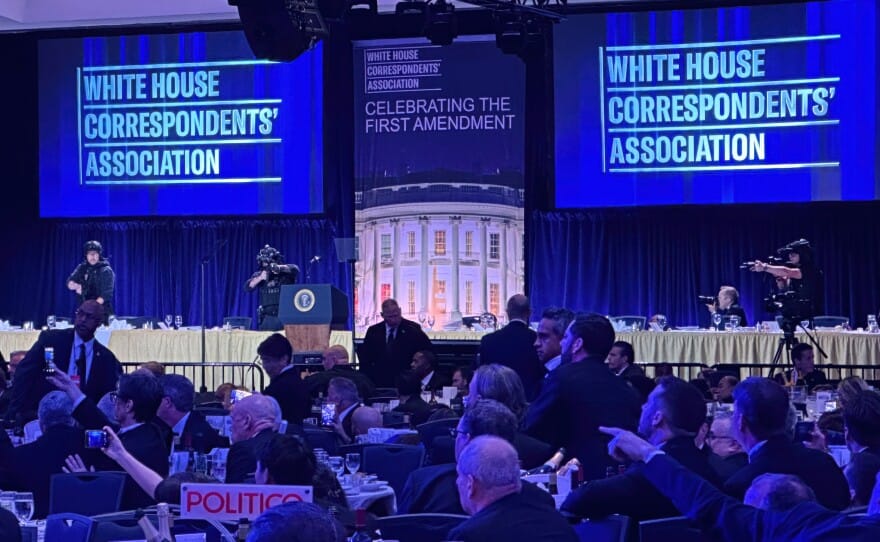
The annual White House Correspondents’ Association Dinner is one of the most high-profile gatherings in Washington. It brings together journalists, government officials, and the President of the United States. Behind the formal atmosphere lies a highly coordinated and layered security operation. This operation is designed to manage risk in a complex and crowded environment.
Held at the Washington Hilton, the event benefits from a venue specifically adapted for presidential security. This adaptation followed the attempted assassination of Ronald Reagan. Moreover, these architectural and logistical features play a central role in how security is implemented during major gatherings.
A Venue Designed for Presidential Protection
The Washington Hilton is uniquely structured to host high-security events. It includes a dedicated presidential entrance and a secure holding room located behind the main stage. The holding room is complete with a presidential seal embedded in the floor. These features were introduced after the 1981 attack on Ronald Reagan. Consequently, these changes fundamentally reshaped how venues accommodate presidential appearances.
The hotel itself presents logistical challenges. With more than 1,100 rooms and multiple simultaneous events, the property remains active with guests unrelated to the dinner. This constant movement requires security teams to balance accessibility with strict control measures.
As attendees approach the ballroom—located two levels below the main lobby—security intensifies. Guests must present credentials and pass through airport-style screening checkpoints positioned one floor above the event space. This layered approach is designed to detect and deter threats before individuals reach the most sensitive areas.
Additional information about large-scale event coordination and security planning can be explored at https://www.secretservice.gov and https://www.dhs.gov. There, federal agencies outline their operational frameworks.
Coordinated Multi-Agency Security Response
When the President attends the dinner, the United States Secret Service assumes primary responsibility for security. However, multiple law enforcement agencies also contribute personnel, creating a coordinated network of protection.
During the recent incident, a sudden noise resembling gunfire triggered an immediate response inside the ballroom. Agents quickly entered from multiple points and initiated protective protocols. The President, Vice President, and other high-ranking officials were rapidly escorted from the stage. At the same time, security teams located and evacuated individuals in the presidential line of succession.
The suspect was later identified as being one floor above the ballroom. According to officials, the individual passed through a checkpoint but was intercepted before reaching the stairs leading directly to the event. This rapid containment underscores the importance of layered defenses and constant surveillance.
Insights into federal emergency response coordination can also be found through https://www.fbi.gov and https://www.ready.gov. These resources detail procedures for threat mitigation and crisis management.
Ongoing Review of Security Measures
Following the incident, federal officials emphasized that established protocols functioned as intended. Authorities noted that multiple layers of security separated the suspect from the President. This highlights the effectiveness of the system despite the breach in proximity.
Nonetheless, the event has prompted renewed scrutiny of access control and screening procedures. Senior officials are expected to review current security operations and identify potential enhancements, particularly for large-scale events involving high-profile attendees.
Discussions are also underway regarding the possibility of rescheduling the event with expanded security perimeters and additional safeguards. While logistical and financial considerations may pose challenges, the incident has reinforced the importance of continuous evaluation in security planning.
The White House Correspondents’ Dinner remains a symbol of the intersection between media and government. However, events like this serve as a reminder that even well-established systems must evolve to address emerging risks and maintain public confidence.