
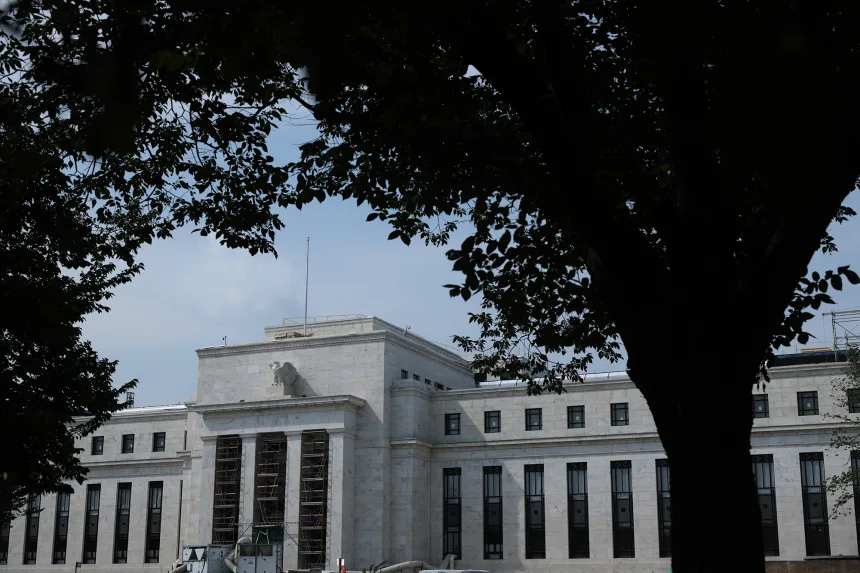
Fed bond market stability is becoming a growing concern as investors confront persistent inflation, rising energy prices, heavy government borrowing and a wave of corporate spending linked to the artificial intelligence boom. Those pressures have pushed Treasury yields higher and increased the cost of financing everything from mortgages and credit cards to the U.S. government’s enormous debt load.
The Federal Reserve has an unconventional tool that could influence long-term borrowing costs: its balance sheet. But using that tool to directly suppress yields would carry significant risks and would conflict with Federal Reserve Chairman Kevin Warsh’s emphasis on returning monetary policy to its traditional foundations.
Instead, greater clarity about how Warsh evaluates inflation, employment, financial conditions and other economic risks could offer a less disruptive way to reduce uncertainty in the bond market.
That possibility has become more important after Warsh’s August 28 speech at the Jackson Hole Economic Policy Symposium. He reaffirmed the Federal Reserve’s 2% inflation target and said policymakers needed to be confident that underlying inflation was moving toward that objective “clearly and at sufficient speed.” He also emphasized that short-term interest rates remain the Fed’s primary monetary-policy tool and that unconventional measures should be used sparingly, if at all.
The message was closely watched because investors had been searching for a clearer understanding of how the new Fed chairman would respond to persistent inflation. His comments increased expectations that the central bank could raise interest rates if price pressures fail to improve.
Why Fed Bond Market Stability Is Becoming More Important
Treasury yields moved higher as investors assessed the combined effect of inflation, energy prices, government borrowing and expectations for future monetary policy. On Tuesday, the 10-year Treasury yield traded around 4.79%, close to its highest levels in several years, while markets awaited new inflation data that could influence the Federal Reserve’s next decision.
Higher long-term Treasury yields do more than affect government financing. They influence mortgage rates, corporate borrowing costs and other forms of credit because longer-term interest rates incorporate expectations about future short-term rates, inflation and economic conditions.
That connection makes communication particularly important. Investors do not need the Federal Reserve to promise a specific path for interest rates. They do, however, need to understand the conditions that would cause policymakers to change course.
This is the role of a “reaction function.” It describes what economic information a central bank watches, how it interprets that information, how it weighs competing risks and what developments could change its policy judgment. Brookings’ explanation of a central-bank reaction function describes why this framework can help markets understand monetary policy without requiring policymakers to provide a fixed timetable for future rate decisions.
Warsh has taken a cautious approach to forward guidance, arguing that markets should pay close attention to economic data rather than simply anticipate the Federal Reserve’s next move. His Jackson Hole speech reinforced that approach. He stressed that policymakers should rely on current, relevant information and remain aware of uncertainty surrounding economic forecasts.
That philosophy does not necessarily prevent greater transparency. The Fed can explain which indicators matter most without committing itself to a predetermined sequence of rate increases.
For bond investors, that distinction is important. If markets understand why the Fed would raise rates in one economic environment but hold them steady in another, they may have less reason to react abruptly to individual data releases or isolated comments from policymakers.
The current uncertainty is visible in rate expectations. Markets have been assigning roughly a 60% probability to an increase at the Federal Reserve’s September meeting, although recent comments from Fed officials have left the timing uncertain.
The possibility of a rate increase would represent a major shift after more than three years without a hike. Investors are also considering the possibility of additional increases later in the year, making the Fed’s communication strategy especially important for longer-term bonds.
Why the Fed Is Unlikely to Use Its Balance Sheet to Cap Yields
The Federal Reserve has used its balance sheet before to influence longer-term borrowing costs. During the financial crisis, it purchased large quantities of Treasury securities and mortgage-backed securities through quantitative easing, expanding the central bank’s balance sheet when short-term interest rates were already close to zero.
Those purchases helped stabilize financial markets and support the economic recovery. But Warsh supported the first round of quantitative easing as an emergency response and later became critical of subsequent asset-purchase programs. His concerns included the distributional effects of large-scale asset purchases and the risk that unconventional policies could move the Federal Reserve too far from its traditional role.
That history helps explain why a new large-scale bond-buying program would be difficult to reconcile with Warsh’s current policy philosophy.
The central bank also has a much older precedent for directly influencing long-term Treasury yields. During World War II, the Federal Reserve agreed to maintain low yields on government debt, allowing the Treasury to finance wartime spending at controlled borrowing costs. The arrangement continued after the war and eventually contributed to tensions over monetary independence. The 1951 Treasury-Federal Reserve Accord restored the central bank’s ability to conduct monetary policy independently of the Treasury. Federal Reserve history of the Treasury-Fed Accord explains how the wartime yield-peg policy eventually gave way to greater central-bank independence.
The historical lesson matters for today’s bond market because deliberately holding yields below levels determined by market conditions can create a conflict between fiscal financing needs and monetary-policy objectives.
If the Federal Reserve purchased bonds primarily to make government borrowing cheaper, investors could question whether the central bank was prioritizing fiscal concerns over inflation control.
That would be particularly sensitive at a time when investors are already focused on large government deficits and the amount of debt that must be financed.
Warsh has repeatedly emphasized the importance of price stability and the Federal Reserve’s independence. His Jackson Hole remarks also made clear that he views short-term interest rates as the central bank’s main policy instrument and unconventional measures as tools for exceptional circumstances.
The balance sheet therefore remains powerful, but its very power makes it an unlikely first choice for addressing today’s bond-market anxiety.
A return to large-scale purchases could lower yields in the short term, but it could also blur the distinction between monetary policy and government debt management. For a central bank trying to convince investors that it will not tolerate persistently high inflation, that tradeoff could undermine the credibility it needs most.
Transparency Could Be the Fed’s Least Disruptive Tool
The more immediate opportunity may therefore lie in communication rather than intervention.
Warsh has already provided some important elements of his policy framework. He has reaffirmed the 2% inflation target, emphasized the importance of underlying inflation and indicated that short-term interest rates should remain the principal instrument for achieving the Federal Reserve’s mandate. He has also warned that recent inflation data have not demonstrated enough progress toward the target.
What remains less clear to investors is precisely how those principles translate into decisions as conditions change.
A clearer explanation could address questions such as which inflation measures receive the greatest weight, how the Fed would respond to another energy-price shock, how much weakness in employment would alter its inflation priorities and what evidence would convince policymakers that monetary policy is sufficiently restrictive.
That would not require Warsh to announce a predetermined rate path. Instead, it would give investors a framework for interpreting new information.
The distinction is significant because long-term Treasury yields depend heavily on expectations. If investors expect the Fed to respond forcefully to persistent inflation, they may demand less additional compensation for inflation risk. If they believe policymakers are uncertain or unwilling to act, longer-term yields can rise even before the central bank changes its benchmark rate.
Warsh’s Jackson Hole remarks offered a partial answer by making inflation the central concern. He said the Federal Reserve’s responsibility was to ensure that underlying inflation was moving toward its objective at a sufficient pace. That was enough to produce a more hawkish interpretation of his policy outlook, even without a formal promise of future rate increases.
The bond market’s reaction illustrates why communication can matter almost as much as the policy decision itself. Investors constantly price future monetary policy into longer-term securities. A clearer framework can therefore influence financial conditions without requiring the Fed to buy large quantities of bonds.
Recent Brookings analysis has similarly argued that transparency does not require the Federal Reserve to provide a precise interest-rate path. Instead, policymakers can explain their economic assessment, the risks they are watching and how policy could respond if conditions change.
That approach would also preserve the Federal Reserve’s flexibility. Economic conditions can change rapidly because of energy prices, geopolitical developments, fiscal policy, financial markets and technological investment. A rigid commitment could become a constraint, while a clearly explained decision-making framework would allow policymakers to adjust without appearing inconsistent.
For investors, the most reassuring signal may therefore be neither a new bond-buying program nor a promise about the next rate decision. It may simply be confidence that the Federal Reserve understands the risks, has a clear framework for responding to them and remains willing to use its conventional policy tools when inflation requires action.