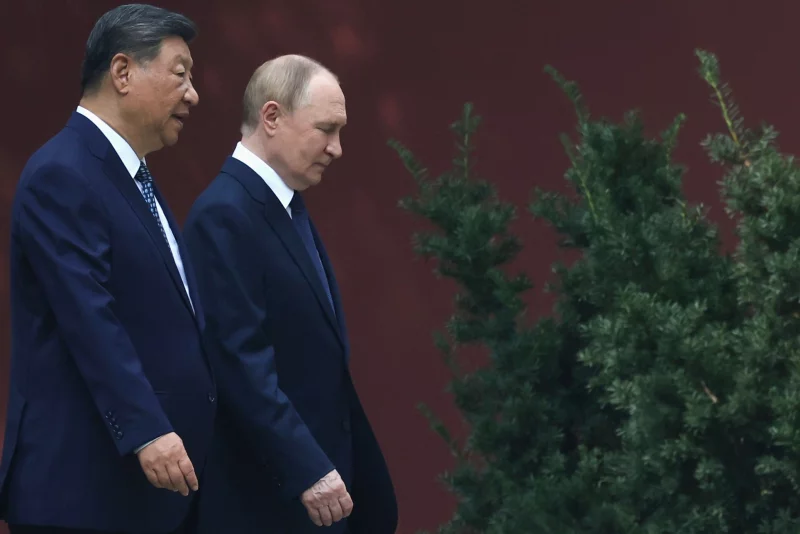
Russian President Vladimir Putin arrived in Beijing this week for high-level talks with Chinese leader Xi Jinping. This meeting reinforces the growing strategic partnership between Moscow and Beijing at a time of shifting global alliances and rising geopolitical uncertainty. The visit comes only days after U.S. President Donald Trump concluded his own summit in China. As a result, there is another layer of international attention to Beijing’s diplomatic balancing act.
Chinese and Russian officials described the meeting as a key moment for strengthening long-term cooperation on trade, energy, security and regional stability. The trip also coincides with the 25th anniversary of the Sino-Russian Treaty of Friendship. This treaty is a landmark agreement that helped lay the foundation for the close political and economic ties both nations maintain today.
Ahead of the visit, Putin praised the relationship with China as being at an “unprecedented level.” He emphasized that cooperation between the two countries now plays a central role in shaping global economic and political stability. Chinese officials echoed similar sentiments. They portrayed the relationship as a strategic pillar in an increasingly fragmented international environment.
Beijing Balances Relations With Moscow and Washington
The timing of Putin’s visit has drawn global scrutiny because it follows Trump’s recent diplomatic meetings with Xi Jinping in Beijing. Analysts say China is attempting to maintain stable communication with the United States. At the same time, Beijing is preserving strong strategic ties with Russia.
According to officials from the Kremlin, Putin and Xi planned extensive discussions on economic cooperation, international conflicts and broader regional security issues. Russian representatives insisted the trip had been scheduled independently of Trump’s visit. They emphasized it should not be interpreted as a response to growing U.S.-China engagement.
Political observers believe Beijing is carefully managing two parallel diplomatic tracks. On one side, China continues seeking economic stability and reduced tensions with Western markets. On the other, it remains committed to maintaining a deep partnership with Russia, especially in energy trade and geopolitical coordination.
During previous meetings, Xi and Putin have repeatedly referred to each other as “old friends,” a phrase rarely used in Chinese diplomacy. This expression reflects the unusually close relationship both leaders have cultivated over the past decade through frequent summits, military cooperation and joint economic initiatives.
Institutions such as the Chinese Foreign Ministry have consistently emphasized that China sees Russia as a long-term strategic partner. This is despite mounting international pressure surrounding the war in Ukraine and broader tensions between Moscow and Western governments.
Energy Cooperation Remains Central to the Partnership
Trade and energy cooperation were expected to dominate much of the Beijing discussions. China has become Russia’s largest trading partner in recent years, especially after Western sanctions reshaped Moscow’s economic relationships following the invasion of Ukraine in 2022.
Russia now serves as one of China’s primary suppliers of oil and natural gas, with energy exports increasing significantly during the past several years. Kremlin officials stated that Russian oil shipments to China rose sharply during the first quarter of 2026. Meanwhile, natural gas deliveries continue expanding through long-term infrastructure agreements.
The strengthening energy relationship has become increasingly important as instability in the Middle East raises concerns over global supply disruptions and higher energy costs. Russian officials described China as a reliable and stable energy consumer. They also portrayed Moscow as a dependable supplier during periods of geopolitical uncertainty.
Data published by the International Energy Agency has highlighted the growing importance of Asian markets for Russian energy exports as Europe reduces dependence on Russian supplies. China’s continued purchases of Russian oil and gas have helped Moscow offset some of the financial impact caused by Western sanctions.
Putin also indicated that additional agreements involving oil and gas infrastructure could move closer to completion during the visit. He described bilateral negotiations as being in their final stages after years of technical and commercial discussions.
Russia and China Expand Global Strategic Coordination
Beyond economics, both governments framed the summit as part of a broader effort to coordinate positions on major international issues. Officials from Moscow and Beijing have repeatedly argued that closer cooperation between the two countries contributes to global stability. This also creates a counterbalance to Western influence.
Chinese leadership continues to publicly describe itself as neutral regarding the war in Ukraine. However, Beijing has maintained strong commercial relations with Moscow throughout the conflict. Western governments have criticized China for continuing trade involving advanced technological components that Russia can potentially use in strategic industries.
At the same time, China has sought to preserve diplomatic flexibility by improving communication with Washington. During Trump’s recent visit, both countries discussed trade stability, technology cooperation and broader economic relations. Beijing has portrayed itself as a global power capable of maintaining dialogue with competing nations simultaneously.
Research groups including the Council on Foreign Relations note that China’s strategy increasingly revolves around positioning itself as a mediator and stabilizing force. At the same time, China is protecting its own economic and geopolitical interests.
As Putin and Xi continue strengthening their partnership, analysts believe future cooperation may expand further into defense coordination, technology development and financial systems. These measures are designed to reduce dependence on Western institutions.