A Delhi building collapse in the Satya Niketan neighbourhood killed seven people and injured five others after a five-storey building used as a private student accommodation came down near Delhi University’s South Campus. Rescue teams worked through the rubble for more than a day as authorities investigated whether basement repair work and water accumulation had weakened the structure.
The building, known as Hostel Daze, collapsed at about 1:30 p.m. local time on Sunday. Satya Niketan is a densely populated area with numerous private hostels and paying-guest accommodations serving students from nearby Delhi University colleges.
The number of people inside the building was initially unclear. Eyewitnesses estimated that several dozen residents could have been inside, while authorities confirmed that people were pulled from the debris and taken to hospital. The rescue operation continued into Monday as emergency crews searched the remaining sections of the collapsed structure.
The building collapse occurred close to Delhi University’s South Campus, where student demand for affordable accommodation has contributed to the growth of privately operated hostels and paying-guest housing.
Delhi Building Collapse Triggers Extended Rescue Operation
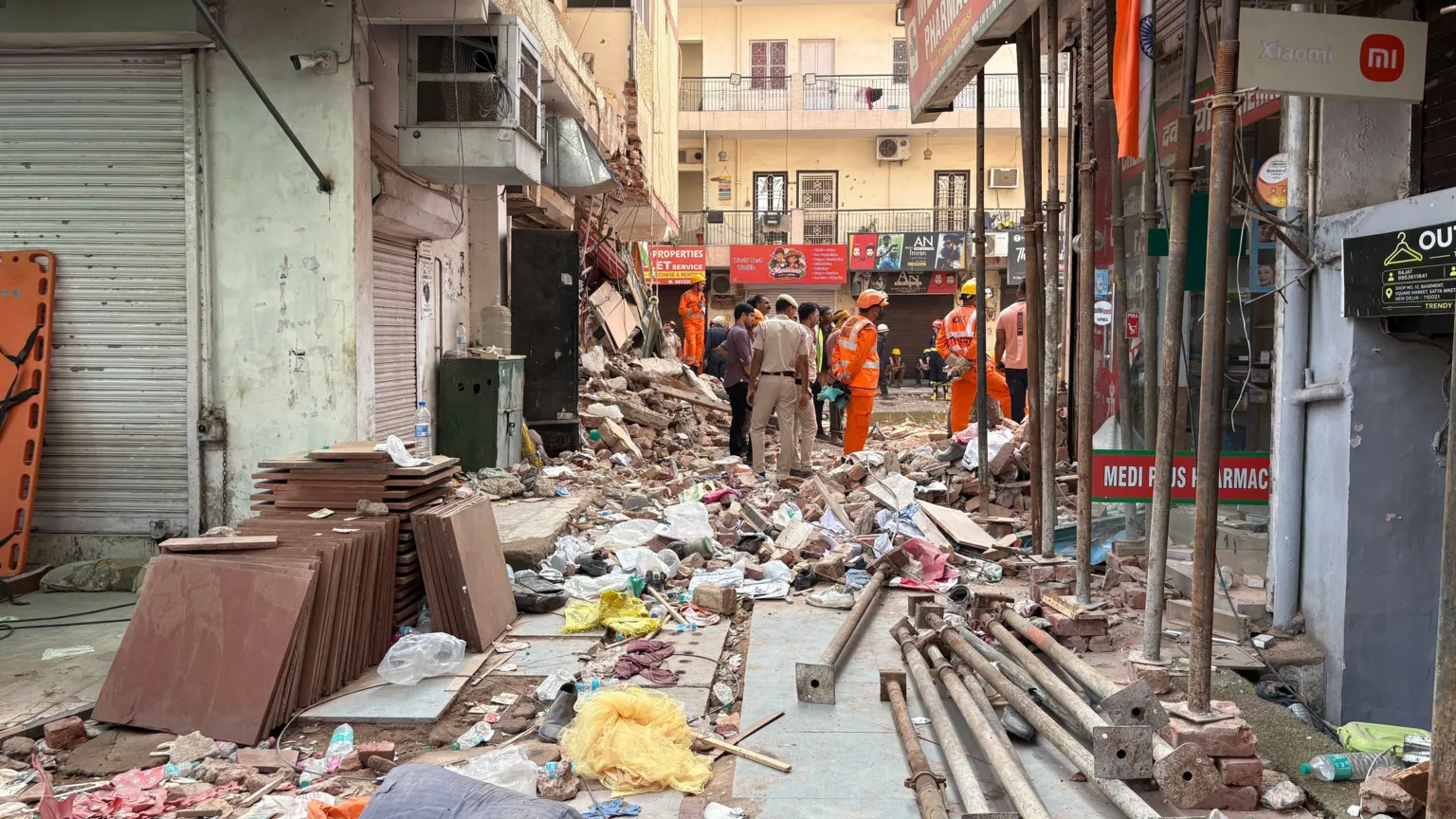
Emergency workers faced a difficult search through layers of bricks, concrete, steel and damaged building materials. Excavators removed large sections of debris while teams from the National Disaster Response Force used cutting equipment to penetrate areas where survivors might have remained trapped.
On Monday morning, Delhi Chief Minister Rekha Gupta said approximately 80% of the debris had been cleared, with the remaining rubble concentrated around the basement. Rescue workers continued examining the site because authorities could not initially establish whether additional people were still underneath the debris.
<a href=”https://www.ndrf.gov.in/” target=”_blank” rel=”noopener noreferrer”>National Disaster Response Force</a>
The operation eventually ended after approximately 27 hours, with seven people confirmed dead and five others injured. The final toll brought the immediate rescue phase of the Delhi building collapse to a close, although the incident left authorities facing questions about the condition of the property and the work being carried out inside it.
Eyewitnesses described the collapse as sudden and violent. One man who was at a nearby shop said the noise resembled the rumble of an earthquake. He recalled seeing smoke and dust spread through the area immediately after the building came down.
Another witness described people helping one another before emergency teams fully arrived at the site. Books, damaged desks and study materials were found among the debris, reflecting the building’s use as student accommodation.
Authorities also evacuated an adjacent building as a precaution because of concerns about its safety. The neighbouring structure was subsequently identified for demolition after officials determined that it posed a risk.
Investigation Focuses on Basement Work and Structural Safety
The cause of the Delhi building collapse has not been established definitively. Gupta said water accumulation combined with repair work in the basement may have contributed to the failure.
Officials have also been examining whether excavation or other structural work was carried out shortly before the collapse. The building’s owner was arrested, while five senior officials from the Municipal Corporation of Delhi were suspended following the incident.
<a href=”https://indianexpress.com/article/cities/delhi/had-to-fix-seepage-accused-to-cops-on-repair-work-at-delhi-hostel-that-gave-way-10867750/” target=”_blank” rel=”noopener noreferrer”>Investigation into basement repair work</a>
The investigation is significant because accounts from the area indicate that work was underway in the basement before the structure failed. Officials have been assessing whether seepage, excavation or repairs affected the building’s structural stability.
The property was estimated by police to be several decades old. Residents and nearby business owners also raised questions about the condition of buildings across Satya Niketan, an area where older residential structures have increasingly been adapted for student housing.
The National Students’ Union of India called for an investigation into the collapse and urged authorities to hold anyone responsible accountable. The incident has also intensified concerns over safety standards in privately operated student accommodation.
<a href=”https://www.indiatoday.in/cities/delhi/story/delhi-pg-collapse-satya-niketan-seven-dead-owners-family-arrested-mcd-officials-suspended-2989345-2026-09-07” target=”_blank” rel=”noopener noreferrer”>Latest investigation and legal developments</a>
The building’s collapse has drawn particular attention because of the number of students living in the surrounding neighbourhood. Many students attending colleges at Delhi University’s South Campus have limited access to university accommodation and instead rely on private hostels and paying-guest properties.
Students interviewed after the incident described crowded conditions and concerns about the maintenance of buildings in the area. One student said a large sociology class had only a small number of college hostel places available, leaving most students dependent on accommodation outside campus.
Another student said a friend living on the third floor had been rescued and taken to hospital after the collapse. Others described buildings in Satya Niketan as overloaded and poorly maintained, with concerns about water, sewage and general safety.
<a href=”https://news.careers360.com/delhi-university-du-hostel-pg-satya-niketan-building-collapse-south-campus-college-students-sri-venkateswara-svc-arsd-high-rent” target=”_blank” rel=”noopener noreferrer”>Student housing pressures around Delhi University</a>
The tragedy has therefore placed attention not only on one building but also on the wider housing conditions faced by students living near South Campus. Satya Niketan has become a major accommodation hub for students, with private hostels and paying-guest properties filling a gap left by limited institutional housing.
Building collapses are a recurring hazard in parts of Delhi, particularly during the monsoon period when heavy or prolonged rain can place additional stress on older structures. The incident has renewed scrutiny of construction practices, building maintenance and the oversight of properties being used for residential accommodation.
The Delhi building collapse also follows other fatal incidents involving unsafe structures and infrastructure in the capital. In April, a residential building collapse in north-eastern Delhi reportedly killed 11 people, including three children.
In 2024, three students died after becoming trapped in a flooded basement at an examination coaching centre in Delhi, an incident that prompted protests and renewed scrutiny of safety standards for facilities used by students.