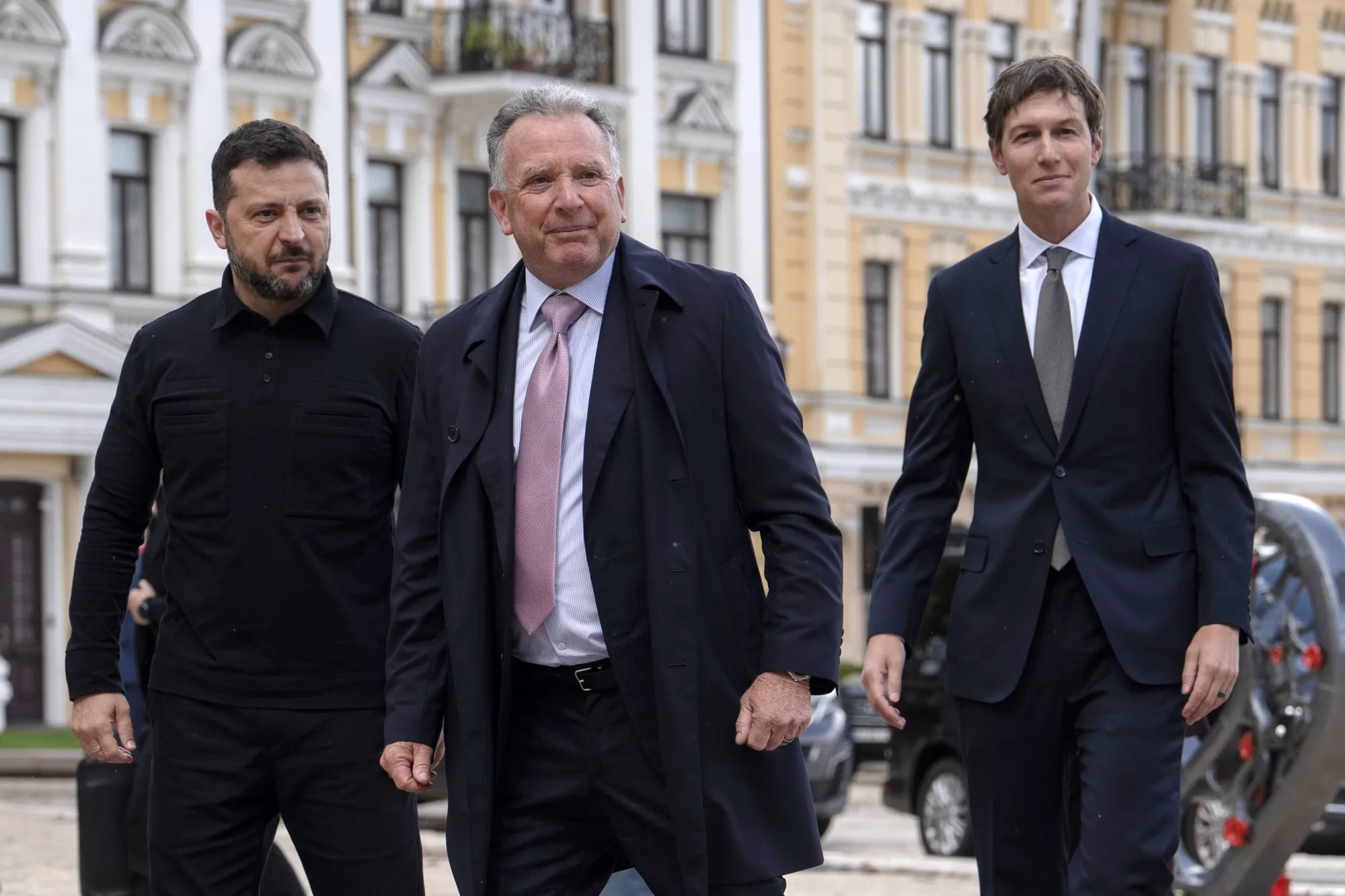
U.S. envoys Steve Witkoff and Jared Kushner arrived in Kyiv on Sunday for talks with Ukrainian officials. The Trump administration seeks to revive diplomatic efforts to end Russia’s war in Ukraine. The Witkoff and Kushner Kyiv visit comes one day after the two held more than three hours of discussions with Russian President Vladimir Putin in Moscow.
The visit marks their first official trip to Ukraine as part of the current peace effort. Ukrainian President Volodymyr Zelenskyy has said Kyiv is prepared for a constructive discussion. He has emphasized that Ukraine wants an end to the fighting, security guarantees and a sustainable postwar settlement.
“We are interested in bringing the end of the war closer. Peace is needed. Security guarantees are needed. A just and sustainable postwar peace is needed. Our proposals are prepared,” Zelenskyy said.
The Ukrainian president had confirmed before the trip that Witkoff and Kushner would travel first to Moscow and then Kyiv. He also said Ukraine was prepared to suspend airstrikes against cities directly involved in the negotiation process while the talks were taking place. Zelenskyy’s statement on the diplomatic visit outlined Kyiv’s expectations for the talks. It also described the temporary arrangements surrounding the envoys’ travel.
The diplomatic push comes after months in which efforts to advance negotiations have struggled to maintain momentum. The United States has also spent much of the past six months focused on the war involving Iran. This has reduced attention on the Russia-Ukraine conflict.
The latest meetings therefore place renewed emphasis on direct U.S. engagement with both Moscow and Kyiv. Yet the circumstances surrounding the trip remain difficult, with military activity continuing despite the diplomatic contacts.
Witkoff and Kushner Kyiv Visit Follows Long Moscow Meeting
Before traveling to Ukraine, Witkoff and Kushner met Putin at the Kremlin on Saturday. The meeting lasted more than three hours and was held behind closed doors.
Russian presidential aide Yuri Ushakov described the discussions as frank, constructive and useful. He said the American representatives presented several ideas concerning possible ways to reach a settlement. However, no detailed proposal or concrete breakthrough was publicly announced.
The Kremlin also said the conversation went beyond the war itself. Economic matters and the possibility of large projects involving Russia and the United States were discussed. This added a broader dimension to the diplomatic engagement.
Reuters reported that the meeting produced no public indication of a breakthrough, despite the Kremlin’s positive description of the talks. Reuters’ account of the Moscow talks said Putin emphasized the value of continued contacts between Washington and Moscow.
The lack of publicly announced progress leaves the Kyiv meeting as an important next stage of the current U.S. effort. Witkoff and Kushner are now expected to discuss the American approach directly with Zelenskyy and other Ukrainian officials.
For Kyiv, the central issue remains whether any diplomatic framework can produce an end to the fighting without undermining Ukraine’s security. Zelenskyy has repeatedly emphasized the need for security guarantees as part of any lasting settlement.
The sequence of the meetings is also significant. The American envoys are engaging both sides directly within a short period. This gives Washington an opportunity to compare the positions presented in Moscow and Kyiv.
At the same time, the Kremlin’s characterization of its own battlefield position remains far from Ukraine’s assessment. Moscow has continued to say that Russian forces are making progress. The Kremlin insists that any settlement must address what it describes as the underlying causes of the conflict.
That leaves substantial questions unresolved even as the diplomatic channel has reopened.
Russia and Ukraine Continue Fighting During Peace Effort
The Witkoff and Kushner Kyiv visit is taking place against an increasingly intense aerial war. Russian and Ukrainian forces have continued launching drones and missiles even as Washington attempts to create space for negotiations.
The front line stretches for roughly 1,250 kilometers, or 775 miles, and ground operations have produced limited movement in many areas. At the same time, both countries have expanded the use of long-range attacks. This brings the conflict far beyond the immediate front.
Ukraine’s State Emergency Service said Russian attacks across several regions killed one person and injured at least 10 others overnight into Sunday. In Zaporizhzhia, a drone strike killed a 74-year-old man and wounded three people. Another drone damaged an apartment building in the Khmelnytskyi region, injuring seven people.
Ukraine’s air force said it intercepted 82 of 108 drones launched by Russia overnight, along with six missiles. Russia, meanwhile, reported that its air defenses destroyed 258 Ukrainian drones over 14 Russian regions, occupied Crimea and the waters of the Black and Azov seas.
The competing claims could not be independently verified in the material available for this article. Still, they illustrate the continuing scale of the aerial confrontation.
The two governments had agreed to pause strikes against each other’s capitals during the diplomatic meetings. However, attacks continued elsewhere, underscoring how difficult it is to separate the negotiation process from the ongoing military campaign.
The broader humanitarian situation also remains severe. United Nations monitors documented a significant increase in civilian casualties during the first half of 2026, with long-range missile and drone attacks remaining a major cause of civilian harm. United Nations reporting on civilian harm in Ukraine has highlighted the growing risks faced by civilians as attacks intensify.
That reality was visible in Kyiv on Sunday, where residents gathered for the nationwide 9 a.m. moment of silence honoring fallen Ukrainian soldiers.
Among those taking part was 67-year-old Nataliia Lipei, whose son Viktor was killed in December 2022. Despite a health condition, she has traveled between Ukrainian cities to participate in the commemoration. She said she hoped the latest diplomatic meetings could finally help end the bloodshed.
Others remained unconvinced. Oleksandr Pastukhov, a 27-year-old video editor attending the ceremony, questioned whether another diplomatic delegation could overcome the failures of previous ceasefire efforts.
His skepticism reflects a broader challenge facing the negotiations: expectations of progress remain tempered by years of fighting, repeated diplomatic initiatives and continued attacks even during periods of political engagement.
For now, the arrival of Witkoff and Kushner gives Washington a renewed opportunity to engage directly with Ukraine after meeting Putin. But the continuation of attacks, the absence of a publicly announced breakthrough in Moscow and the unresolved security questions facing Kyiv leave the latest peace effort at an uncertain stage.