
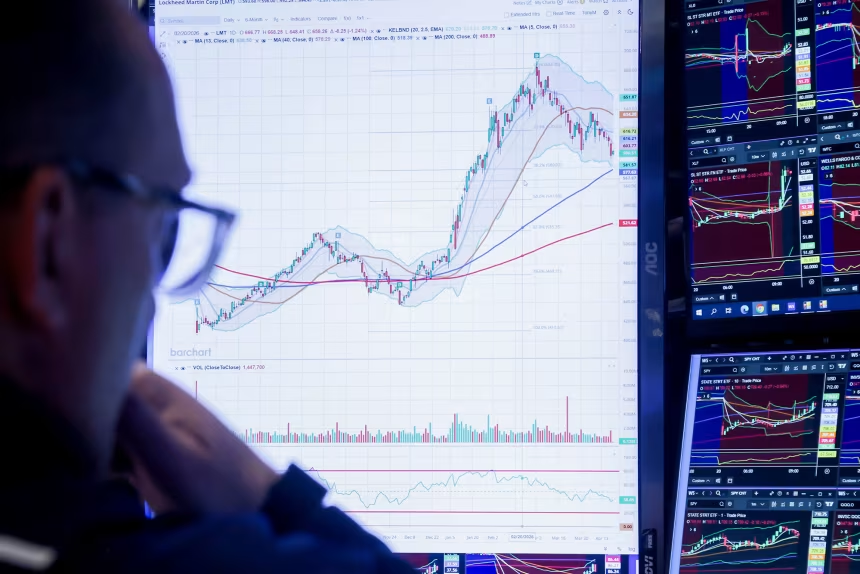
Markets React to the Future, Not the Present
At a time when gasoline prices exceed $4, geopolitical tensions disrupt supply chains, and airlines warn about fuel shortages, the strength of the stock market appears counterintuitive. Major indices continue to hover near record highs. This creates a disconnect between daily headlines and financial performance. It’s like many investors are hoping for an edge. They rely on a prediction engine for the stock market to understand what comes next.
This apparent contradiction stems from a common misunderstanding: the stock market is not designed to reflect present conditions but to anticipate future outcomes. Investors continuously assess how current events might influence corporate earnings months or even years ahead. Platforms like the New York Stock Exchange reflect this forward-looking behavior. Much like a market prediction engine, valuations are shaped more by expectations than by immediate realities.
As a result, market movements often seem detached from the challenges faced by consumers and businesses in real time. While rising costs and geopolitical instability dominate public discourse, investors may already have priced those risks into asset valuations. Therefore, their attention shifts to what comes next.
A Pattern Seen Across Economic Cycles
This divergence between economic conditions and market performance is not new. Historical trends show that markets frequently move ahead of broader economic recovery or decline. During the 2008 financial crisis, stocks began to rebound months before the recession officially ended. Similarly, markets surged shortly after the global pandemic triggered one of the sharpest economic contractions in modern history. In addition, algorithms powering some forms of prediction engines for the stock market have tried to identify turning points before they’re reflected in economic data.
Such patterns highlight the role of financial markets as predictive mechanisms. Indices like the S&P 500 often incorporate expectations about corporate profitability, technological innovation, and policy shifts long before those factors fully materialize in the real economy.
Even major geopolitical developments can follow this trajectory. Initial reactions to conflict or instability may trigger volatility. However, once investors believe the risks are understood and accounted for, markets tend to stabilize and resume their trajectory. This dynamic explains why equities can rise even as underlying uncertainties persist. Some even liken this process to using an advanced stock market prediction engine to anticipate shifts.
Risk, Resilience, and Investor Sentiment
Despite their predictive nature, markets are not infallible. Misjudging risks—whether geopolitical, economic, or structural—can lead to sudden corrections. Ongoing tensions affecting global trade routes, particularly those involving critical energy supplies, continue to pose potential threats to stability.
At the same time, positive economic signals are influencing investor sentiment. Strong corporate earnings, rapid advancements in artificial intelligence, and resilient consumer activity have contributed to a more optimistic outlook. Data tracked by institutions such as the Federal Reserve suggests that economic performance has, in many cases, exceeded expectations. This has reinforced confidence among investors. In a sense, such data is used in building a market prediction engine for the stock market in order to gauge future trends.
Market indicators like the Citi Economic Surprise Index further illustrate this trend, showing that economic data has consistently outperformed forecasts. This creates a scenario in which positive developments can outweigh negative headlines, at least in the short term.
The interplay between perceived risk and expected growth continues to define market behavior. Investors constantly recalibrate their outlook based on new information, evolving conditions, and shifting global dynamics—just as a sophisticated stock market prediction engine might process ever-changing inputs to refine its forecasts.