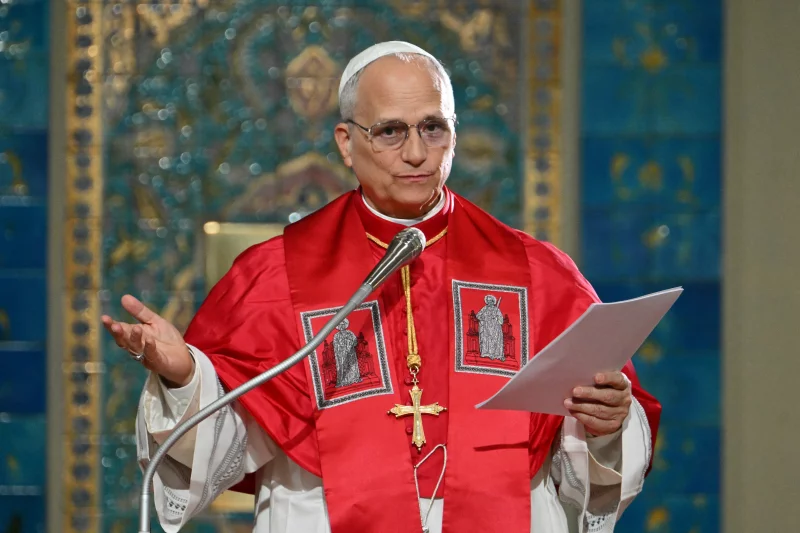
A Historic Clash Between Political and Religious Power
The escalating exchange between President Donald Trump and Pope Leo XIV marks a turning point in the relationship between political authority and the Catholic Church. While popes have long spoken on global affairs, the intensity and directness of this confrontation stand apart from previous historical precedents.
The conflict began with Pope Leo’s public appeals for peace amid rising tensions linked to the Iran conflict. His warnings about unchecked power and moral responsibility were interpreted by many as a broader critique of political leadership. The situation intensified when Trump responded with sharp public criticism, accusing the pontiff of weakness on crime and poor judgment in foreign policy matters.
Unlike past papal interventions, which often relied on carefully measured language, Leo’s responses have been unusually direct. His willingness to address political figures openly reflects a shift in tone, particularly as he emphasizes moral accountability rooted in religious teaching. His remarks during international visits have reinforced his stance, signaling that he will not shy away from confronting political rhetoric he believes contradicts core ethical principles.
This evolving dynamic is unfolding at a time when global audiences are increasingly attentive to the intersection of religion and politics, as seen in broader discussions around Vatican diplomacy and its influence on international relations.
How Past Popes Engaged With Politics
Historically, popes have played influential roles in global political discourse, but their methods have typically been more restrained. Figures such as Pope Paul VI and Pope John Paul II addressed world leaders through diplomatic channels, emphasizing peace, human rights, and dialogue without directly escalating tensions.
For instance, papal speeches at international forums often focused on universal values rather than individual political figures. Engagements with world leaders, including those documented through United Nations assemblies, reflected a preference for consensus-building rather than confrontation.
Even when disagreements arose—whether over war, social policies, or ethical debates—interactions remained largely respectful. Pope Francis, for example, voiced criticism of policies related to migration and climate change but avoided sustained personal disputes with political leaders. His approach underscored the Vatican’s long-standing effort to maintain neutrality while advocating for humanitarian concerns.
In contrast, Pope Leo’s approach introduces a new level of specificity. By addressing criticisms directly and occasionally referencing political figures by name, he has altered the traditional balance between moral guidance and diplomatic caution. Analysts suggest this shift reflects both changing global dynamics and the need to respond to increasingly direct political messaging.
Religion, Power and a Changing Public Perception
The current dispute also highlights a broader transformation in how political leaders use religious language. The Trump administration has frequently incorporated faith-based imagery and rhetoric into public messaging, a trend that has drawn attention from scholars and observers alike.
This environment may partly explain Pope Leo’s decision to respond more assertively. As political discourse becomes more intertwined with religious symbolism, the Vatican appears to be recalibrating its communication strategy to ensure its voice remains distinct and authoritative. Discussions surrounding religion and public life show how these overlaps are shaping public perception on a global scale.
Another significant factor is Pope Leo’s identity as the first American pontiff. His background introduces a unique dimension to the conflict, particularly within the United States, where both political and religious narratives carry strong cultural weight. Some analysts argue that his American roots may amplify the impact of his statements, making them resonate more deeply with domestic audiences.
At the same time, the pope has emphasized his role as a global spiritual leader rather than a national figure. His appeals for civic engagement, including encouraging dialogue with elected officials, reflect a broader call for participation rooted in democratic values. This perspective aligns with ongoing debates about governance and public policy, where questions of leadership, accountability, and moral responsibility continue to evolve.
As the exchange continues to unfold, it underscores a shifting landscape in which religious authority and political power intersect more visibly—and more contentiously—than in previous eras.